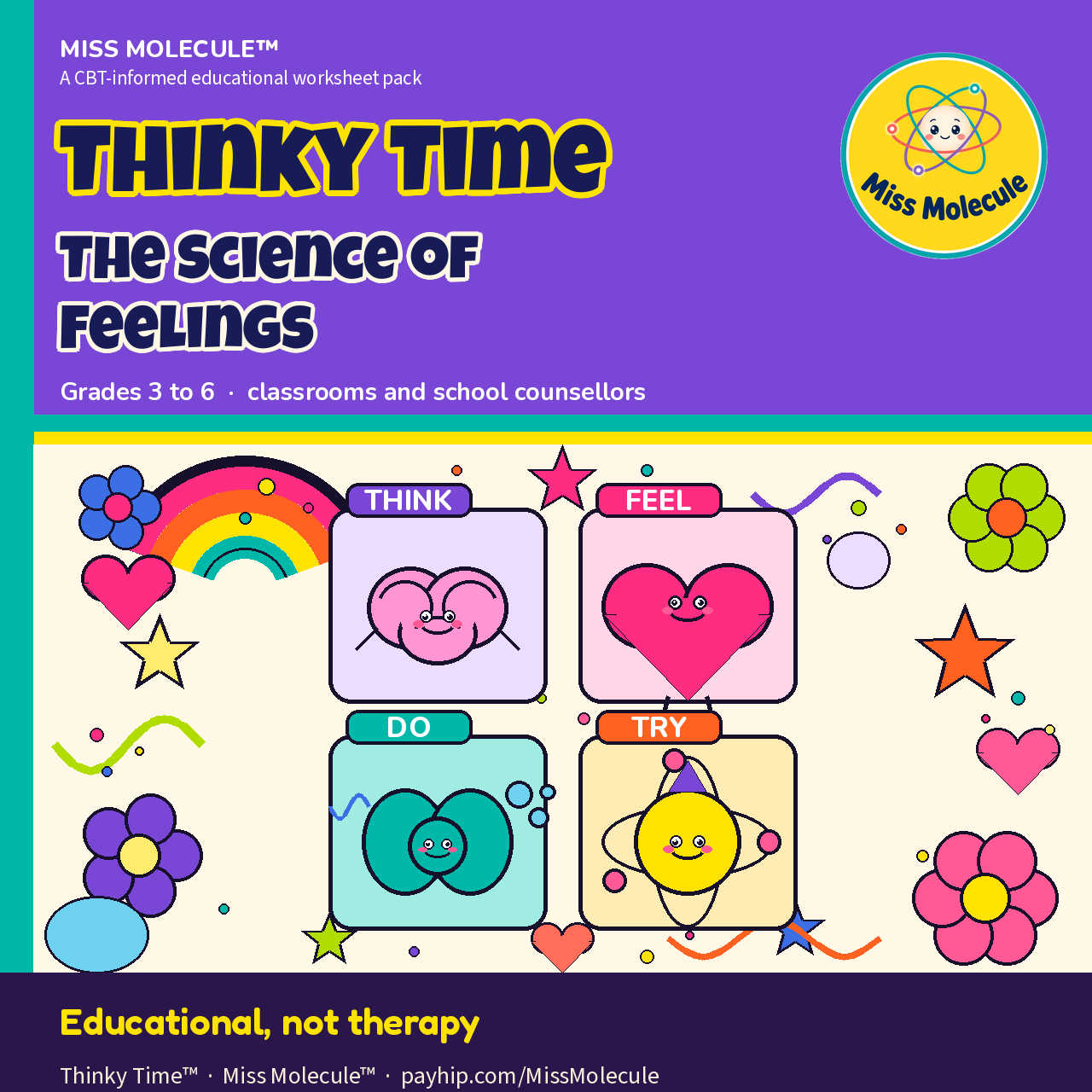
Thinky Time: The Science of Feelings
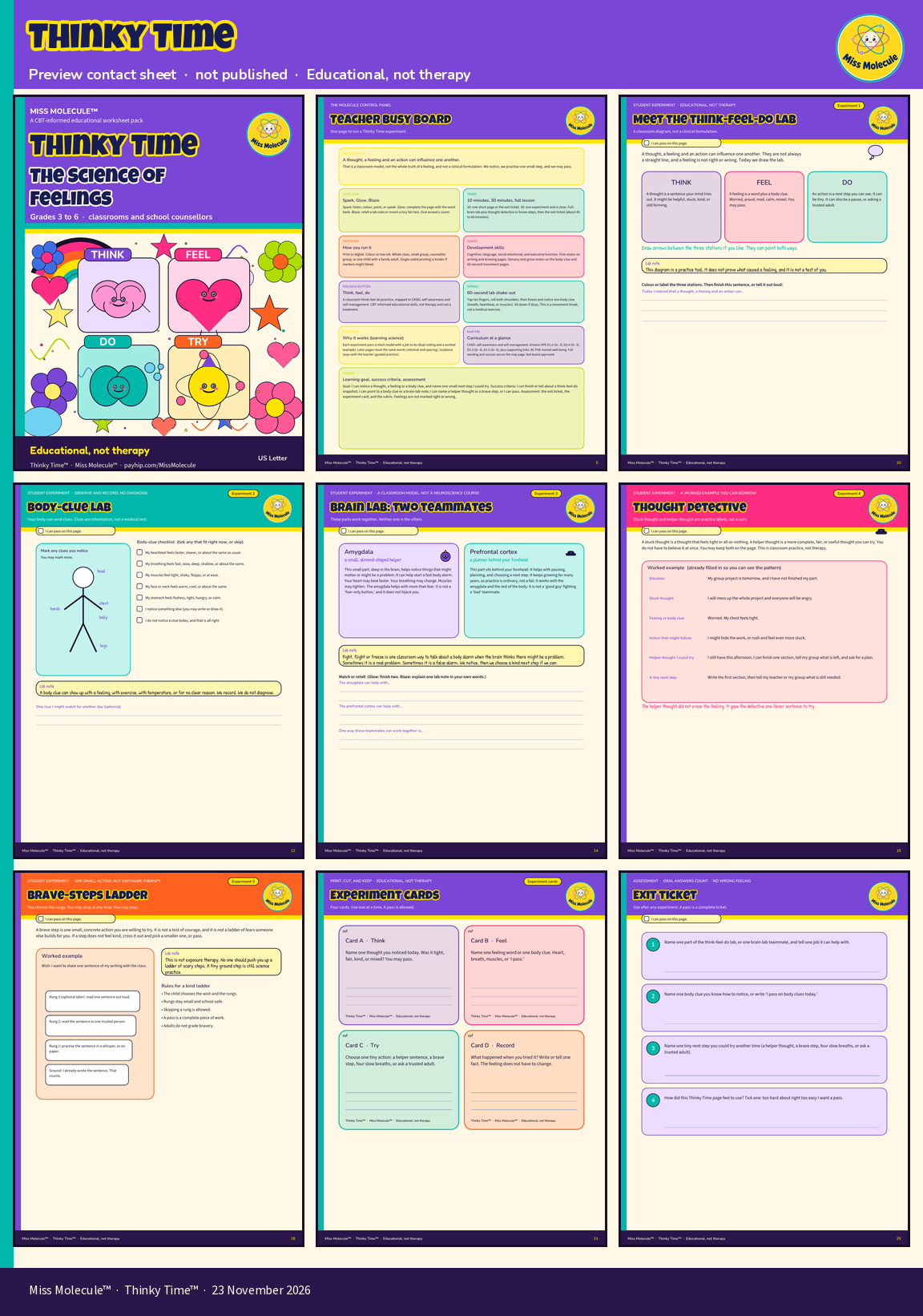
Thinky Time™ is a Miss Molecule™ worksheet pack for Grades 3 to 6 (ages 8 to 12), with a simpler Spark option that a Grade 2 learner can use with an adult. Each student page is a Thinky Time experiment: a classroom think-feel-do lab, a body-clue lab, a careful brain lab, a thought detective page, a brave-steps ladder, and experiment cards.
This resource is CBT-informed educational skills practice. It is not cognitive behavioural therapy, not a treatment, and not a substitute for care from a qualified professional.
What's inside (28 pages, plus matching low-ink files):
- A teacher and counsellor guide, with 10-minute, 30-minute and full-lesson paths, Spark, Glow and Blaze levels, and when to pause and refer
- The Molecule Control Panel (one-page teacher busy board)
- A curriculum map with only real, verified codes, plus honest gaps
- Research notes used as background only, never as proof this pack works
- A family letter you may send home
- Student experiments: think-feel-do, body clues, heart and breath watch, brain lab (amygdala and prefrontal cortex as a classroom model), thought detective with a worked example, a brave-steps ladder, experiment cards, Spark pages, a word bank, and a 60-second movement break
- Exit ticket and a simple rubric in kid language (feelings are not scored)
- Full educational and CBT-informed disclaimers
Sharing is always optional. A child may pass, draw, or talk instead of write. Brave steps are one small, chosen action. They are not exposure therapy.
Curriculum (codes checked 23 November 2026 against official sources):
- CASEL: self-awareness and self-management (framework names, not government codes, and not an endorsement). The other three competencies are not claimed as full lessons.
- Ontario Health and Physical Education, 2019: Grade 3 D1.6 (brain stress response) and D3.4; Grade 4 D3.3 and a supporting link to D2.5; Grade 6 D1.5 (thoughts, emotions and actions). Grade 2 D1.6 is a light supporting fit for the Spark pages only. Grade 5 D2.6, Grade 5 D3.4, Grade 6 D1.4, and puberty or substance-use expectations are not mapped.
- British Columbia Physical and Health Education: Grade 3 Big Ideas on managing emotions and interconnected health; Grade 3 to 6 mental well-being competencies on strategies that promote mental well-being. A neighbouring competency on substance use is not mapped. Career Education goal-setting in Grades 4 to 5 is a light supporting fit for the brave-steps ladder only, and is not printed on the cover.
- No science curriculum code is claimed. Brain and body notes are classroom models, not a science unit.
This is not an official endorsement and is not board approved.
Official sources: the Ontario 2019 HPE curriculum PDF (https://www.edu.gov.on.ca/eng/curriculum/elementary/2019-health-physical-education-grades-1to8.pdf), the Ontario curriculum site, BC curriculum grade pages for Physical and Health Education 3 to 6 and Career Education 5 (https://curriculum.gov.bc.ca), and CASEL (https://casel.org/what-is-sel/).
Research cited in the grown-up guide (describes those studies, not this pack):
A major review of 213 universal school SEL programmes, involving more than 270,000 students, found that participants showed stronger social and emotional skills, better attitudes and behaviour, and academic performance that was, on average, 11 percentile points higher than control groups (Durlak, Weissberg, Dymnicki, Taylor and Schellinger, 2011). Those were complete school programmes, not a worksheet pack.
A review of 118 school trials found that psychological prevention programmes taught in schools, many of them CBT-based, were linked to small average reductions in depression and anxiety symptoms right after the programme (Werner-Seidler and colleagues, 2021). This describes those programmes, not a Miss Molecule product, and it is not a treatment claim.
Research cited here describes the study named, not a Miss Molecule product. Miss Molecule has not tested this resource against those outcomes.
Format: Instant PDF download. US Letter and A4. Colour and low-ink versions included. Print at 100 percent. Licensed for one teacher's classroom, one school counsellor's group, or one family. Please do not share or resell the files. Ask through the shop for a site or co-op licence.
These pages teach classroom and family skills, with simple science of the brain and body. They are educational, not therapy and not a treatment. They are not intended to diagnose, treat, prevent or cure any condition. If you are worried about a child's safety or mental health, follow your school's procedures and seek qualified help.
Educational tools only. Miss Molecule resources are for classrooms, families and school staff. They are not therapy, not a treatment plan, and not a diagnosis. They do not replace a teacher's professional judgement or care from a qualified health or mental-health professional. Where a curriculum link is stated, it is mapped to a real official outcome. This is not an official endorsement and is not board approved. Miss Molecule™.
Type and illustrations are original code-drawn graphics. Some wording was drafted with AI tools and then edited. Created as Miss Molecule.
© 2026 Miss Molecule. All rights reserved. Miss Molecule™. Licensed for one classroom or one household. No resale, sharing, shared sites or AI training.