
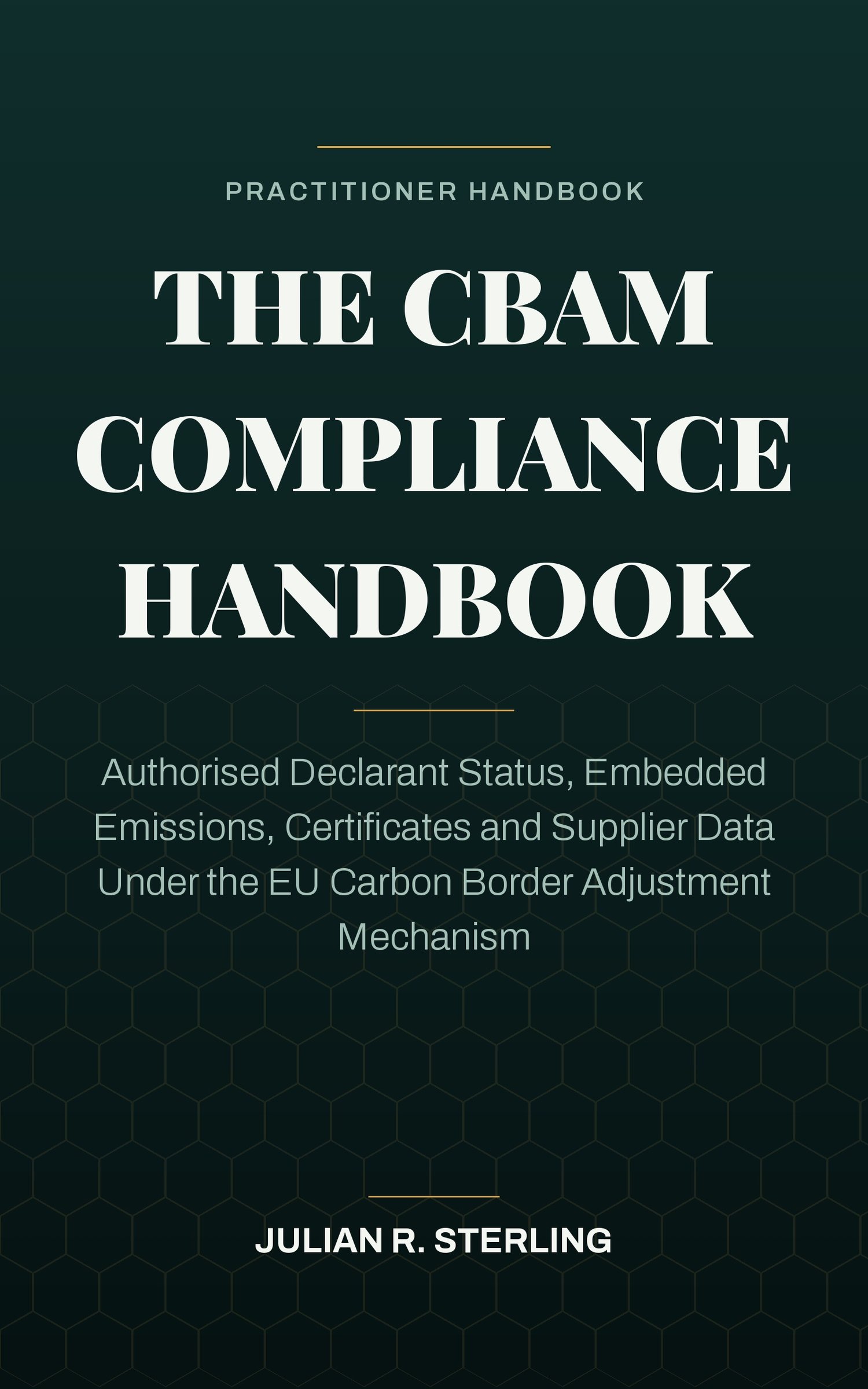
The CBAM Compliance Handbook (PDF edition)
Customs will not wait for your data.
On 1 January 2026 the EU Carbon Border Adjustment Mechanism stopped being a quarterly reporting exercise and became a financial obligation enforced at the border. Goods in scope can only be released for free circulation by an authorised CBAM declarant. Embedded emissions have to be calculated, obtained from suppliers who owe you nothing, and eventually verified. Certificates go on sale on 1 February 2027, have to be held against a quarterly checkpoint, and have to be surrendered every year — with the first annual declaration and surrender, covering 2026 imports, falling due on 30 September 2027.
Somebody in your organisation has just been handed that file. This handbook is written for that person.
The CBAM Compliance Handbook works through the mechanism in the order the problems actually arrive, not in the order the regulation sets them out. Twenty-five sections take the reader from the first screening question to the closing of an annual cycle:
- Scoping by customs nomenclature code, including the downstream goods that surprise people
- The fifty-tonne cumulative counter that replaced the old per-consignment rule, and who has to own it
- The authorised declarant application: criteria, evidence and decision timelines
- The customs interface, and the most common reasons a release stalls
- The embedded-emissions method, with a fully worked calculation on an illustrative steel import
- Default values, and a decision rule for when accepting them is the rational commercial choice
- Getting data out of a supplier who will not answer — the real problem of the book, with a sequenced escalation path
- Verification, and the capacity squeeze between 2026 and the 2027 deadline
- Certificates, price, and the cash-flow model a treasurer can plan against
- The free allocation adjustment and credit for a carbon price paid abroad
- The annual cycle, penalties and enforcement, and the internal operating model
Five appendices built to be used rather than read: a compliance calendar, a supplier data request pack of four ready-to-send communications, a contract clause checklist, a forty-question readiness assessment, and a glossary of every acronym and term of art in the text.
Two conventions run through every page. Every volatile figure — a certificate price, a published default value, an uptake statistic — carries the date it was true, so a reader coming to it later knows exactly what to re-check. And where the official sources do not yet agree, or an implementing act is still pending, the book says so and names the text to confirm it against, rather than smoothing the gap over with confident invention.
Written for customs and trade compliance managers, indirect tax specialists, sustainability and carbon accounting leads, category buyers in steel and aluminium, indirect customs representatives, and the non-EU suppliers being asked for emissions data who want to understand why.
This is a practitioner's explanation of how the mechanism works and how the work is organised. It is not legal advice, it does not adjudicate the trade debate, and it recommends no adviser, platform or scheme.
This edition: PDF, 6 x 9 in, 158 pages, DRM-free. The free companion Excel workbooks for this book are at julianrsterling.com/cbam.