

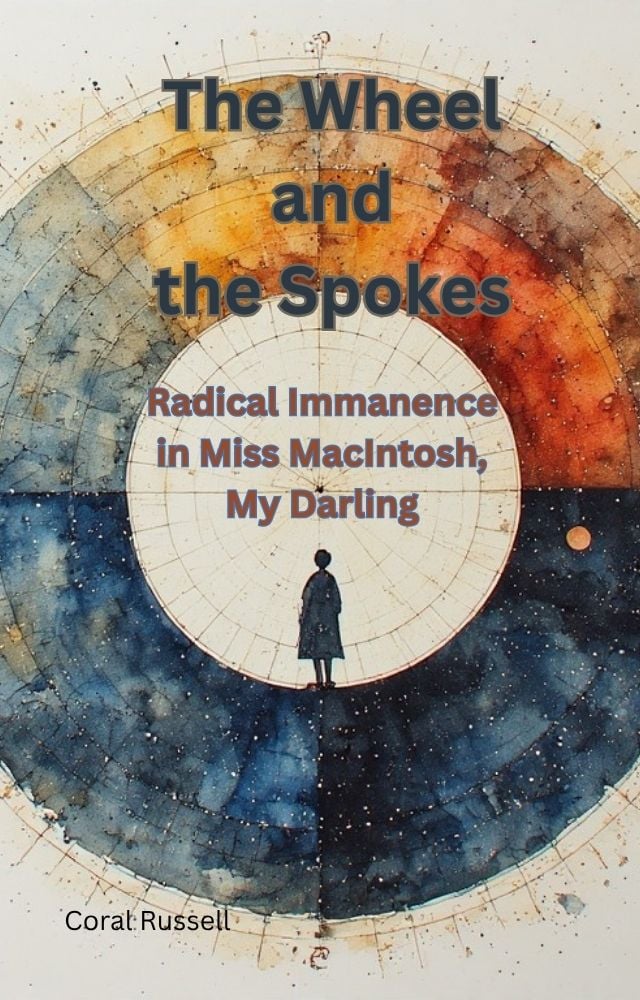
The Wheel and The Spokes
You can download it for FREE here
OR
Purchase on Amazon for $2.99
Marguerite Young spent eighteen years writing Miss MacIntosh, My Darling, a novel of 1,198 pages that follows a woman named Vera Cartwheel on a bus ride through Indiana in search of her vanished nursemaid. When it was published in 1965, critics called it magnificent and impossible. Then they largely set it aside.
The Wheel and Its Spokes argues that we have been missing the point — and that what we have been missing is a complete philosophical system, embedded in the novel's form and enacted by its prose.
Drawing on close readings of all eighty-two chapters, this study identifies Eleven Pillars of Radical Immanence at the heart of Young's work: a coherent, rigorous, and urgently contemporary philosophy of selfhood, grief, time, language, and the sacred. The Plural Self. Illusion as Primary. Grief as Permanent Weather. The Witness. Recursive Construction. The Ethics of Incompletion. The Ontology of the Marginal. Sedimentary Time. Language as Construction. Immanent Transcendence. The Crossing Point. These are not themes extracted from the novel from outside. They are the discovered grammar of a consciousness that refuses the consolations of singularity, resolution, and transcendence-as-escape.
Young's novel demonstrates that the self is constitutively multiple and irresolvable. That grief does not move through stages toward acceptance but accumulates, layer by layer, like geological strata, until it becomes the ground we walk on. That the sacred does not live elsewhere — in heaven, in resolution, in the promised land of a concluded sentence — but here, in the grey bus, in the permanent grief, in the plural self in all its unresolved reality. That the past does not recede. It presses upward through everything we are.
The Wheel and Its Spokes also demonstrates that Radical Immanence is not merely a literary philosophy. Tracing its implications through feminist theory, contemporary physics, and the mathematics of infinity, the study shows Young to be a systematic thinker whose work speaks directly to our most pressing questions about consciousness, identity, loss, and what it means to be constituted by what came before us while constituting the ground for what comes after.
For readers of Young, this is the first full philosophical account of her major work. For readers of philosophy, feminist theory, and literary criticism, it is an encounter with a thinker whose voice has been waiting, in the sediment of the American literary tradition, to be heard.
The wheel has ten spokes. The eleventh pillar is the form itself — the crossing point where everything meets.