
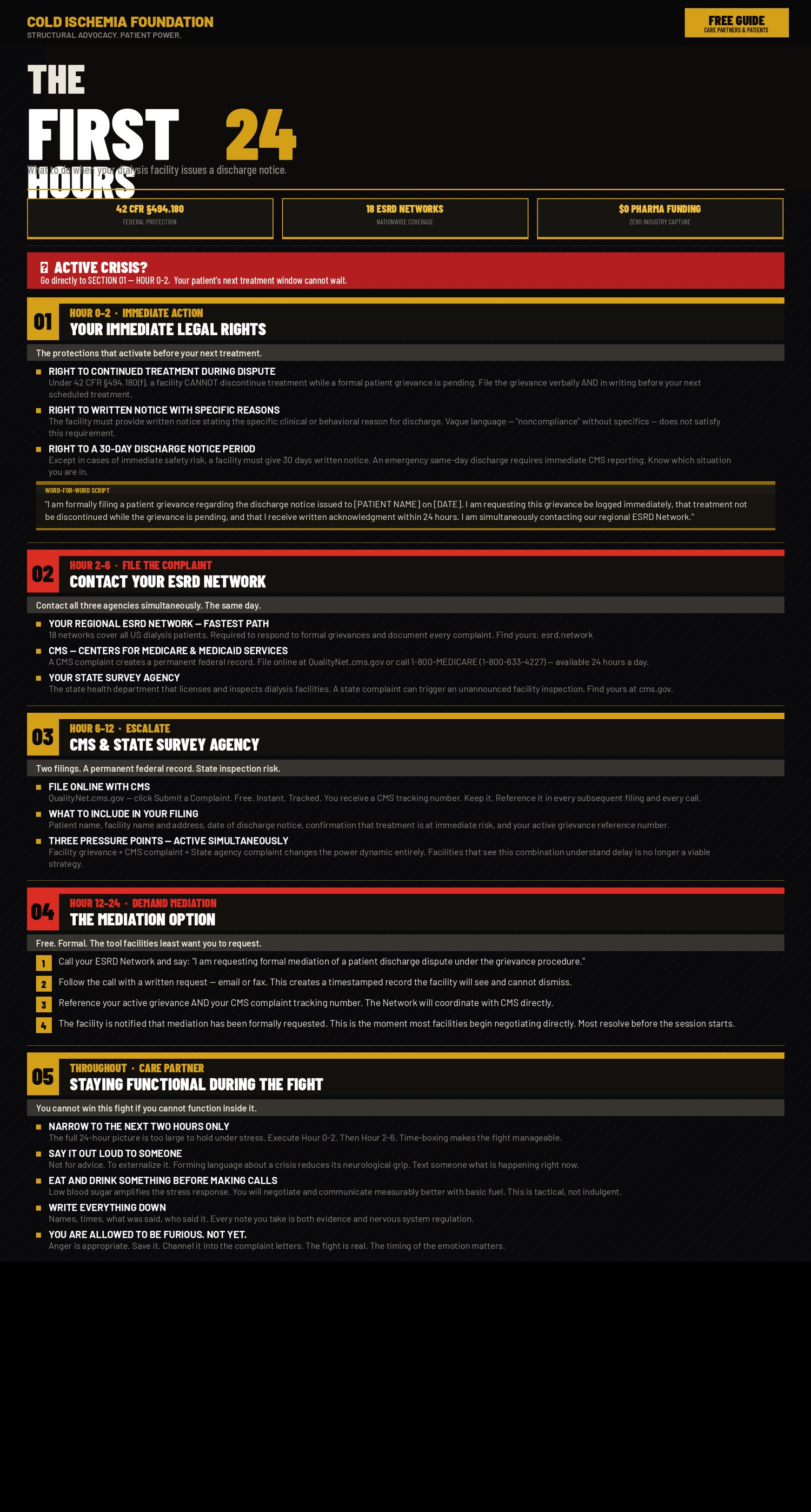
The First 24 Hours: What the System Was Never Going to Tell You — and What to Do About It
There is a moment most dialysis patients and care partners never see coming.
The notice arrives — sometimes verbally, sometimes on paper, sometimes with almost no explanation at all — and the ground shifts. A dialysis facility has told you, or the person you love, that treatment is ending. And the clock that matters most is not the one on the wall. It is the window between now and the next scheduled treatment session.
Most people freeze. The system counts on that.
What you are holding right now is the guide that changes what happens in that moment. The First 24 Hours is a free, step-by-step federal action guide built specifically for dialysis patients and care partners facing facility discharge — written by a three-time kidney transplant recipient who has lived inside the system long enough to understand exactly how it uses silence, complexity, and urgency against the people it is supposed to serve.
This is not general wellness advice. This is not a summary of patient rights written for a hospital compliance wall. This is a tactical document built for a crisis — organized by the hour, grounded in federal regulation, and written in plain language by someone who needed it and could not find it.
Here is what this guide gives you.
In the first two hours, you learn exactly which federal protections activate the moment a discharge notice is issued — including the provision under 42 CFR §494.180(f) that prohibits a facility from discontinuing treatment while a formal grievance is pending. You receive the word-for-word script to file that grievance on the spot, verbally and in writing, before your next treatment window closes. You learn what the facility is legally required to give you in writing and what vague, non-specific language tells you about whether they are prepared for a challenge.
Between hours two and six, you learn about the agency most patients have never heard of — your regional ESRD Network — and why it is the fastest, most direct path available to you. Eighteen of these networks cover every dialysis patient in the United States. They are required by federal mandate to respond to formal grievances, document every complaint, and intervene when facilities step out of line. This guide tells you exactly what to say when you call.
Between hours six and twelve, you escalate simultaneously — a CMS complaint that creates a permanent federal record, a state survey agency complaint that introduces the risk of an unannounced facility inspection. Three pressure points active at the same time. That combination changes the power dynamic in ways most facilities are not prepared to manage.
In the final stretch — hours twelve through twenty-four — you request formal mediation through your ESRD Network. It is free. It is formal. It creates an independent documented record that neither party can dismiss. And according to the data, most facilities choose to negotiate the moment the mediation request lands. Not because they suddenly develop a conscience. Because the calculus shifts.
The guide also includes something no legal toolkit ever does: a section on staying functional while the fight is happening. A facility discharge notice in an active care situation is a form of institutional trauma. It triggers the same physiological stress response as a physical threat. This section is not self-care advice. It is a tactical framework for keeping your executive function intact enough to execute every step in this document — because none of this works if you are frozen.
This guide was built by Cold Ischemia Foundation — a structural healthcare advocacy organization that accepts zero pharmaceutical funding, zero hospital system advertising, and zero sponsored content of any kind. No one paid to shape what is in these pages. No industry partner reviewed it for comfort. What you are reading reflects only one priority: giving dialysis patients and care partners the specific, actionable, federally-grounded information they need to protect a life.
The system moves fast when it wants to remove a patient. This guide helps you move faster.
Download it free. Read Section 01 first if you are in an active crisis right now. Share it with every care partner and patient advocate you know, because the people who most need this information are the ones least likely to have found it yet.