
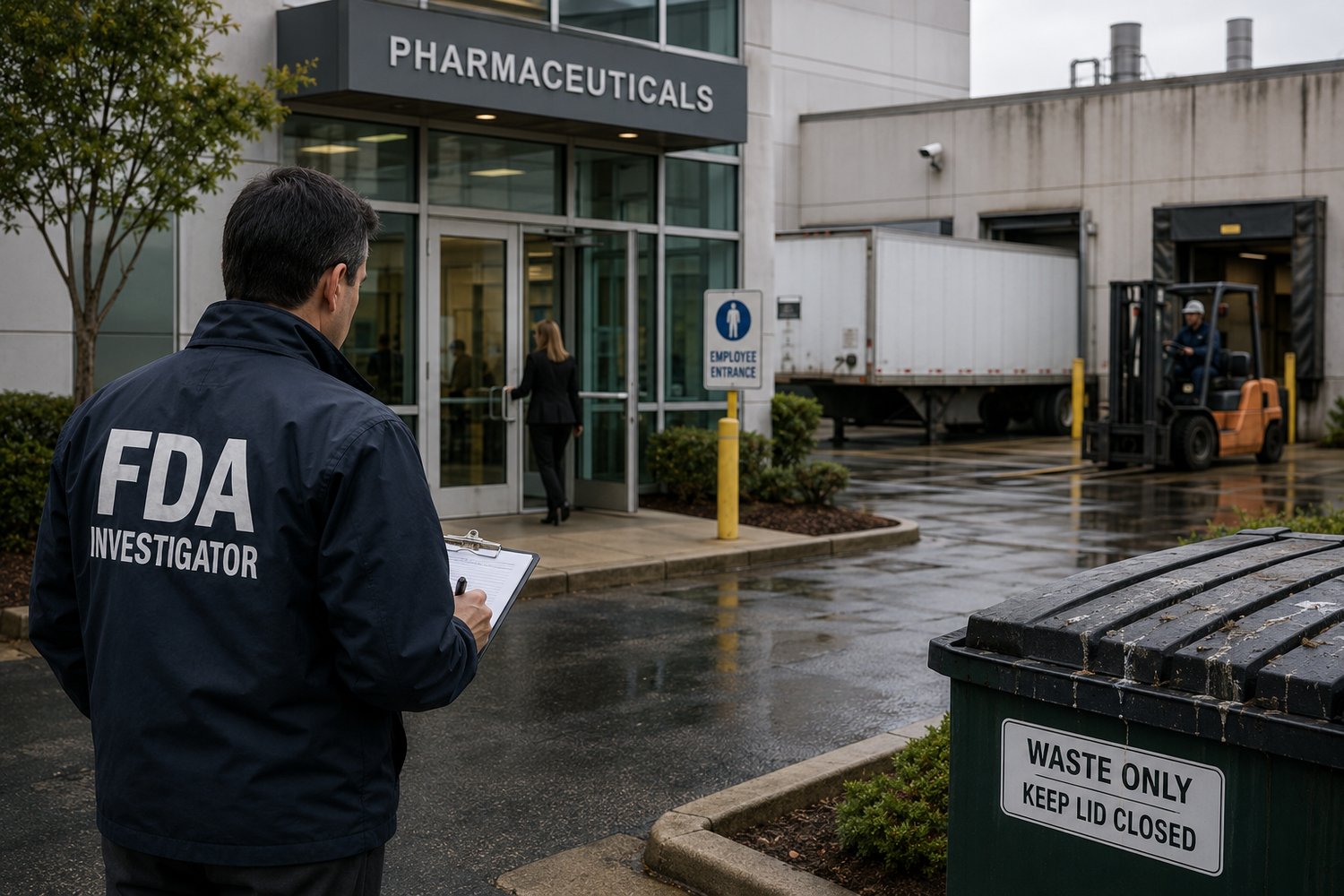
(PART II) THE FIRST 15 THINGS I WOULD REQUEST IF I WALKED INTO YOUR FACILITY AS AN FDA INVESTIGATOR — PART II
THE FIRST 15 THINGS I WOULD REQUEST IF I WALKED INTO YOUR FACILITY AS AN FDA INVESTIGATOR — PART II
A DEEPER DIVE INTO QUESTIONS #3 AND #4
Part I introduced four inspection requests that can open surprisingly broad investigative trails:
- “Please provide me with your major manufacturing equipment list.”
- “Please provide me with the forced degradation study for this product.”
Part II goes considerably deeper into requests #3 and 4.
Former FDA Investigator DeVaughn Edwards demonstrates how an experienced Investigator can use these seemingly routine requests to uncover connections involving equipment qualification, corrective maintenance, replacement parts, change controls, process validation, stability data, complaints, degradation pathways, packaging, storage and distribution.
This is not a repetition of the introductory discussion.
It is an expanded, advanced examination of the investigative reasoning behind Questions #3 and #4—including the follow-up questions, cross-system comparisons and document trails that can take an inspection somewhere the company never anticipated.
QUESTION #3: THE MAJOR MANUFACTURING EQUIPMENT LIST
An equipment list may look like a basic administrative document. In the hands of an experienced Investigator, however, it can become a roadmap into the history of both the equipment and the manufacturing process.
Part II explores how an Investigator may use that list to examine:
• Whether equipment remains in its qualified state
• Major corrective maintenance and emergency repairs
• Whether replacement parts were genuinely “like-for-like”
• Change controls and requalification decisions
• Operating ranges documented in qualification versus actual batch records
• Differences between current equipment and the original NDA- or ANDA-era process
• Work orders, production downtime and unreported interventions
• Equipment failures that were never classified as deviations
• Yield discrepancies and unexplained product losses
• Whether repeated equipment changes have materially altered the validated process
You will see why a beautiful IQ/OQ/PQ package may not answer the Investigator’s real question: Is the equipment operating today still the same—or functionally equivalent to what was originally qualified, validated and potentially represented to FDA?
QUESTION #4: THE FORCED DEGRADATION STUDY
Why would an FDA Investigator reviewing complaints of lack of effectiveness suddenly request an old forced degradation study?
Because the study may contain a scientific roadmap showing exactly how the product can fail.
Part II explains how an Investigator may connect forced degradation findings with:
• Routine stability testing
• Increasing degradation products
• Chromatographic data and analytical method capability
• Passing results that may still reveal a concerning trend
• Complaints alleging lack of effectiveness
• Packaging and container-closure protection
• Labeled storage conditions
• Temperature excursions
• Distribution practices
• Scientific knowledge that was never incorporated into commercial investigations
A complaint file may say the retain sample met specification. That does not necessarily end the inquiry.
If the company’s own development studies identified a degradation pathway capable of affecting potency or product performance, an experienced Investigator may ask whether that knowledge was considered during the complaint investigation—and whether the analytical method used would even detect the problem.
WHAT MAKES PART II DIFFERENT?
This installment demonstrates how FDA inspections move beyond individual documents.
Equipment List → Maintenance Records → Batch Records → Interventions → Change Controls → Qualification and Validation
Forced Degradation → Stability → Complaints → Packaging → Storage → Distribution
The deficiency may not exist within any single record. It may be hiding in the connections between records that different departments reviewed separately.
That is the difference between reviewing documents and investigating a pharmaceutical operation.
WHO SHOULD READ THIS?
This advanced publication is especially valuable for:
• Quality Assurance and Quality Control professionals
• Engineering and Maintenance leaders
• Manufacturing and Operations personnel
• Validation and Technical Services professionals
• Analytical scientists and laboratory management
• Regulatory Affairs professionals
• Complaint and stability investigation teams
• Inspection readiness teams
• Pharmaceutical consultants and auditors
• FDA Investigators and other regulatory professionals
ABOUT THE AUTHOR
DeVaughn Edwards spent 14 years as an FDA Investigator conducting domestic and international inspections. He subsequently spent more than a decade in pharmaceutical Quality and Compliance leadership, giving him extensive experience on both sides of the FDA inspection table.
Today, through FD-AID, LLC, he helps pharmaceutical companies prepare for FDA inspections, identify compliance vulnerabilities and recognize the connections an experienced Investigator may discover before FDA enters the facility.
FORMAT: Professionally designed downloadable PDF
SERIES: The First 15 Things — Part II
LEVEL: Advanced deeper-dive analysis of Questions #3 and #4
ACCESS: Immediate download following purchase
The Investigator may begin with an equipment list or an old scientific study.
Where the inspection goes next depends on what those records reveal—and whether your organization connected the information before FDA did.