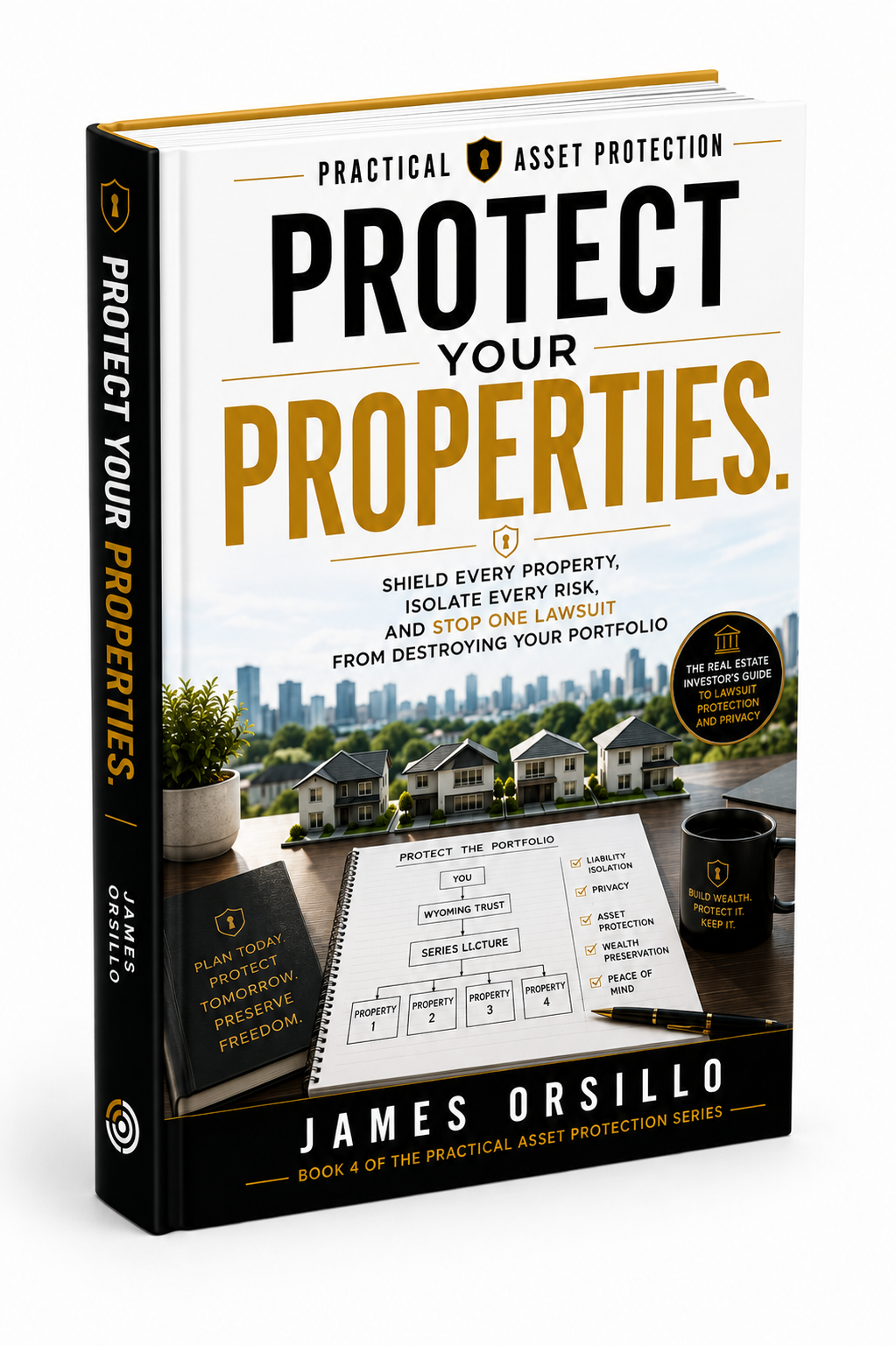
COMING SOON — Every Property You Buy Increases Your Wealth. It Can Also Increase The Number Of Ways Somebody Can Come After It
That is the contradiction most real-estate owners eventually discover.
- You buy property to build equity.
- You collect rent.
- You improve buildings.
- You pay down mortgages.
- You acquire another property.
- Then another.
Twenty years later, you may have built a substantial real-estate portfolio—while unknowingly leaving millions of dollars of equity sitting inside structures that were never designed to protect it.
Protect Your Properties is James Orsillo's practical guide to understanding real estate asset protection from the owner's side of the table.
Because owning property isn't enough.
You need to understand how you own it.
- A tenant gets injured.
- A contractor files a claim.
- A property dispute turns ugly.
- A judgment exceeds your insurance coverage.
- A personal lawsuit attacks assets outside the property where the problem originated.
- One property creates the liability.
The question is:
How much of everything else you own did you leave connected to it?
That is where real estate asset protection begins.
YOUR DEED IS AN ASSET-PROTECTION DOCUMENT
Most investors look at a deed and see proof of ownership.
James Orsillo wants you to see something else:
Exposure.
- Whose name is on it?
- Your personal name?
- An LLC?
- A trust?
- A holding structure?
- And what does that ownership actually accomplish?
- This is where generic internet advice becomes dangerous.
- “Put the property in an LLC.”
Fine.
Then what?
- Should several properties share the same LLC?
- Should valuable equity remain inside the same entity generating the liability?
- What happens when the LLC itself gets sued?
- What happens when you personally get sued?
- Where does insurance fit?
- Where do land trusts fit?
- What about holding companies?
- What about mortgages and liens?
- What happens when your portfolio crosses state lines?
- There isn't one magic document that answers every one of those questions.
- There is a structure.
And the purpose of Protect Your Properties is to help you understand it.
THIS ISN'T ABOUT HIDING PROPERTY
It is about separating risk intelligently.
There is an enormous difference.
Real asset protection is built before the lawsuit, before the creditor, before the accident, and before you desperately need it.
Once a claim exists, fraudulent-transfer laws can severely restrict what you can legitimately move.
That means the best time to understand your real-estate structure is when absolutely nothing is wrong.
This book explores the practical thinking behind property LLCs, ownership separation, equity protection, insurance, trusts, holding structures, liability compartmentalization, financing considerations, documentation, and portfolio-level asset protection.
Not as isolated legal tricks.
As pieces of one system.
THE ONE-PROPERTY STRATEGY DOESN'T ALWAYS SCALE
A structure that was perfectly adequate when you owned one rental may become ridiculous when you own ten.
That's one of the central lessons of this book.
As your portfolio grows, three things grow with it:
- Equity.
- Liability.
- Complexity.
Your asset-protection architecture has to grow too.
James Orsillo walks through the reasoning an experienced property owner should understand when deciding where properties belong, what should be separated, where valuable equity accumulates, and how one property's problem can potentially become a portfolio problem.
The goal isn't to bury every building beneath another mountain of entities.
The goal is to know why each entity exists.
If you can't explain what a company, trust, insurance policy, lien, or ownership layer is doing in your structure, you don't have a strategy.
You have paperwork.
NO GATEKEEPING. UNDERSTAND YOUR OWN STRUCTURE.
Real-estate asset protection has become an industry filled with fragments.
One person sells LLCs.
Another sells trusts.
Someone else talks about land trusts.
An insurance broker sells another policy.
A CPA talks about taxes.
An attorney drafts documents.
And the property owner is somehow expected to understand how all of it fits together.
Protect Your Properties was written to put the owner back in the middle of that conversation.
You do not need to become your own lawyer.
But you absolutely should understand:
- What owns the property.
- Where the equity sits.
- Where the liability originates.
- What else that liability can reach.
- What each protective layer is supposed to accomplish.
That is practical asset protection. And when you finish the book, the door stays open.
James Orsillo created Practical Asset Protection so property owners and entrepreneurs can continue exploring real estate protection, LLC structures, trusts, equity strategies, educational guides, and the other pieces that make up a complete asset-protection plan.
PART OF THE AMERICAN ENTREPRENEUR SERIES
Protect Your Properties is part of James Orsillo's American Entrepreneur Series—six books built for people who aren't merely trying to make money.
They're trying to build something, protect it, convert it into wealth, and eventually create enough independence to walk away.
If you own a business, investment property, or both, read the complete six-book series.
Because buying the property was the easy part.
Paying it off took years.
Building the equity took longer.
Don't spend twenty years building a real-estate portfolio and twenty minutes deciding how to own it.
Protect your properties. Protect the equity. Protect what all those years of work actually created.
By James Orsillo
Author and founder of Practical Asset Protection