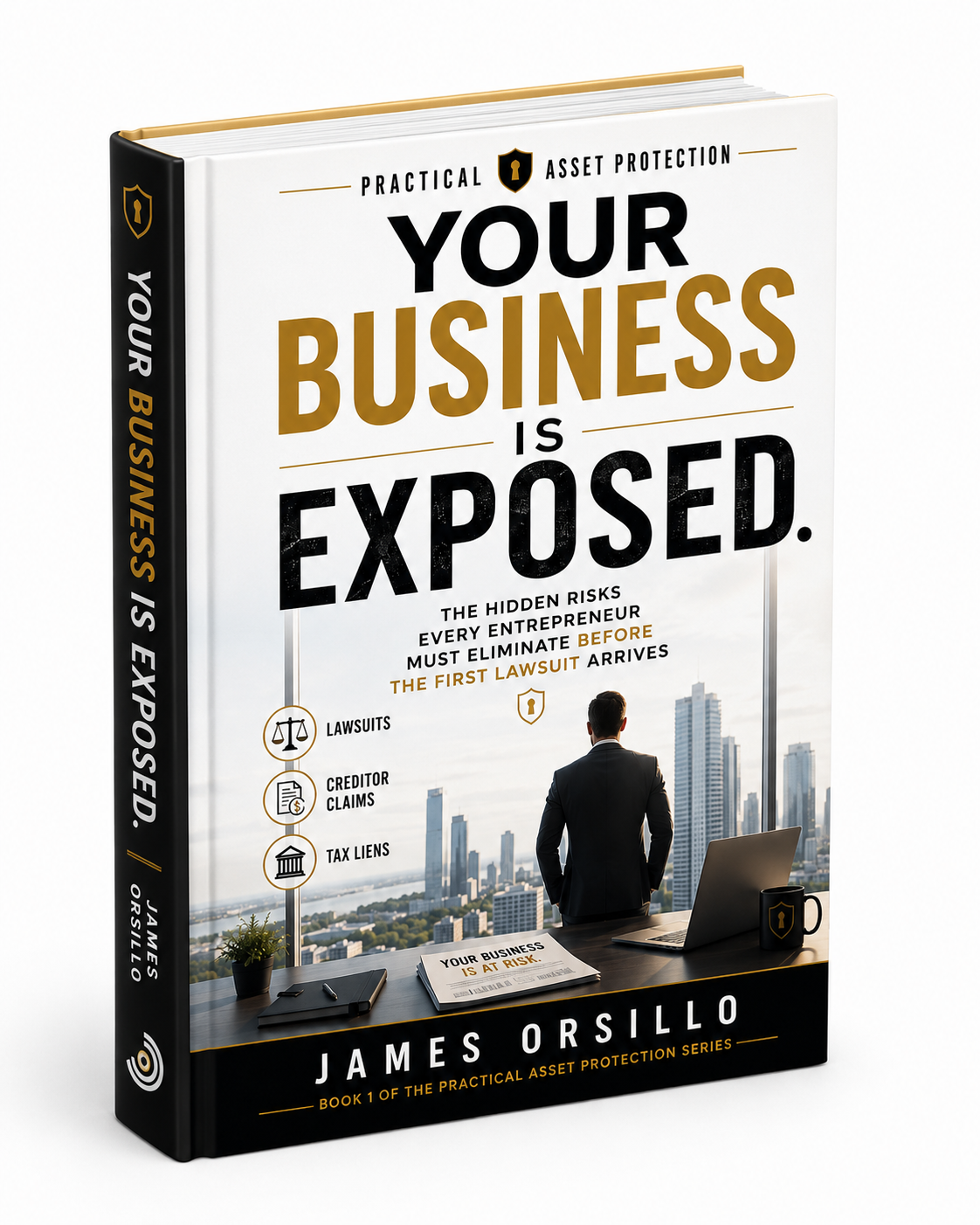
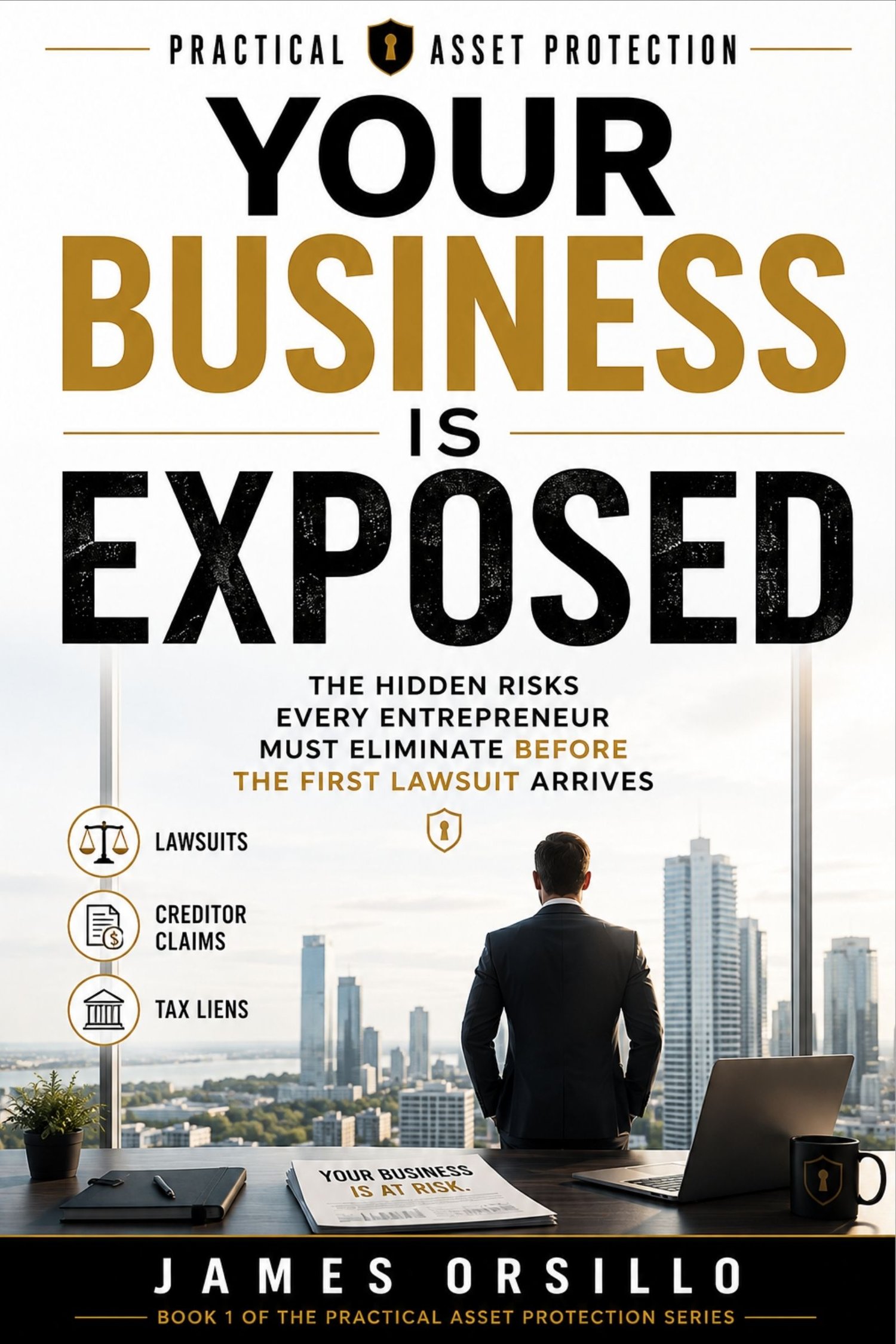
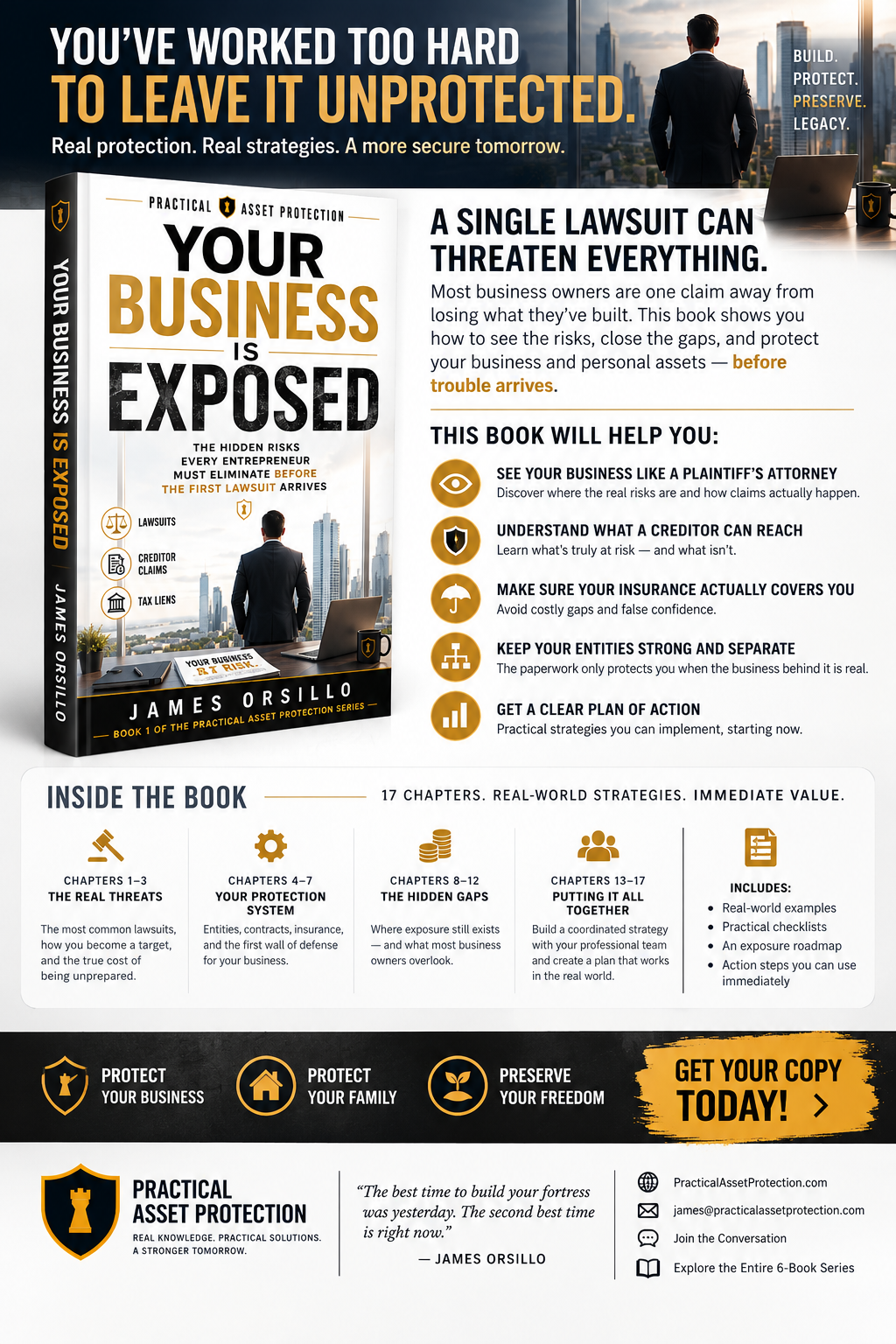
Your Business Is Exposed | You Built The Business. Now Find Out What Can Take It Away
On Sale
$19.50
$19.50
Your Business Is Exposed is James Orsillo’s practical guide to understanding the asset-protection weaknesses hiding inside an otherwise successful business.
Most entrepreneurs are taught how to start a company, generate revenue, hire employees, buy equipment, acquire property, and grow.
Almost nobody teaches them what happens after they finally have something worth taking.
That is where this book begins.
James Orsillo strips away the gatekeeping, legal jargon, and surface-level internet advice surrounding business asset protection and explains the subject from an entrepreneur’s point of view: What is exposed? Why is it exposed? What structures actually matter? When should they be created? And how do the pieces work together?
This isn't another collection of vague warnings telling you to “form an LLC and buy insurance.”
It is designed to help you understand the architecture behind real asset protection so you can have intelligent conversations with attorneys, CPAs, insurance professionals, and other advisors—and recognize when an important piece is missing.
Inside, you'll explore the practical thinking behind protecting a business, separating valuable assets from operating risk, using business entities deliberately, protecting accumulated wealth, planning before a lawsuit or creditor appears, and building multiple layers of protection rather than betting everything on one document or entity.
No gatekeeping. No pretending the important stuff is too complicated for you to understand.
The goal is simple: when you finish this book, you should have a much clearer understanding of what you own, where the exposure lives, what can potentially reach it, and what questions you need to ask next.
And the book doesn't have to be the end of the conversation.
James Orsillo created Practical Asset Protection as an open-door educational resource for entrepreneurs and property owners who want to keep learning. Readers can continue exploring the strategies, guides, structures, and educational material available through Practical Asset Protection.
PART OF THE AMERICAN ENTREPRENEUR SERIES
Your Business Is Exposed is part of James Orsillo's American Entrepreneur Series—six books built around the larger journey of building a business, protecting it, protecting the wealth it creates, making better ownership decisions, and eventually being able to walk away on your own terms.
If you're running a business with the intention of someday turning that work into wealth, independence, and retirement, don't stop with one book.
Read the complete six-book series.
- You spent years learning how to build it.
- Spend a few hours learning what can take it away.
Your business is exposed. Find the holes before somebody else does.
By James Orsillo
Author and founder of Practical Asset Protection
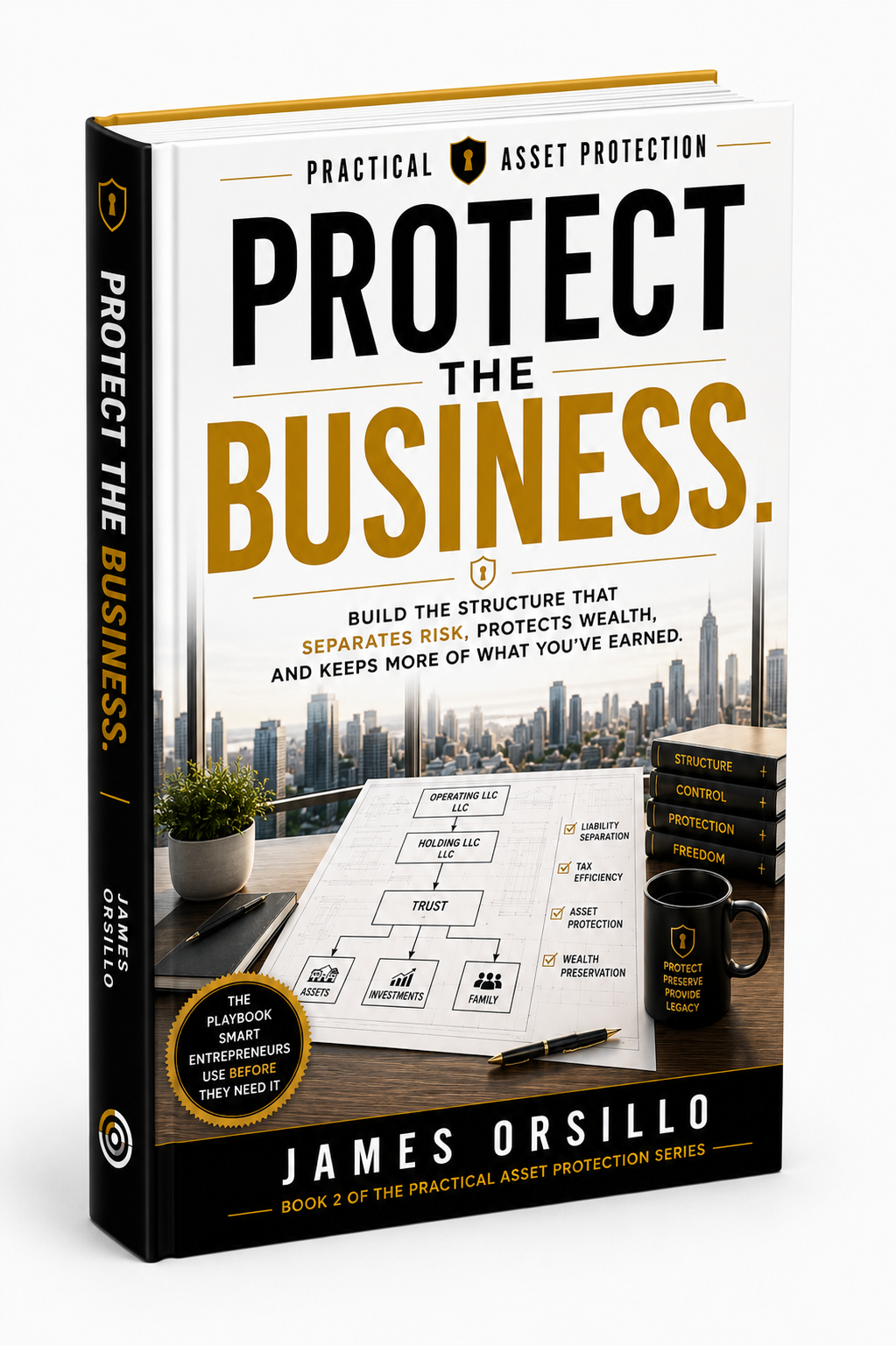
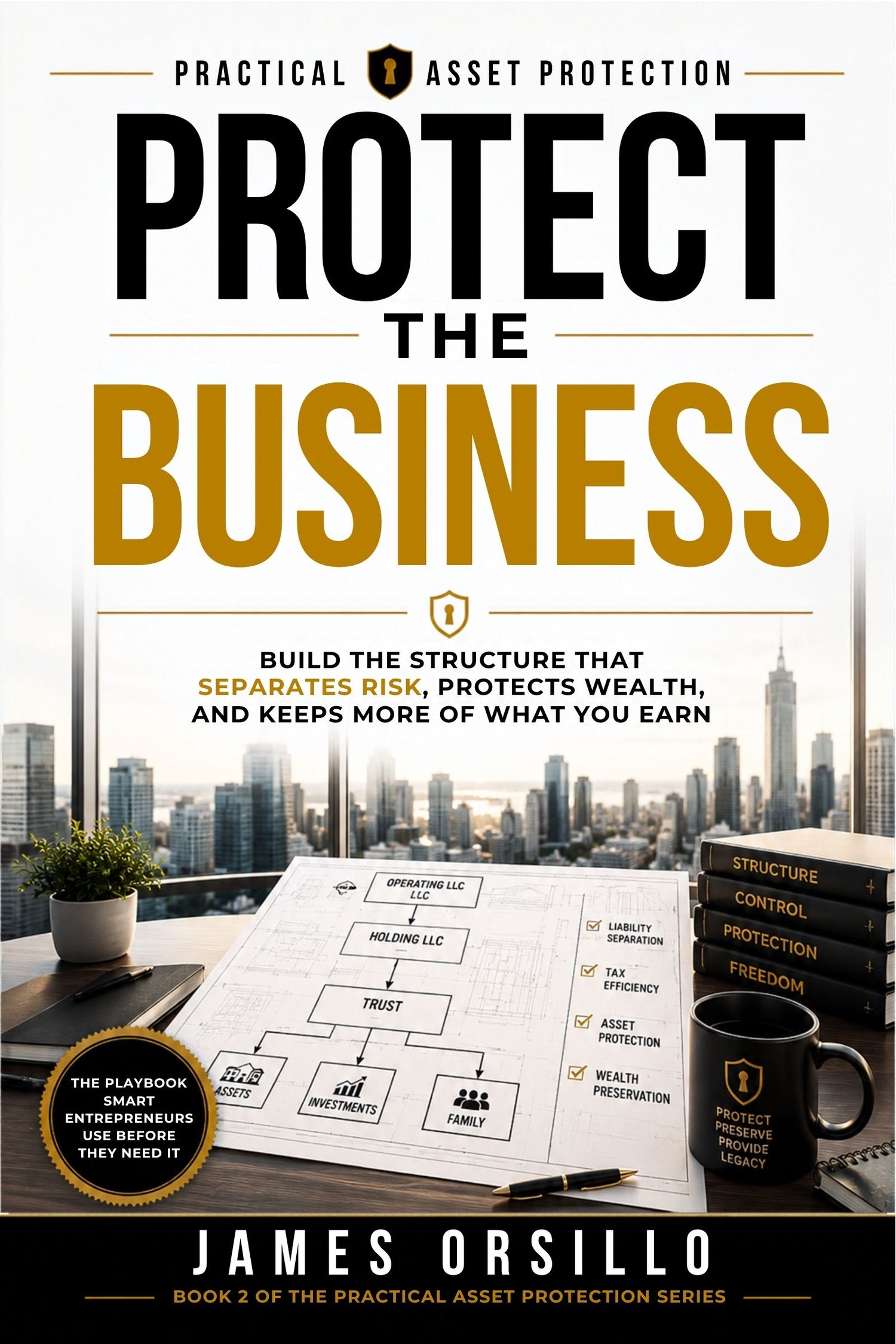
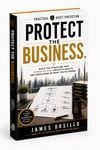
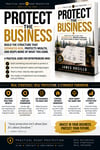

Protect the Business | Every Property You Buy Increases Your Wealth. It Can Also Increase The Number Of Ways Somebody Can Come After It
On Sale
$19.50
$19.50
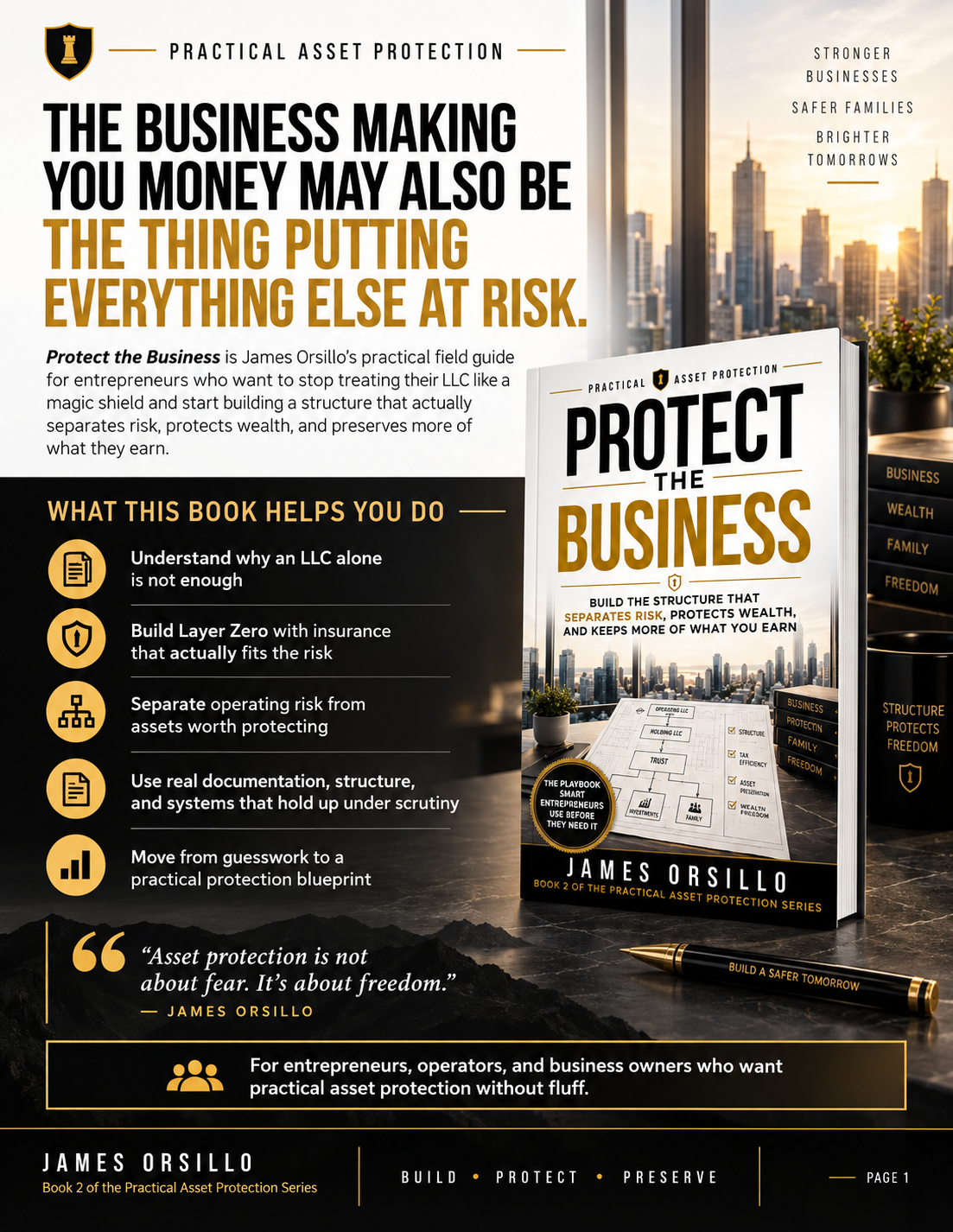
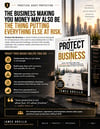
The business making you money may also be the thing putting everything else at risk.
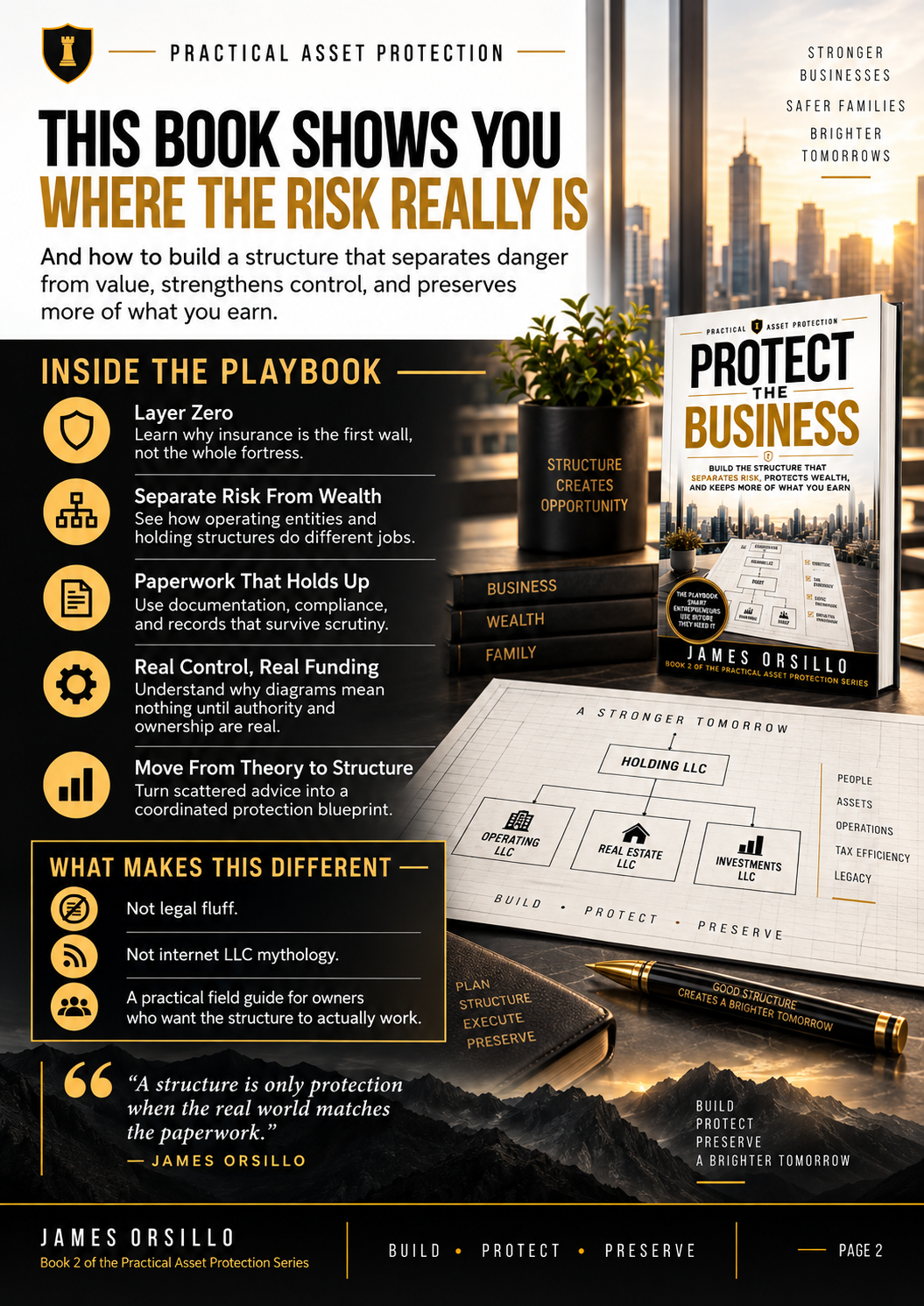
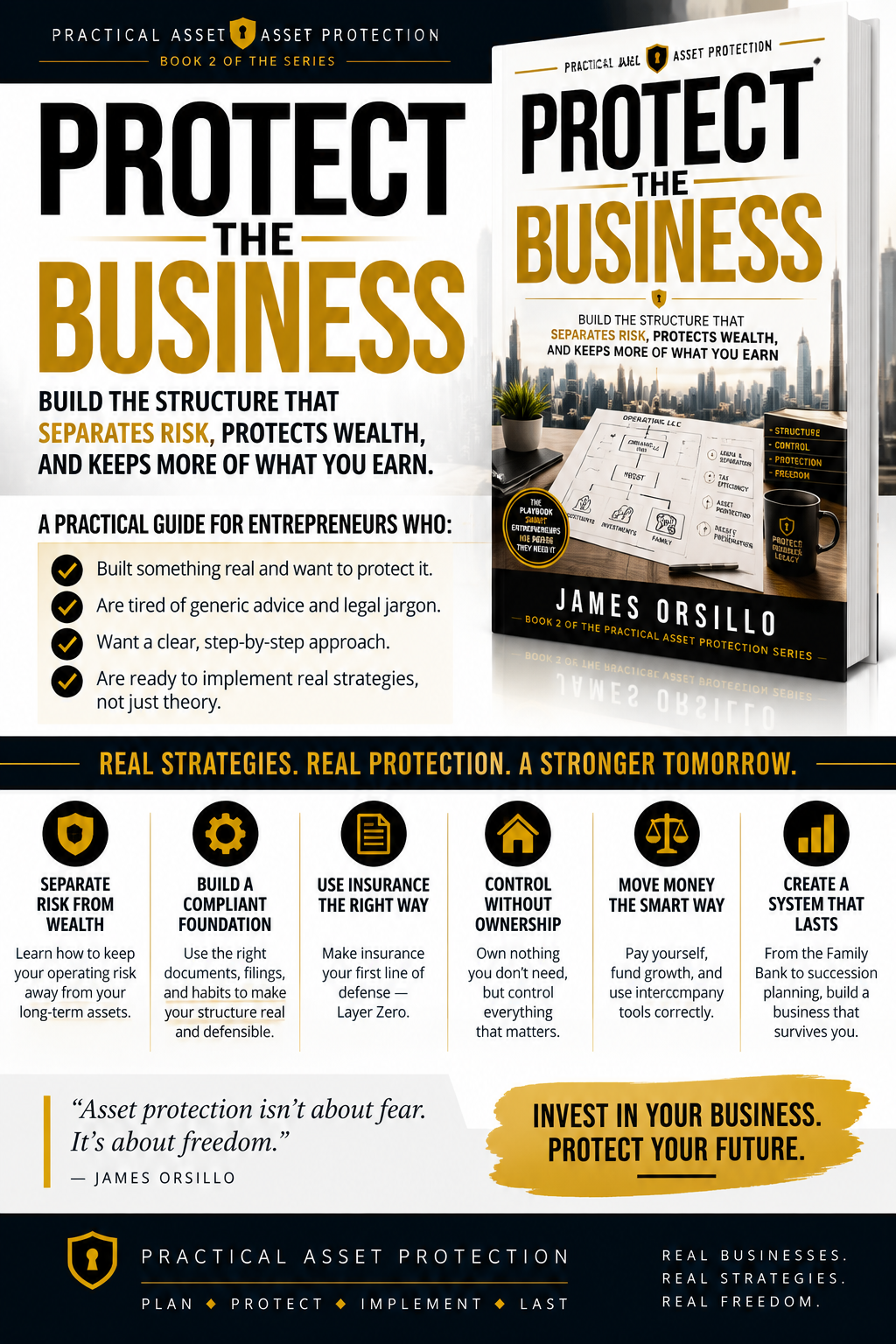
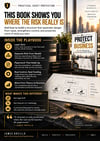
Protect the Business is James Orsillo’s practical guide to separating the company you operate from the assets and wealth you cannot afford to lose.
Entrepreneurs are usually told to form an LLC, buy insurance, keep decent records, and get back to work.
That's a start.
It is not an asset-protection strategy.
The real question is what happens when the operating business—the company signing contracts, employing people, dealing with customers, driving vehicles, performing work, and creating liability every day—gets sued.
What does that lawsuit actually reach?
And just as importantly:
What did you unnecessarily leave sitting inside its reach?
James Orsillo wrote Protect the Business to take business asset protection out of the lawyer's conference room and put it into language an entrepreneur can actually use.
No gatekeeping. No assumption that you need a law degree to understand your own structure. No pretending that filing an LLC automatically solved the problem.
This book helps you understand what should be separated, why the separation matters, where liability originates, how ownership structures interact, and what questions need to be answered before a problem appears.
You'll explore the practical thinking behind separating operating risk from valuable assets, using LLCs for specific jobs instead of treating one LLC as a magic shield, protecting equipment and other business property, creating cleaner ownership structures, understanding insurance as one layer rather than the entire plan, maintaining entity separation, and building protection before a creditor or lawsuit gives you a reason to wish you had.
The objective isn't to bury your business underneath paperwork.
It is to understand the architecture.
Operating company. Assets. Ownership. Liability. Insurance. Documentation. Separation.
Each has a job.
When those jobs are confused, the structure gets weaker.
When they're deliberately coordinated, you stop relying on a single wall to protect everything you've spent years building.
THIS BOOK IS FOR THE OWNER WHO HAS SOMETHING TO LOSE
Maybe your business started with a laptop, a pickup truck, or a few thousand dollars.
Now there are employees.
- Equipment.
- Contracts.
- Cash.
- Receivables.
- Real estate.
- Investments.
- Equity.
- Maybe twenty years of your life.
- The business grew.
Your protection strategy should have grown with it.
Protect the Business is written for the entrepreneur who wants to understand that transition before an attorney, creditor, accident, employee claim, customer dispute, or unexpected lawsuit teaches the lesson instead.
And when you finish reading, the conversation doesn't have to stop.
James Orsillo created Practical Asset Protection as an open-door educational resource where business owners can continue exploring asset-protection structures, guides, planning concepts, and practical implementation.
PART OF THE AMERICAN ENTREPRENEUR SERIES
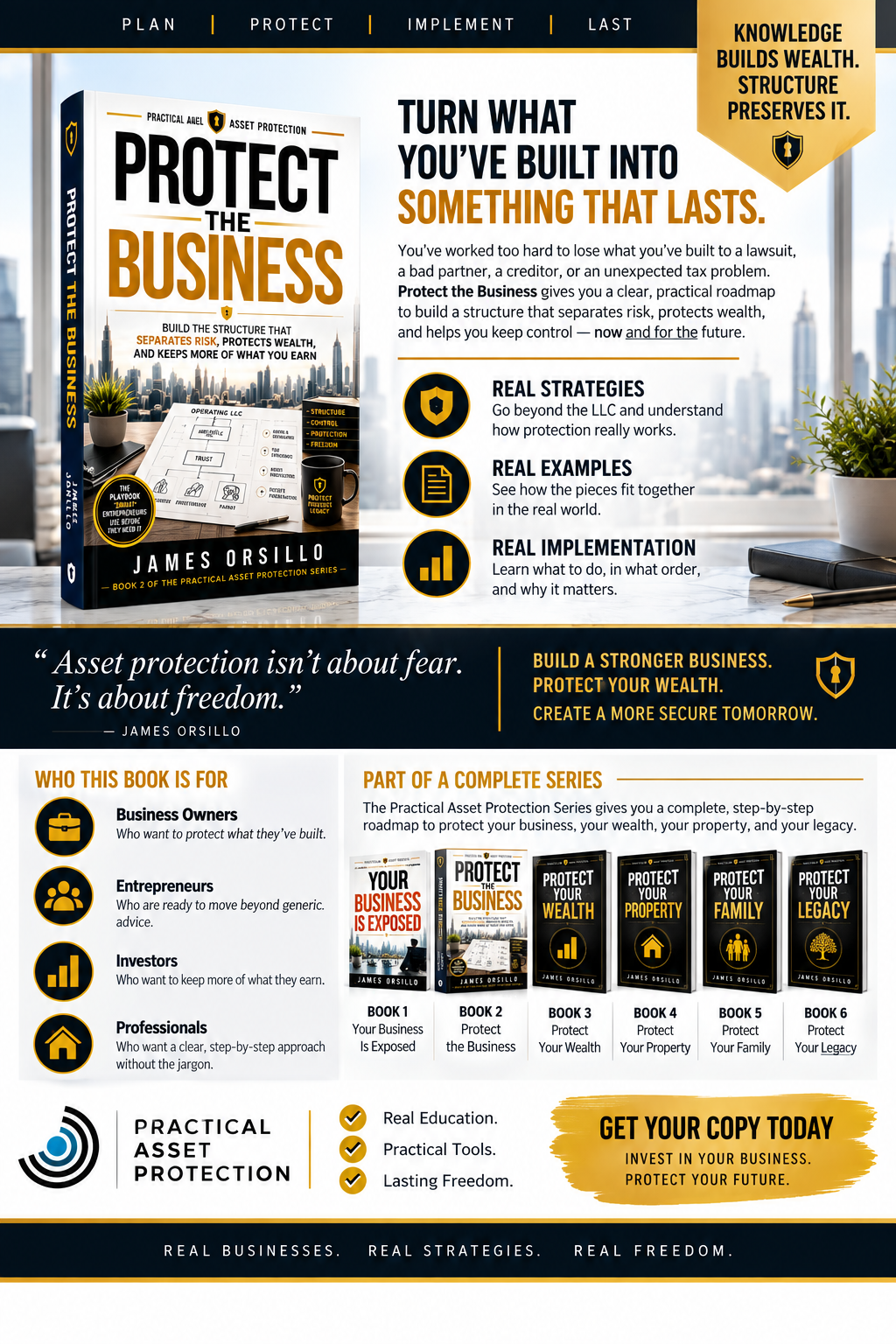
Protect the Business is part of James Orsillo's American Entrepreneur Series—six books designed around the complete entrepreneurial journey:
- Build it. Protect it.
- Protect the wealth it creates.
- Make better decisions. Know who to trust.
- And eventually create the freedom to walk away.
If you're building a company because you eventually want wealth, independence, and retirement, don't treat these as six unrelated books.
Read the complete six-book series.
Because making money was only the first job.
Keeping what the business creates is the second.
Protect the business before the business becomes the thing that costs you everything.
By James Orsillo
Author and founder of Practical Asset Protection
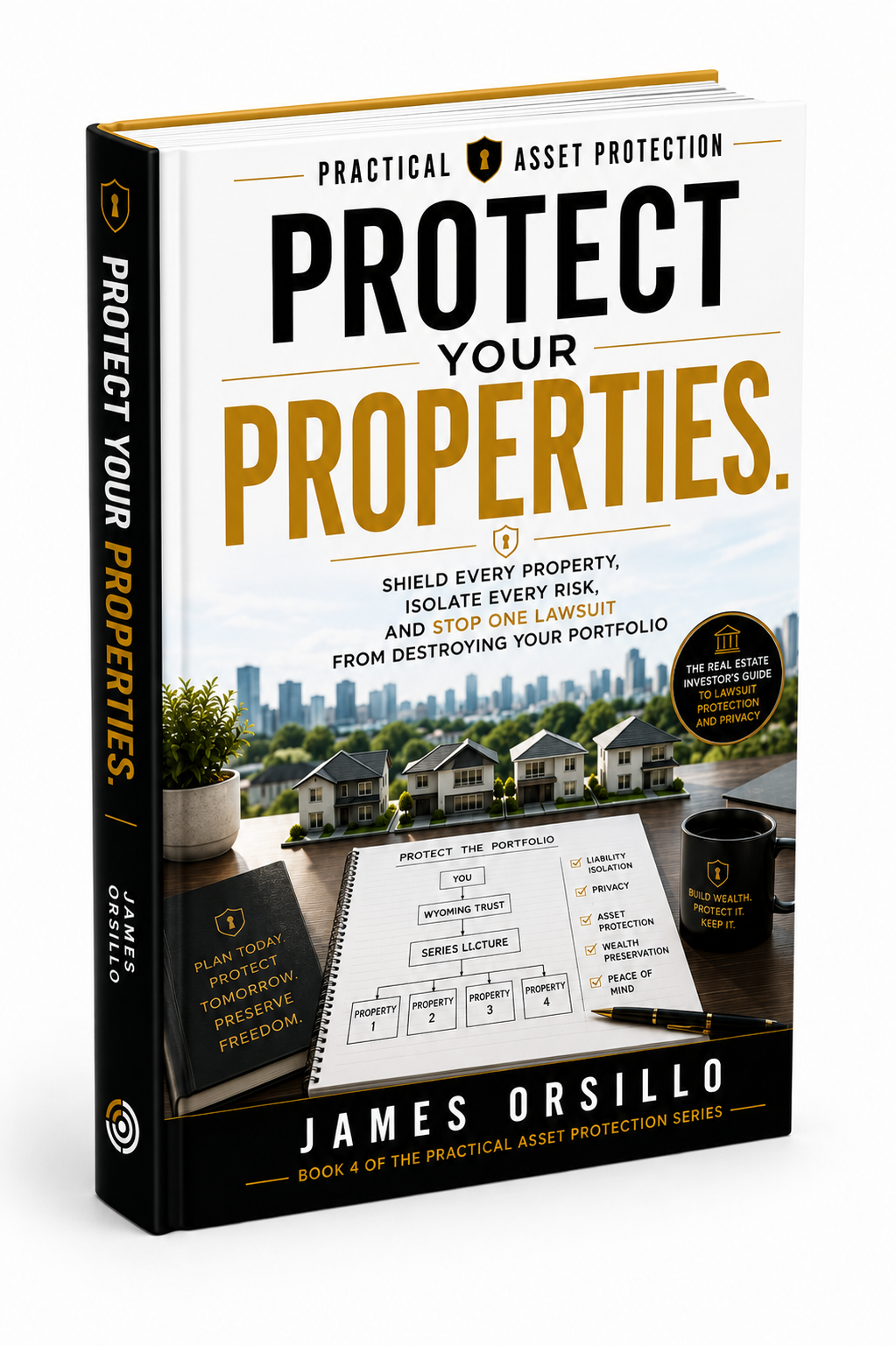
COMING SOON — Every Property You Buy Increases Your Wealth. It Can Also Increase The Number Of Ways Somebody Can Come After It
On Sale
$0.00
That is the contradiction most real-estate owners eventually discover.
- You buy property to build equity.
- You collect rent.
- You improve buildings.
- You pay down mortgages.
- You acquire another property.
- Then another.
Twenty years later, you may have built a substantial real-estate portfolio—while unknowingly leaving millions of dollars of equity sitting inside structures that were never designed to protect it.
Protect Your Properties is James Orsillo's practical guide to understanding real estate asset protection from the owner's side of the table.
Because owning property isn't enough.
You need to understand how you own it.
- A tenant gets injured.
- A contractor files a claim.
- A property dispute turns ugly.
- A judgment exceeds your insurance coverage.
- A personal lawsuit attacks assets outside the property where the problem originated.
- One property creates the liability.
The question is:
How much of everything else you own did you leave connected to it?
That is where real estate asset protection begins.
YOUR DEED IS AN ASSET-PROTECTION DOCUMENT
Most investors look at a deed and see proof of ownership.
James Orsillo wants you to see something else:
Exposure.
- Whose name is on it?
- Your personal name?
- An LLC?
- A trust?
- A holding structure?
- And what does that ownership actually accomplish?
- This is where generic internet advice becomes dangerous.
- “Put the property in an LLC.”
Fine.
Then what?
- Should several properties share the same LLC?
- Should valuable equity remain inside the same entity generating the liability?
- What happens when the LLC itself gets sued?
- What happens when you personally get sued?
- Where does insurance fit?
- Where do land trusts fit?
- What about holding companies?
- What about mortgages and liens?
- What happens when your portfolio crosses state lines?
- There isn't one magic document that answers every one of those questions.
- There is a structure.
And the purpose of Protect Your Properties is to help you understand it.
THIS ISN'T ABOUT HIDING PROPERTY
It is about separating risk intelligently.
There is an enormous difference.
Real asset protection is built before the lawsuit, before the creditor, before the accident, and before you desperately need it.
Once a claim exists, fraudulent-transfer laws can severely restrict what you can legitimately move.
That means the best time to understand your real-estate structure is when absolutely nothing is wrong.
This book explores the practical thinking behind property LLCs, ownership separation, equity protection, insurance, trusts, holding structures, liability compartmentalization, financing considerations, documentation, and portfolio-level asset protection.
Not as isolated legal tricks.
As pieces of one system.
THE ONE-PROPERTY STRATEGY DOESN'T ALWAYS SCALE
A structure that was perfectly adequate when you owned one rental may become ridiculous when you own ten.
That's one of the central lessons of this book.
As your portfolio grows, three things grow with it:
- Equity.
- Liability.
- Complexity.
Your asset-protection architecture has to grow too.
James Orsillo walks through the reasoning an experienced property owner should understand when deciding where properties belong, what should be separated, where valuable equity accumulates, and how one property's problem can potentially become a portfolio problem.
The goal isn't to bury every building beneath another mountain of entities.
The goal is to know why each entity exists.
If you can't explain what a company, trust, insurance policy, lien, or ownership layer is doing in your structure, you don't have a strategy.
You have paperwork.
NO GATEKEEPING. UNDERSTAND YOUR OWN STRUCTURE.
Real-estate asset protection has become an industry filled with fragments.
One person sells LLCs.
Another sells trusts.
Someone else talks about land trusts.
An insurance broker sells another policy.
A CPA talks about taxes.
An attorney drafts documents.
And the property owner is somehow expected to understand how all of it fits together.
Protect Your Properties was written to put the owner back in the middle of that conversation.
You do not need to become your own lawyer.
But you absolutely should understand:
- What owns the property.
- Where the equity sits.
- Where the liability originates.
- What else that liability can reach.
- What each protective layer is supposed to accomplish.
That is practical asset protection. And when you finish the book, the door stays open.
James Orsillo created Practical Asset Protection so property owners and entrepreneurs can continue exploring real estate protection, LLC structures, trusts, equity strategies, educational guides, and the other pieces that make up a complete asset-protection plan.
PART OF THE AMERICAN ENTREPRENEUR SERIES
Protect Your Properties is part of James Orsillo's American Entrepreneur Series—six books built for people who aren't merely trying to make money.
They're trying to build something, protect it, convert it into wealth, and eventually create enough independence to walk away.
If you own a business, investment property, or both, read the complete six-book series.
Because buying the property was the easy part.
Paying it off took years.
Building the equity took longer.
Don't spend twenty years building a real-estate portfolio and twenty minutes deciding how to own it.
Protect your properties. Protect the equity. Protect what all those years of work actually created.
By James Orsillo
Author and founder of Practical Asset Protection
Your Business Is Exposed | You Built The Business. Now Find Out What Can Take It Away
On Sale
$19.50
$19.50
Your Business Is Exposed is James Orsillo’s practical guide to understanding the asset-protection weaknesses hiding inside an otherwise successful business.
Most entrepreneurs are taught how to start a company, generate revenue, hire employees, buy equipment, acquire property, and grow.
Almost nobody teaches them what happens after they finally have something worth taking.
That is where this book begins.
James Orsillo strips away the gatekeeping, legal jargon, and surface-level internet advice surrounding business asset protection and explains the subject from an entrepreneur’s point of view: What is exposed? Why is it exposed? What structures actually matter? When should they be created? And how do the pieces work together?
This isn't another collection of vague warnings telling you to “form an LLC and buy insurance.”
It is designed to help you understand the architecture behind real asset protection so you can have intelligent conversations with attorneys, CPAs, insurance professionals, and other advisors—and recognize when an important piece is missing.
Inside, you'll explore the practical thinking behind protecting a business, separating valuable assets from operating risk, using business entities deliberately, protecting accumulated wealth, planning before a lawsuit or creditor appears, and building multiple layers of protection rather than betting everything on one document or entity.
No gatekeeping. No pretending the important stuff is too complicated for you to understand.
The goal is simple: when you finish this book, you should have a much clearer understanding of what you own, where the exposure lives, what can potentially reach it, and what questions you need to ask next.
And the book doesn't have to be the end of the conversation.
James Orsillo created Practical Asset Protection as an open-door educational resource for entrepreneurs and property owners who want to keep learning. Readers can continue exploring the strategies, guides, structures, and educational material available through Practical Asset Protection.
PART OF THE AMERICAN ENTREPRENEUR SERIES
Your Business Is Exposed is part of James Orsillo's American Entrepreneur Series—six books built around the larger journey of building a business, protecting it, protecting the wealth it creates, making better ownership decisions, and eventually being able to walk away on your own terms.
If you're running a business with the intention of someday turning that work into wealth, independence, and retirement, don't stop with one book.
Read the complete six-book series.
- You spent years learning how to build it.
- Spend a few hours learning what can take it away.
Your business is exposed. Find the holes before somebody else does.
By James Orsillo
Author and founder of Practical Asset Protection
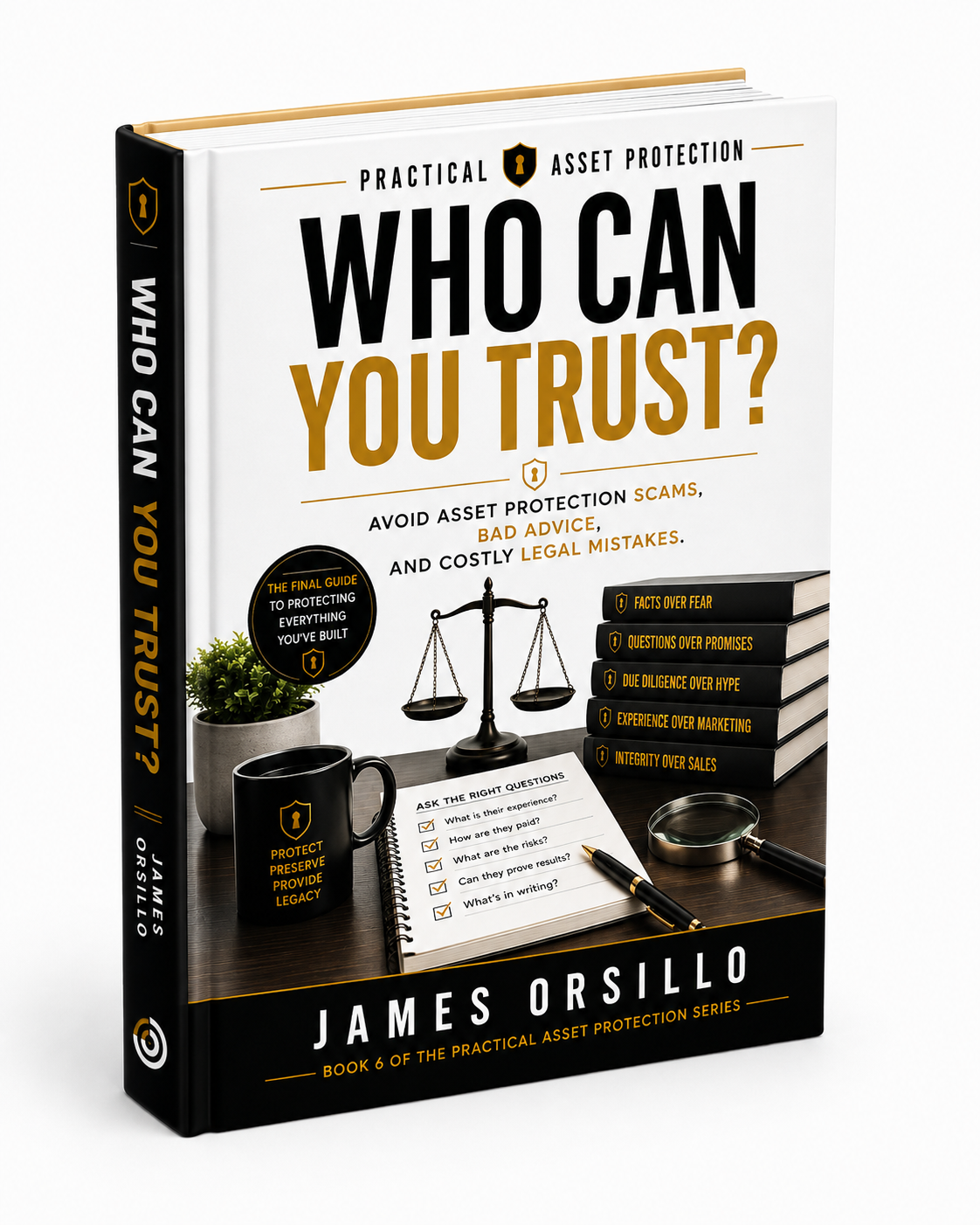
COMING SOON — The Most Dangerous Person In Your Financial Life May Be The Professional You Hired To Protect It
On Sale
$0.00
You built the business.
You accumulated the wealth.
You bought the property.
You learned enough about asset protection to understand that you need attorneys, CPAs, insurance professionals, financial advisors, bankers, and other specialists.
Now comes a problem almost nobody prepares entrepreneurs for:
How do you know who actually knows what they're doing?
Who Can You Trust is James Orsillo's practical guide to choosing, questioning, coordinating, and—when necessary—firing the professionals who advise you about your business and wealth.
Because credentials aren't enough.
- A license doesn't guarantee judgment.
- A beautiful office doesn't guarantee competence.
- A large bill certainly doesn't guarantee that anyone has looked at the whole picture.
And one of the most expensive mistakes an entrepreneur can make is assuming:
“My attorney handles that.”
- Which attorney?
- Handles what?
- Did the CPA know?
- Did the insurance professional know?
- Did anybody actually coordinate the pieces?
Or did five competent professionals each solve their own little problem while nobody protected the owner?
That's the problem this book attacks.
THE PROFESSIONALS MAY ALL BE RIGHT—AND YOUR PLAN CAN STILL BE WRONG
This is one of the hardest lessons in business and asset protection.
- Your attorney may give perfectly reasonable legal advice.
- Your CPA may give perfectly reasonable tax advice.
- Your insurance professional may properly insure the risk they were shown.
- Your financial advisor may properly manage the investments in front of them.
- Your estate-planning attorney may properly draft the trust you requested.
And the complete structure can still have a hole big enough to drive a truck through.
Why?
Because each professional is looking through a different window.
Nobody necessarily owns the entire blueprint.
James Orsillo wrote Who Can You Trust for the person who should own that blueprint:
You.
YOU DON'T NEED TO KNOW MORE THAN YOUR ATTORNEY
You need to know enough to recognize when the conversation doesn't make sense.
That's a completely different standard.
You should be able to ask:
- Why are we doing this?
- What problem does this solve?
- What doesn't it solve?
- What owns this asset?
- What happens if this company gets sued?
- What happens if I personally get sued?
- What are the tax consequences?
- Does my CPA agree?
- Does this conflict with my estate plan?
- What happens if I die?
- What happens if I become incapacitated?
- What happens if my partner leaves?
- What happens if I sell the company?
- And perhaps the most important question of all:
- Who else needs to know about this?
If a professional becomes irritated because an owner wants to understand those answers, you've learned something important before signing the check.
THE $5,000 SUIT DOESN'T MAKE SOMEONE AN EXPERT
Entrepreneurs are particularly vulnerable to authority theater.
- Fancy terminology.
- Complicated diagrams.
- Huge binders.
- Expensive offices.
- “Proprietary” structures.
- Promoters telling you they discovered something nobody else knows.
- Professionals who make a straightforward concept sound impossibly complicated—and then conveniently sell the solution.
Asset protection attracts plenty of this.
- So does tax planning.
- So does estate planning.
- So does investing.
Who Can You Trust is designed to help entrepreneurs distinguish real expertise from salesmanship.
Not by pretending you can become an attorney or CPA over a weekend.
By teaching you to evaluate the thinking behind the recommendation.
A good professional should be able to explain the strategy.
A great professional should be able to explain its weaknesses.
And somebody you trust with decades of accumulated wealth should be comfortable saying:
“I don't know. We need another specialist at the table.”
That's not weakness.
That's professionalism.
BUILD THE TEAM BEFORE YOU NEED THE TEAM
- The worst time to search for an asset-protection attorney is after you've been sued.
- The worst time to find an estate-planning attorney is during a family emergency.
- The worst time to discover your CPA and attorney disagree about your structure is after the transaction closes.
- And the worst time to learn that nobody coordinated your advisors is when something breaks.
Build the team while things are boring.
- Know who you're calling.
- Know what each person is responsible for.
- Make sure they understand what the others are doing.
- And keep yourself in the center.
Your professional team may include attorneys, CPAs, insurance professionals, bankers, financial advisors, estate planners, and specialists.
- They don't all need to agree.
- They do need to communicate.
- Because this is not their business.
- This is not their property.
- This is not their retirement.
It's yours.
NO GATEKEEPING. NO BLIND TRUST.
James Orsillo created Practical Asset Protection around a simple belief:
You shouldn't have to blindly surrender your financial life to professionals simply because they know terminology you don't.
Use professionals.
Pay good ones well.
Listen when they know more than you do.
But understand enough about your own business, wealth, property, and asset-protection structure to participate intelligently in the decisions.
That is the purpose of this book, and the conversation remains open after you finish it.
Through Practical Asset Protection, readers can continue exploring James Orsillo's books, asset-protection education, business structures, trusts, planning guides, and practical resources designed to make complicated subjects understandable to the people who actually own the assets.
THE SIXTH BOOK IN THE AMERICAN ENTREPRENEUR SERIES
Who Can You Trust completes James Orsillo's six-book American Entrepreneur Series.
The series follows the journey most entrepreneurs actually live:
- Your Business Is Exposed — Find the vulnerabilities.
- Protect the Business — Separate and contain operating risk.
- Protect Your Wealth — Protect what the business created.
- Protect Your Properties — Protect real estate and accumulated equity.
- Your Last Business Decision — Prepare the company and yourself for the eventual exit.
- Who Can You Trust — Build the professional team capable of helping you protect all of it.
These aren't six random business books.
They're one entrepreneurial journey.
If you're building a business because you ultimately want wealth, independence, and the ability to retire on your own terms, read all six.
- There will always be attorneys.
- There will always be accountants.
- There will always be advisors.
- There will always be somebody willing to sell you the next great strategy.
- But at the end of the day, there is only one person who has lived every year it took to build what they're advising you about.
You.
- Hire expertise.
- Demand competence.
- Understand the advice.
- Coordinate the team.
And be very careful who you trust with everything you spent your life building.
By James Orsillo
Author and founder of Practical Asset Protection
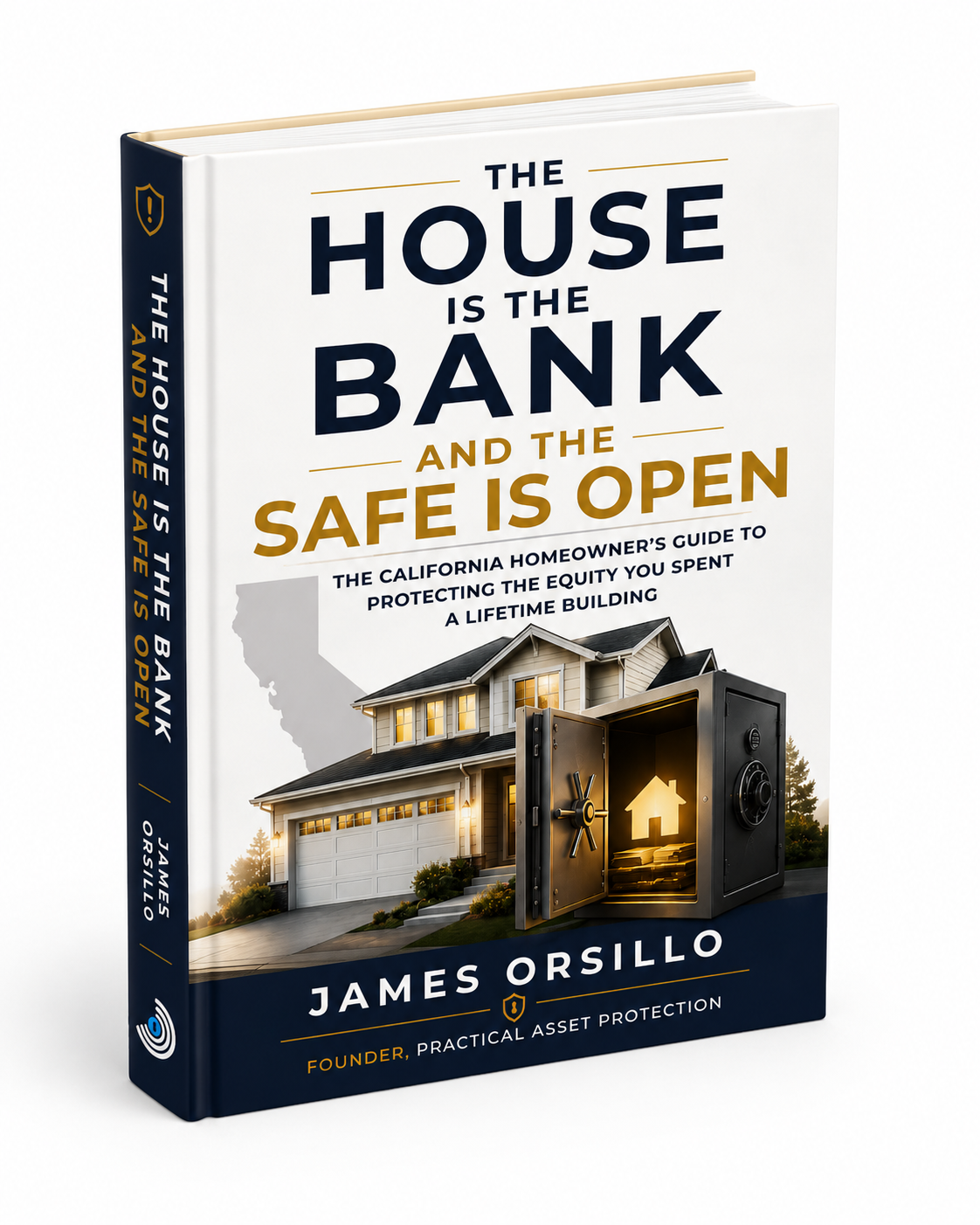






The House Is the Bank and the Safe Is Open
On Sale
$19.50
$19.50
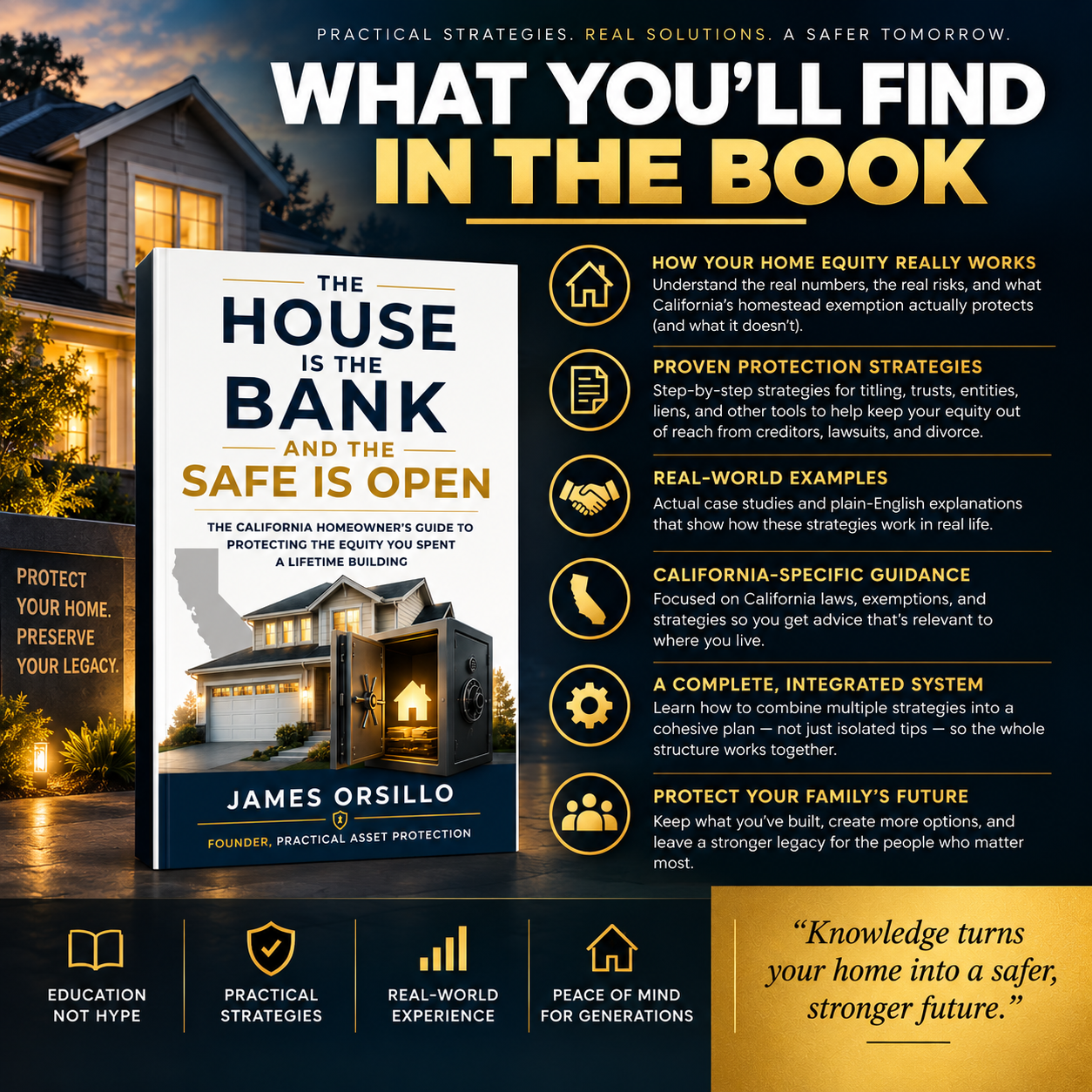
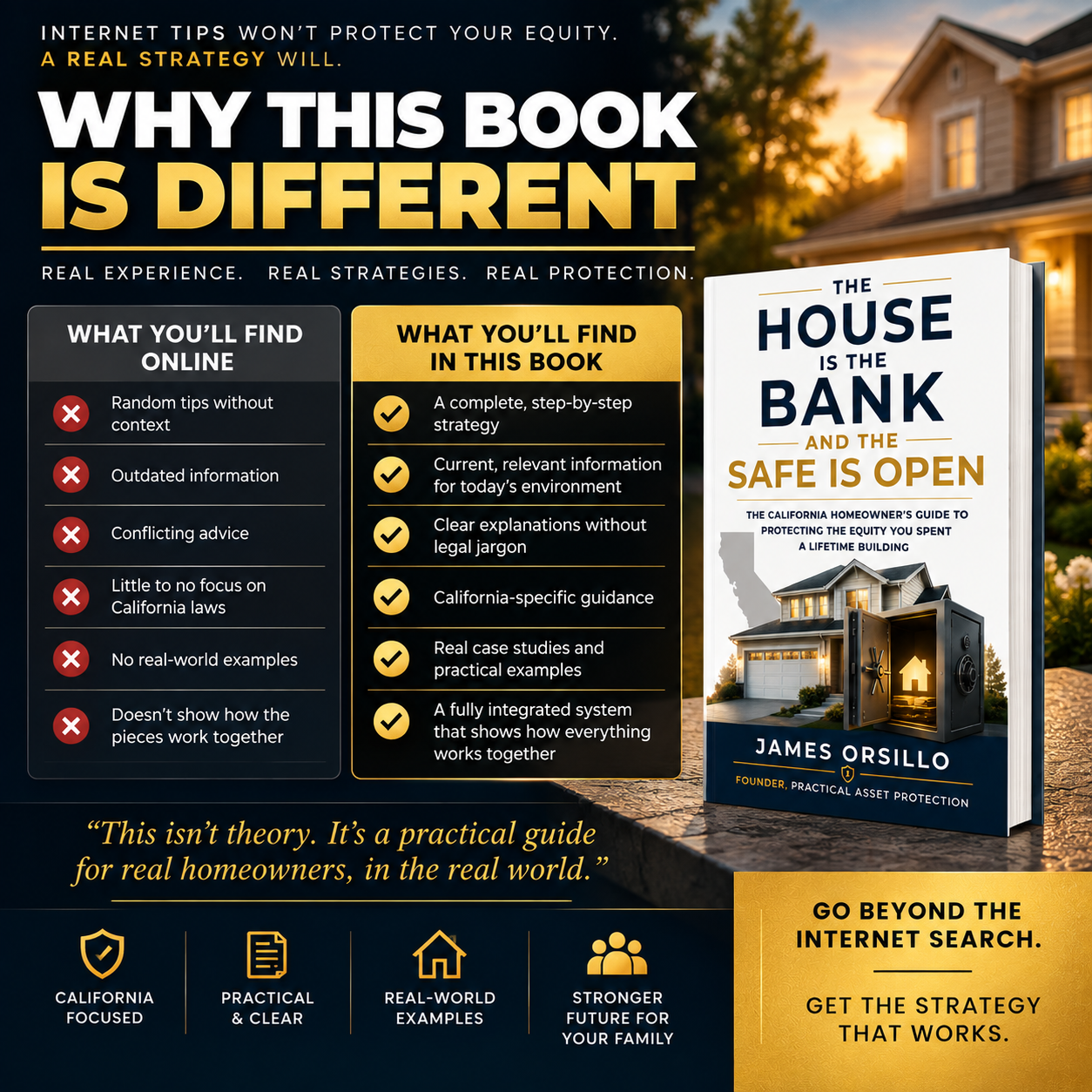
That's the uncomfortable idea behind The House Is the Bank and the Safe Is Open.
Most Americans are taught the same financial lesson:
- Buy the house.
- Make the payments.
- Pay down the mortgage.
- Build equity.
- Own it free and clear.
- Celebrate.
James Orsillo wants you to look at that house from another direction.
What does somebody trying to collect from you see?
- They don't see the years you worked.
- They don't see the mortgage payments you made when money was tight.
- They don't see the weekends you spent repairing the place.
- They don't see the sacrifice required to accumulate $300,000, $500,000, or $1 million in equity.
- They see an asset.
- They see equity.
And depending on your circumstances and applicable law, some of that equity may be reachable.
You built the bank.
The question is whether you remembered to close the safe.
YOUR HOUSE CAN BE BOTH WEALTH AND EXPOSURE
For many entrepreneurs, homeowners, and real-estate investors, property becomes one of the largest stores of accumulated wealth they will ever own.
That's exactly why it deserves more thought than:
“The house is paid off. I'm safe.”
- Paid off from whom?
- The mortgage company?
- That's one kind of safety.
Asset protection asks a different question:
Who else could potentially reach the equity?
- A judgment creditor?
- A business creditor after a personal guarantee?
- A lawsuit?
- A claim exceeding insurance limits?
- Another unexpected financial catastrophe?
The answer depends on the property, the owner, the state, the type of claim, applicable exemptions, existing liens, and the structure surrounding the asset.
That is why this book doesn't begin with a magic trick.
It begins with understanding how equity actually fits into your financial fortress.
THE PROBLEM ISN'T OWNING EQUITY
The problem is failing to understand what that equity represents.
If you have a $700,000 property with a $600,000 legitimate mortgage, the financial picture looks very different from a $700,000 property owned free and clear.
- Same house.
- Same kitchen.
- Same bedroom.
- Same owner.
Very different equity position.
That simple observation opens the door to a much larger discussion about real-estate asset protection.
- Homestead protections.
- Insurance.
- Ownership.
- Liens.
- Mortgages.
- LLCs.
- Trusts.
- Financing.
- Equity management.
And the difference between legitimately structuring your affairs before a problem exists and trying to rearrange assets after a creditor is already knocking.
EQUITY IS NOT JUST A NUMBER ON ZILLOW
It is stored financial value.
And stored financial value deserves protection.
The House Is the Bank and the Safe Is Open explores the practical thinking behind home-equity protection, real-estate asset protection, insurance, homestead laws, ownership structures, debt and liens, entity planning, trusts, and layered protection.
But this isn't a legal textbook.
And it isn't a collection of internet tricks.
James Orsillo approaches the subject the way an entrepreneur approaches a machine:
What is this part doing?
- Why is it here?
- What happens if it fails?
- What protects the next layer?
- And where is the weak point?
That's how a real asset-protection system should be understood.
ONE WALL IS NOT A FORTRESS
Insurance matters.
But insurance has limits, exclusions, conditions, and coverage boundaries.
An LLC can matter.
But an LLC doesn't solve every personal liability problem.
A trust may serve an important purpose.
But simply putting the word “trust” on a document doesn't make property untouchable.
A homestead exemption can be extremely valuable.
But its protection depends heavily on applicable state law and circumstances.
A mortgage or other legitimate lien changes the equity picture.
But debt isn't automatically an asset-protection strategy.
Every tool has a job.
The mistake is asking one tool to do all of them.
This book is about understanding how the layers interact.
THE GOAL IS NOT TO MAKE YOUR HOUSE DISAPPEAR
- Your property is still your property.
- Your equity is still real.
- Your financial statements still matter.
- Your taxes still matter.
- Your lenders still matter.
- And legitimate creditors don't disappear because you formed another LLC.
- Asset protection isn't magic.
It's planning.
- It's understanding exposure while you still have time to make legitimate decisions.
- It's maintaining insurance.
- Understanding your state's protections.
- Structuring ownership deliberately.
- Keeping records.
- Coordinating your real estate with your business and estate plan.
And recognizing that the worst time to start asking these questions is after the lawsuit arrives.
IF YOU OWN A BUSINESS AND OWN REAL ESTATE, PAY ATTENTION
Entrepreneurs can face an additional problem.
They may spend decades building wealth in two places simultaneously:
The business and the property.
- Then they personally connect them.
- Personal guarantees.
- Personal ownership.
- Cross-collateralization.
- Shared entities.
- Poor documentation.
- Accumulated equity.
One structure begins touching another until nobody can clearly explain where one risk stops and the next asset begins.
That's when you need to see the whole board.
- Not just the house.
- Not just the LLC.
- Not just the insurance policy.
Everything.
NO GATEKEEPING. UNDERSTAND WHAT YOU OWN.
You shouldn't need to become a real-estate attorney to understand why your house may be exposed.
You shouldn't need a CPA license to ask intelligent questions about your structure.
And you shouldn't have to blindly purchase an expensive asset-protection package without understanding what each piece is supposed to accomplish.
That's the philosophy behind James Orsillo's Practical Asset Protection.
Learn the architecture.
Understand the terminology.
Recognize the risks.
Then sit down with the appropriate attorneys, CPAs, insurance professionals, lenders, and advisors and have a much better conversation.
The website and educational resources at Practical Asset Protection continue that conversation beyond this book.
Because the objective isn't to replace professionals.
It's to stop being completely dependent on somebody else to explain your own financial life to you.
YOU ALREADY BUILT THE WEALTH
Look at your house differently.
Don't just ask:
“What is it worth?”
Ask:
- “How much equity is there?”
- “Who can potentially reach it?”
- “What protections already exist?”
- “What am I assuming protects me that actually doesn't?”
- “How does this property fit into everything else I own?”
Those questions can completely change how you think about a paid-off house.
You spent years putting money into the safe.
Now learn how the door works.
The House Is the Bank and the Safe Is Open.
By James Orsillo
Author and founder of Practical Asset Protection
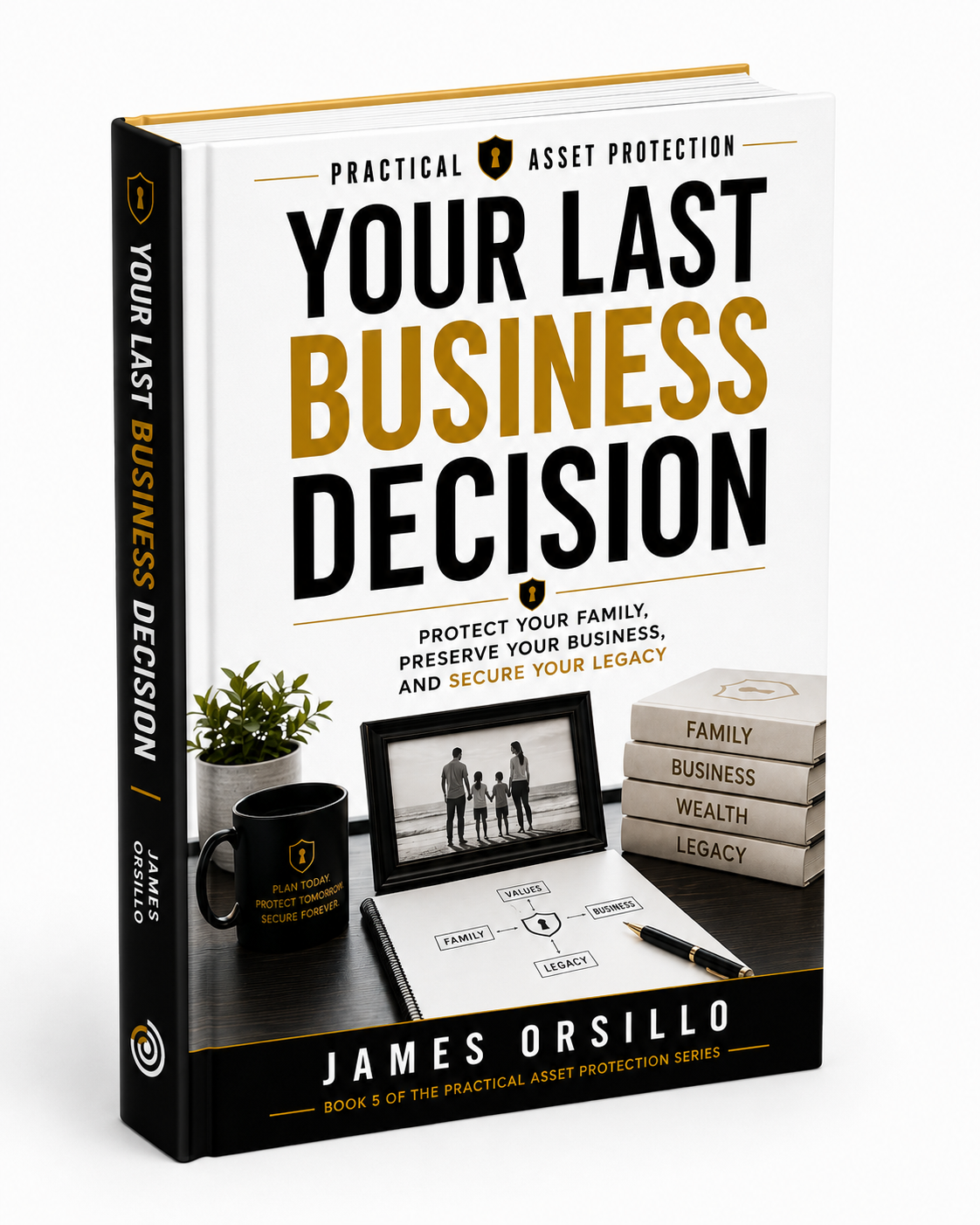
COMING SOON — You Knew How To Start The Business. Nobody Taught You How To Leave It
On Sale
$0.00
For years, maybe decades, almost every important decision pointed in the same direction:
- Grow.
- Hire.
- Sell.
- Invest.
- Borrow.
- Build.
- Survive.
Then one day the question changes.
How do I get out?
Your Last Business Decision is James Orsillo's practical guide to one of the most important—and most neglected—decisions an entrepreneur will ever make:
What happens to the business when you no longer want to run it?
- Sell it?
- Hand it to your children?
- Bring in management?
- Transfer ownership to a partner?
- Keep the company and collect income?
- Wind it down?
- Or discover, far too late, that the business you thought was worth millions is really just a demanding job that stops producing the moment you stop showing up?
That's the problem.
Entrepreneurs spend enormous amounts of time creating businesses. Very few deliberately create businesses they can eventually leave.
YOUR BUSINESS IS NOT YOUR RETIREMENT PLAN UNTIL SOMEONE ELSE CAN OWN IT
- Revenue isn't value.
- Profit isn't necessarily value.
- And twenty-five years of hard work doesn't automatically create something another person will pay you for.
- A buyer isn't purchasing your memories.
- They aren't buying your sacrifice.
- They aren't compensating you for the weekends you missed, the payrolls you somehow made, or the years you spent keeping the company alive.
They're buying what survives after you leave.
- Customers.
- Contracts.
- Systems.
- Employees.
- Management.
- Cash flow.
- Intellectual property.
- Equipment.
- Reputation.
- Processes.
- Predictability.
- Transferability.
If all of those roads lead directly back to you, you may have built a successful business without building a transferable one. That distinction can be worth millions of dollars.
THE LAST BUSINESS DECISION STARTS YEARS BEFORE THE LAST DAY
One of the worst times to begin exit planning is when you're exhausted and finally ready to leave.
By then, your options may already be limited.
Your Last Business Decision is about understanding the exit before you need the exit.
James Orsillo walks through the practical thinking behind business succession, exit planning, valuation, ownership transfer, management independence, buyer readiness, continuity, documentation, risk reduction, and protecting the wealth created when ownership finally changes hands.
Not from the perspective of somebody selling you a transaction.
From the perspective of the entrepreneur who has to live with the result.
Because there is a massive difference between:
Owning a valuable company
and
owning a company somebody else can actually buy.
THERE ARE MORE WAYS OUT THAN "SELL THE COMPANY"
That's another piece most entrepreneurs aren't taught.
An exit doesn't necessarily mean putting the company on the market tomorrow.
- Your eventual transition might involve family.
- Employees.
- Partners.
- An outside buyer.
- A management team.
- A gradual transfer.
- A continuing ownership interest.
- Or an intentionally planned shutdown.
- Each creates different questions about control, valuation, taxes, liability, income, timing, and what happens to you afterward.
And underneath all of them sits the question entrepreneurs rarely ask soon enough:
What do I actually want my life to look like when the business is gone?
- That's not a legal question.
- It's not an accounting question.
- It's an ownership question.
- And nobody else can answer it for you.
YOU NEED A BUSINESS THAT CAN SURVIVE YOU
Think about this before you talk to a broker.
- If you disappeared for six months tomorrow, what happens?
- Do employees know what to do?
- Can someone else make decisions?
- Are the customer relationships institutional—or personal to you?
- Are contracts documented?
- Are processes documented?
- Does management actually manage?
- Can another owner understand the financials?
- Does the company have predictable cash flow without your constant intervention?
If the answer to half of those questions is no, you've just found part of your exit plan.
That's what this book is designed to do. Make you see the company through the eyes of the person who might someday inherit it, manage it, or write the check to buy it.
NO GATEKEEPING. YOU SHOULD UNDERSTAND THE DEAL.
Eventually, an entrepreneur preparing to exit may sit across from attorneys, CPAs, valuation professionals, financial planners, business brokers, lenders, and potential buyers.
Everybody at that table has expertise.
Everybody may also have a different incentive.
You are the one selling thirty years of your life.
You need to understand the conversation.
James Orsillo created Practical Asset Protection around that same principle: give owners enough practical knowledge to understand the structures, risks, and decisions surrounding the wealth they've built.
You don't need to become your own attorney, CPA, or valuation expert.
You need to become an educated owner who knows what questions to ask. And when the book ends, the conversation doesn't.
Practical Asset Protection provides additional educational resources, guides, and strategies for entrepreneurs who want to keep protecting what they've built before, during, and after the transition.
PART OF THE AMERICAN ENTREPRENEUR SERIES
Your Last Business Decision is part of James Orsillo's American Entrepreneur Series—six books following the complete arc of entrepreneurship:
- Build the business.
- Understand the exposure.
- Protect the business.
- Protect the wealth.
- Protect the property.
- Prepare for the day you walk away.
If you're running a business because you eventually want wealth, independence, and retirement on your own terms, read the complete six-book series.
You probably made thousands of decisions to build your company.
- Some were brilliant.
- Some cost you money.
- Some nearly killed the business.
- You survived all of them.
Eventually, only one decision remains.
What happens to everything you built when you're finally ready to leave?
Make that decision deliberately.
Your last business decision may be the one that determines what the first thirty years were actually worth.
By James Orsillo
Author and founder of Practical Asset Protection
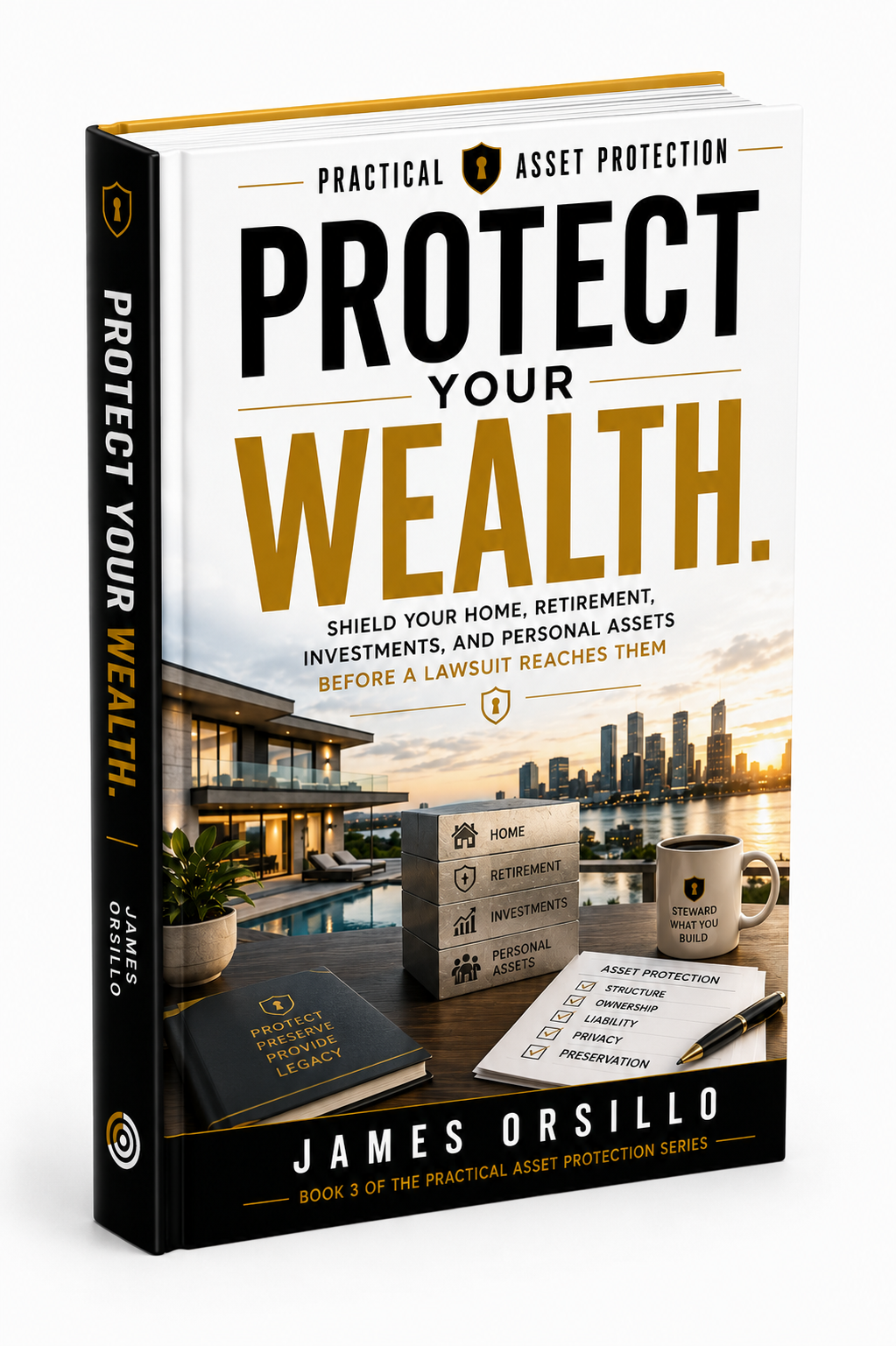
COMING SOON — Making The Money And Keeping The Money Are Two Completely Different Skills
On Sale
$0.00
Most entrepreneurs spend decades learning the first one.
Almost nobody teaches them the second.
Protect Your Wealth is James Orsillo’s practical guide to what happens after the business starts producing real wealth—when you've accumulated cash, investments, equity, retirement assets, property, and other things you cannot simply rebuild after one catastrophic loss.
At that point, the game changes.
You're no longer protecting an idea.
You're protecting twenty or thirty years of your life.
And one of the biggest mistakes successful entrepreneurs make is allowing the wealth created by the business to remain unnecessarily connected to the risks of the business—or exposed to completely different risks outside it.
- A lawsuit.
- A personal guarantee.
- A creditor.
- A bad partnership.
- An accident.
- A failed investment.
- A judgment that blows through the limits of an insurance policy.
You can do everything right while building wealth and still discover that you never actually built a structure to keep it.
That is what this book is about.
James Orsillo takes the principles of asset protection, wealth preservation, ownership structure, liability separation, trusts, business entities, insurance, and long-term planning and explains them from the perspective of the person who actually owns the assets.
- No gatekeeping.
- No legal theater.
- No pretending that complicated terminology somehow makes the underlying concepts impossible for an intelligent business owner to understand.
- You should know how your own fortress works.
- You should know what owns what.
- You should know where the liability lives.
- You should know which assets are exposed.
You should understand why one structure protects against one problem but may do absolutely nothing against another.
And you should understand the difference between legitimate planning done before a problem exists and desperate asset movement attempted after the fire has already started.
THE QUESTION CHANGES WHEN YOU HAVE SOMETHING WORTH PROTECTING
Early in your career, the question is:
How do I make money?
Later it becomes:
How do I stop losing it?
That's the transition Protect Your Wealth is designed to help you understand.
You'll explore the practical thinking behind separating accumulated wealth from operating liability, protecting investment assets, understanding where trusts and entities fit, using insurance as one defensive layer rather than your entire strategy, recognizing unnecessary concentrations of risk, coordinating ownership structures, and thinking about wealth as something that requires its own architecture.
The objective is not to make your financial life impossibly complicated.
It is the opposite.
- Know what you own.
- Know who owns it legally.
- Know what can reach it.
- Know what protects it.
- Know where the holes are.
Once you understand those five things, asset protection stops looking like some mysterious legal industry and starts looking like what it really is:
Risk engineering for your wealth.
THERE IS NO SECRET ROOM YOU AREN'T ALLOWED TO ENTER
One of the reasons James Orsillo created Practical Asset Protection was the enormous amount of gatekeeping surrounding this subject.
You search online and get fragments.
- An article about LLCs.
- Another about trusts.
- Something about insurance.
- Something about charging orders.
- Another attorney telling you that your situation is too complicated to explain without scheduling a consultation.
But nobody shows you how the pieces relate.
Protect Your Wealth is designed to change that.
The purpose isn't to turn you into your own attorney or CPA.
It's to make you an educated owner—someone capable of sitting across the table from professionals and understanding what they're proposing, why they're proposing it, and whether an important piece of the structure has been ignored. And the conversation doesn't end on the last page.
Readers can continue learning through Practical Asset Protection, where James Orsillo's books, educational guides, asset-protection strategies, and planning resources are built around the same principle:
You deserve to understand what you're paying professionals to build.
PART OF THE AMERICAN ENTREPRENEUR SERIES
Protect Your Wealth is part of James Orsillo's American Entrepreneur Series—six books following the entrepreneur from exposure and business protection through wealth preservation, property protection, major business decisions, and choosing the professionals trusted with what you've built.
If you're running a business because you eventually want wealth, independence, and the ability to retire on your own terms, read the complete six-book series.
The first victory is building something valuable.
The second is making sure one bad day can't erase it.
You already did the hard part.
Now protect the wealth you fought to create.
By James Orsillo
Author and founder of Practical Asset Protection
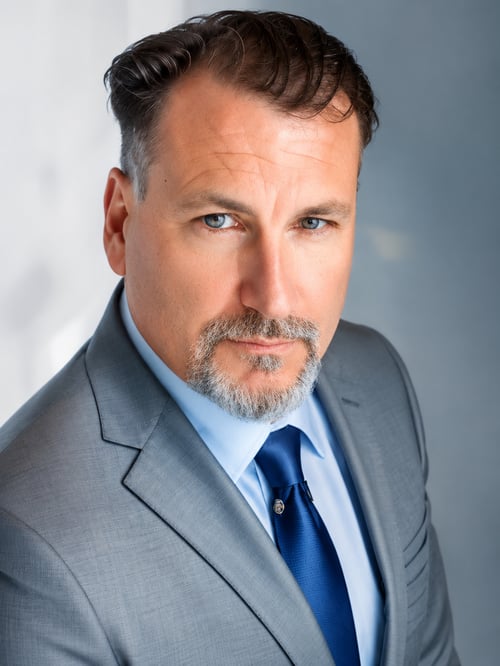
About Me
James Orsillo — Founder, Practical Asset Protection
James Orsillo didn't learn asset protection from a textbook, a law degree, or a seminar. He learned it from three decades of building businesses, lending his own money, and watching exactly what happens to wealth when it isn't protected — because for a stretch of his own life, it happened to him.
Twenty-Two Years Old and Already In Business
James started his first business, Pro Insulation, in San Diego at twenty-two years old. Most people that age are still figuring out what they want to do. James was already running crews, managing jobs, and learning what it actually takes to keep a small business alive month to month. From there he expanded, opening a second company, Des Moines Insulation, operating between San Diego and Portland, Oregon. Around that same period, he founded his engineering company — what would eventually grow into Systematic Inc., a semiconductor engineering company he built from the ground up.
This wasn't a straight line to success. It was the ordinary, grinding path of someone building real companies in real industries, learning the mechanics of business the only way that actually teaches anyone anything: by doing it, badly at first, then better.
The Lender's Side of the Table
As his businesses grew, James started doing something most business owners never do: he became a private lender. He loaned his own capital against restaurants, commercial real estate, and private residences. That single decision gave him a perspective almost nobody teaching asset protection actually has — he has sat on both sides of the transaction. He knows what a borrower looks like when a deal is about to go sideways, and he knows what a lender needs to see before capital is safe to deploy. That dual perspective — builder and financier — is the foundation of everything Practical Asset Protection teaches today.
Building the Fortress
As the businesses, the lending, and the real estate holdings grew, James did what any serious operator eventually has to do: he surrounded himself with people who knew things he didn't. Attorneys, structuring specialists, people who had already built and protected serious wealth. Together, over years, they built what James describes simply as an entire fortress — multiple land trusts, layered LLC holdings, commercial real estate positions, domestic trusts, and offshore trusts, all working together to protect what he'd built from the exact threats every successful business owner eventually faces: lawsuits, creditors, and the slow bleed of assets left exposed in plain sight.
He didn't learn this from a single course or a single advisor. It was assembled piece by piece, structure by structure, over years of trial and error — and error is the operative word. Even with a fortress in place, James built significant wealth over his career, and he also lost significant wealth. Not because the tools didn't work, but because building the fortress and building the business happened at different speeds, and the gaps in between are exactly where wealth gets exposed. By his own accounting, the tuition for those lessons ran into the millions of dollars — money paid not to any school, but to the school of hard knocks.
That period coincided with a broader personal reckoning. After roughly twenty years of marriage, James went through a significant life transition that put him on an unplanned, nomadic path — eventually leading him to Sedona, Arizona, where he underwent what he describes as a genuine personal transformation, one that reshaped how he approached both money and life going forward. The path continued from there: Hawaii, back across the mainland, and eventually overseas, where James now lives as an expat in Southeast Asia, currently based in Da Nang, Vietnam. He is the father of three adult children and remains an active, hands-on entrepreneur.
Why Practical Asset Protection Exists
Every structure James built — the land trusts, the LLC holdings, the domestic and offshore trusts — came from trial and error most people can't afford to go through themselves. He founded Practical Asset Protection to hand that knowledge to the people who need it most and can least afford to learn it the hard way: the working homeowner, the small landlord, the business owner who's finally making real money and just realized how exposed they actually are.
Practical Asset Protection prepares customized living trusts, land trusts, LLC formations, and equity stripping packages for California homeowners and property owners. Every document is drafted to the client's specific property, family situation, and goals — never a generic template pulled off a legal-forms website. The company coordinates with licensed attorneys and CPAs where appropriate, because the goal was never to replace professional counsel. It was to make sure the client walks into that professional relationship already informed, instead of paying — again — for an education James already paid for once.
The Books
James is the author of The House Is the Bank and the Safe Is Open, the founding title in the Practical Asset Protection library, written for California homeowners sitting on equity they don't realize makes them a target. It's the first release in a growing catalog built around three practical categories: Home Protection, covering the tools that shield real property from lawsuits, probate, and fraud; Marital Agreements, covering prenuptial and postnuptial structures as an underused asset protection tool in their own right; and Business Strategies, covering entity structuring, LLCs, and the compliance realities every business owner now faces under the current Corporate Transparency Act reporting regime.
More titles across all three categories are in active production. Readers who want early access and ongoing coverage of California statutory changes can find everything at practicalassetprotection.com.
The Standard
Every structure Practical Asset Protection builds, and every word James Orsillo publishes, is held to one standard:
Protect the years. Everything else is just paperwork.
— James Orsillo