
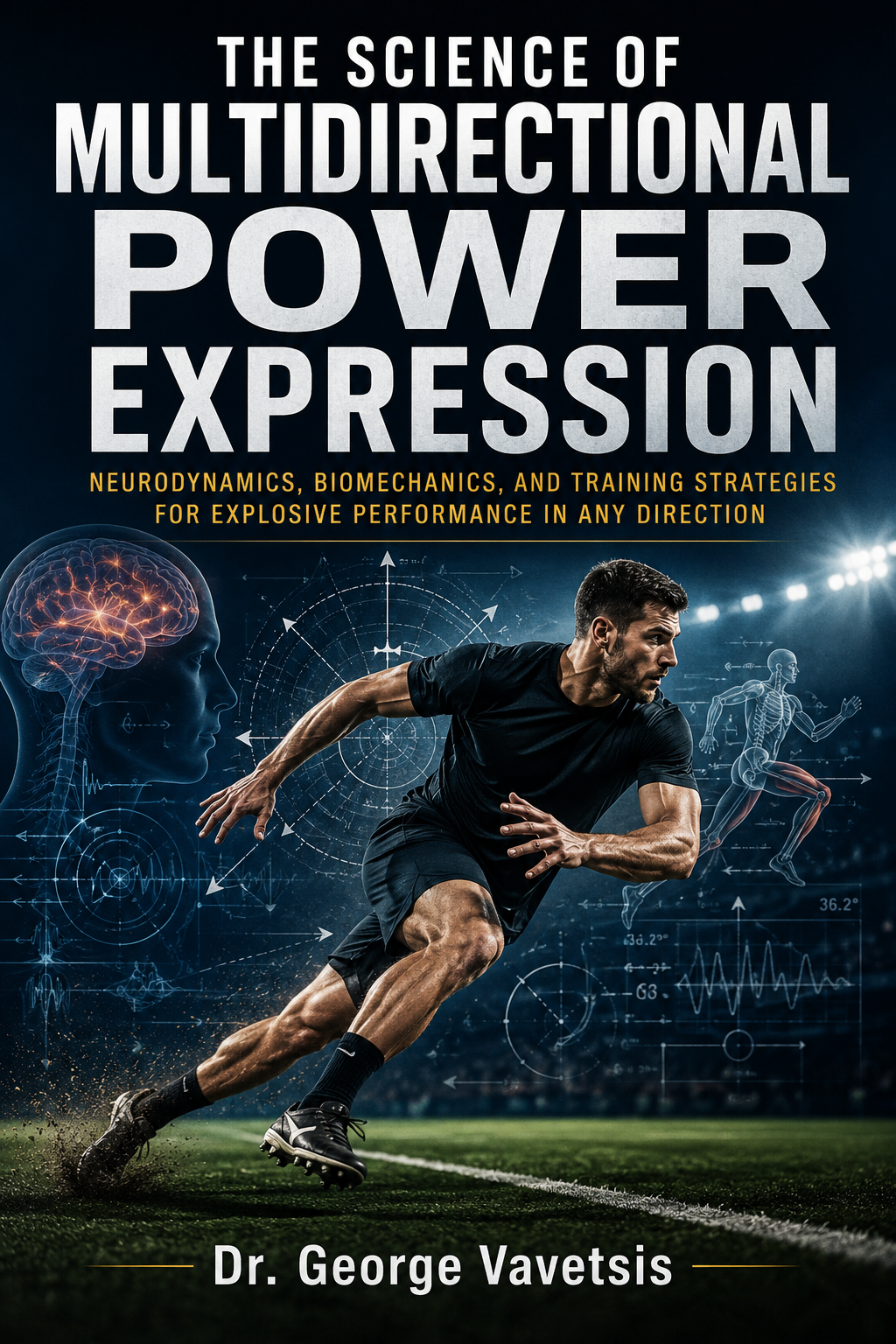
The Science of Multidirectional Power Expression
Pages: 1112
Explosive performance in sport has traditionally been interpreted through a narrow mechanical lens dominated by linear acceleration, maximal force production, and isolated expressions of muscular power. Yet the reality of elite athletic competition is profoundly more complex. Human movement in open-skill environments rarely unfolds in a predictable or unidirectional manner. Instead, athletes are continuously required to accelerate, decelerate, rotate, reorient, stabilize, react, absorb, and reproduce force across constantly changing spatial and temporal constraints. The true competitive separator is therefore not simply the ability to generate force, but the capacity to express power multidirectionally under perceptual, cognitive, biomechanical, and neurophysiological stress.
The purpose of this work is not merely to discuss speed, agility, or change-of-direction performance in conventional terms. Rather, it seeks to establish a comprehensive scientific framework for understanding how multidirectional explosive actions emerge from the interaction of supraspinal neurodynamics, cortical motor output, sensorimotor integration, force-vector redistribution, neuromechanical synchronization, and ecological movement adaptability. It is an attempt to move beyond reductionist training models and toward a systems-based understanding of athletic explosiveness.
Modern sport has evolved into an environment of extraordinary movement chaos. Basketball, football, handball, rugby, combat sports, volleyball, tennis, hockey, and many other disciplines require athletes to repeatedly solve high-speed movement problems under immense perceptual uncertainty. These environments demand rapid coupling between sensory information and motor execution. The athlete must perceive, decide, organize, and express movement within fractions of a second while simultaneously controlling momentum, body orientation, trunk stiffness, and force transmission through multiple planes of motion.
It emerges through the orchestration of cortical excitability, reticulospinal drive, motor-unit discharge variability, perception–action coupling, reactive ground-contact synchronization, and high-speed intermuscular coordination. Every acceleration, cut, braking maneuver, rotational reorientation, or reactive transition reflects the integrated output of a highly adaptive neuromechanical system. Understanding this system is essential for coaches, sport scientists, rehabilitation professionals, and performance practitioners seeking to maximize athletic capability while minimizing performance deterioration and injury risk.
The first is the neurophysiological dimension. Here, the reader will encounter concepts related to corticospinal excitability, intracortical inhibition–facilitation dynamics, sensorimotor integration, cortical motor-output plasticity, reticulospinal tract involvement, and neuroelectrical synchronization during high-velocity transitions. Explosive movement is treated not simply as a muscular phenomenon, but as a product of dynamic neural readiness and adaptive neural regulation.
The second dimension is biomechanical. Multidirectional athletic performance depends on the athlete’s ability to efficiently manipulate ground-reaction forces across vertical, horizontal, lateral, and rotational vectors. Force redirection, braking mechanics, eccentric impulse acceptance, frontal-plane stabilization, and transverse-plane control all contribute to successful movement execution. This book explores how these forces are transferred, absorbed, synchronized, and reproduced under real sporting conditions.
The third dimension is perceptual-cognitive. Open-skill sport is fundamentally reactive. Athletes must continuously process visual, auditory, spatial, and opponent-derived information while maintaining movement efficiency. Therefore, perception–action coupling becomes central to elite performance. Decision latency, false-step frequency, attentional allocation, sensory overload, and tactical recognition all influence multidirectional movement quality. Training must therefore integrate neurocognitive complexity rather than artificially separating physical and cognitive preparation.
The fourth dimension is ecological and adaptive. Human movement in sport cannot be fully understood through rigid deterministic models. Elite performance requires adaptability. The athlete must possess a movement system capable of reorganizing itself under unstable and unpredictable conditions. This includes the capacity to preserve coordination under fatigue, maintain force-expression quality during chaotic transitions, and generate stable movement solutions despite fluctuating environmental demands.
A major objective of this book is to bridge the gap between theoretical neuroscience and applied performance training. Scientific understanding alone has little value if it cannot be translated into effective training methodologies. Consequently, every chapter emphasizes practical integration for the strength and conditioning coach, performance specialist, or rehabilitation practitioner. Monitoring systems, drill design, reactive loading structures, neural fatigue management, perception–action integration strategies, and multidirectional force-development methods are discussed through an applied lens.
Importantly, this book does not advocate excessive complexity for its own sake. Elite performance environments already contain sufficient noise, variability, and pressure. The challenge for the practitioner is not to create confusion, but to create meaningful adaptation. The goal is to understand which forms of variability stimulate neural plasticity, which forms of complexity improve transfer, and which forms of overload ultimately impair performance quality.
Another central theme of this work is the importance of quality over quantity. High-density multidirectional training without neural management often leads to deteriorating decision speed, impaired coordination, reduced movement precision, and elevated injury risk. Multidirectional power expression is highly dependent on neural freshness, timing integrity, and sensorimotor synchronization. Therefore, intelligent volume control, strategic recovery integration, and readiness monitoring become indispensable components of high-performance programming.
The future of sports performance will increasingly belong to practitioners capable of integrating neuroscience, biomechanics, motor learning, perception–action theory, and ecological dynamics into coherent training systems. The era of purely mechanical conditioning is rapidly disappearing. Modern athletes require preparation models that reflect the true complexity of competition.
It is intended for coaches who wish to move beyond simplistic agility drills. For sport scientists searching for deeper neuromechanical explanations of explosive movement. For rehabilitation professionals attempting to restore multidirectional efficiency after injury. For performance practitioners seeking greater transfer between training and competition. And ultimately, for all those committed to understanding the extraordinary complexity of human movement under pressure.