
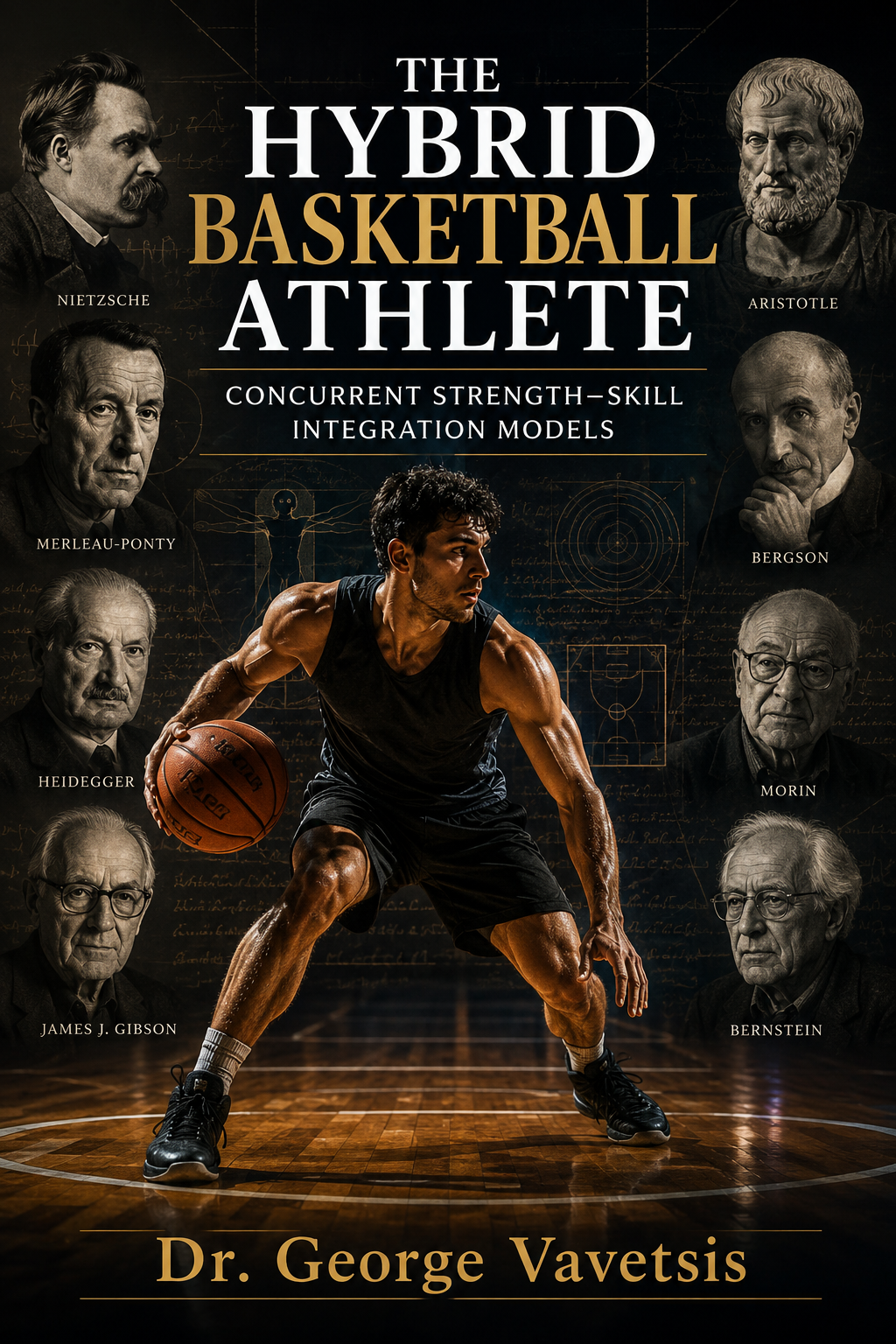
The Hybrid Basketball Athlete
Pages: 619
“Basketball is not merely played. It is embodied, perceived, negotiated, suffered, synchronized, and continuously recreated through the living interaction between force, consciousness, space, rhythm, and human intentionality.”
The modern basketball athlete no longer exists within the traditional borders that once separated strength from skill, conditioning from cognition, or physicality from creativity. The contemporary game has evolved beyond reductionist categorizations of the athlete as merely “strong,” “fast,” “skilled,” or “intelligent.” Instead, elite basketball now demands the emergence of a new archetype: the hybrid basketball athlete — an organism capable of simultaneously integrating neuromechanical robustness, tactical perception, ecological adaptability, and embodied decision-making into one coherent performance identity.
This book, The Hybrid Basketball Athlete: Concurrent Strength–Skill Integration Models, was born from the necessity to rethink basketball preparation not as the accumulation of isolated physical qualities, but as the orchestration of a living adaptive system. The athlete is not a machine composed of independent parts. The athlete is an evolving biological philosophy. The athlete is a complex adaptive structure embedded within an ever-changing ecological environment of constraints, affordances, rhythms, collisions, tactical uncertainties, and temporal pressures.
Traditional sport preparation has historically inherited the Cartesian fracture between mind and body. Strength training was treated as separate from technical development. Tactical cognition was detached from physiological adaptation. Basketball skill was often trained independently from the energetic, emotional, and perceptual conditions within which it truly emerges. Yet basketball itself rejects such fragmentation. The game demands simultaneous perception and action, simultaneous force absorption and tactical creativity, simultaneous emotional regulation and explosive execution. In reality, no movement in basketball is purely “physical” or purely “technical.” Every action is a neurobiological event shaped by intention, environmental information, fatigue, memory, perception, anticipation, and interaction.
The philosophical foundation of this work draws heavily from phenomenology, ecological dynamics, complex systems theory, and embodied cognition. Thinkers such as Maurice Merleau-Ponty, Martin Heidegger, James J. Gibson, Henri Bergson, Edgar Morin, and Nikolai Bernstein provide the intellectual architecture through which basketball performance can be understood not as mechanical repetition, but as emergent adaptive behavior.
From this perspective, basketball movement becomes embodied intentionality. The athlete does not simply execute motor commands. The athlete perceives opportunities, anticipates possibilities, negotiates constraints, and expresses tactical meaning through movement. A crossover dribble is not merely a biomechanical action. It is a temporal deception. A defensive slide is not simply locomotion. It is ecological negotiation within unstable space. A rebound is not only vertical force production. It is a dynamic contest of anticipation, leverage, timing, and positional intelligence.
The hybrid athlete therefore emerges as a self-organizing performance organism — autopoietic in nature — continuously reconstructing identity through interaction with training, competition, teammates, tactical systems, and adversity. This book rejects the obsolete idea that basketball development is linear. Adaptation is recursive. Growth occurs through cycles of destabilization and reorganization. Elite basketball performance is nonlinear, unpredictable, and deeply ecological.
Within these pages, strength is not presented merely as muscular capacity. Strength becomes tactical authority. Eccentric force becomes restraint. Isometric stability becomes structural intelligence. Rotational force transmission becomes tactical fluidity. Conditioning becomes rhythmic biological regulation. Agility becomes temporal intelligence under constraint. Collision tolerance becomes embodied resilience. Decision-making becomes emergent consciousness under compressed time. Every physical quality acquires philosophical significance because every physical quality influences how the athlete exists within the game.
This book also challenges the prevailing obsession with specialization too early in development. Basketball is fundamentally a multidimensional sport requiring perceptual adaptability, emotional elasticity, movement diversity, and tactical creativity. Over-specialized athletes often become fragile performers within unstable environments. Conversely, the hybrid athlete develops broad adaptive bandwidth — the capacity to solve evolving problems under varying physiological, tactical, and emotional conditions.
The concurrent integration models presented throughout this text are therefore not simply programming methods. They are philosophical systems of athlete construction. They aim to dissolve artificial barriers between:
- strength and skill,
- cognition and movement,
- fatigue and creativity,
- force and perception,
- biology and consciousness,
- tactical structure and adaptive freedom.
The practical implications for coaches are profound. Strength and conditioning can no longer function as an isolated department disconnected from tactical identity and movement ecology. Coaches must become architects of integrated adaptation. Training must reflect the complexity of competition itself. This requires ecological task design, perception-action coupling, perturbation exposure, multi-system periodization, neurocognitive loading, movement variability, and dynamic interaction between physical and tactical constraints.
Equally important, this book views basketball as a human phenomenon rather than merely a performance product. Athletic preparation is existential in nature. Athletes continuously negotiate identity, meaning, fear, resilience, confidence, aggression, and belonging through participation in the game. Basketball is not simply competition; it is a form of embodied expression. The court becomes a dynamic arena where biological, psychological, cultural, and philosophical dimensions converge into action.
At the elite level, victory rarely belongs solely to the strongest or fastest athlete. It belongs to the athlete capable of integrating perception, timing, rhythm, resilience, cognition, emotional control, tactical awareness, and physical preparedness into coherent adaptive functionality under chaos.
This book is dedicated to coaches, performance scientists, philosophers of sport, and athletes who refuse simplistic explanations of basketball excellence. It is written for those who understand that the future of basketball preparation lies not in fragmentation, but in integration; not in isolated capacities, but in emergent systems; not in mechanical repetition, but in intelligent adaptation.