
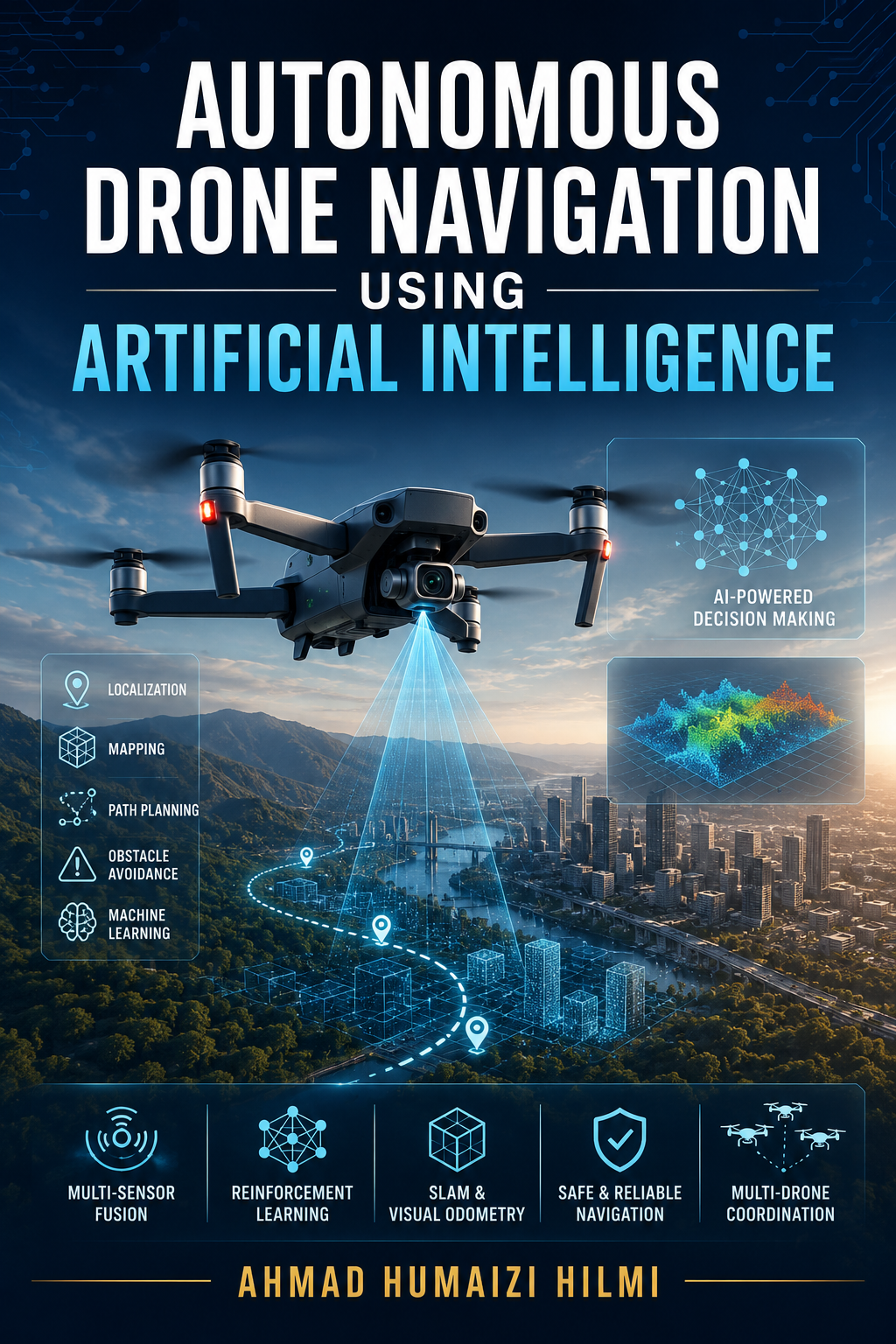
Autonomous Drone Navigation Using Artificial Intelligence
This review synthesises recent advances in autonomous unmanned aerial vehicle navigation across platform classes, sensing modalities, onboard software, algorithms and application domains, with the aim of characterising where research has advanced and where gaps remain. It compares platform trade-offs from agile quadrotors to long-endurance fixed-wing and stratospheric systems and summarises core subsystems that integrate IMU, visual, LiDAR and radio modalities for localisation and mapping. The survey traces the evolution from model-based control and formally grounded planners to data-driven perception and reinforcement-learning controllers, emphasising hybrid hierarchical architectures that pair global planners with learned local policies. Probabilistic and uncertainty-aware techniques, including Bayesian neural networks and Bayesian reinforcement learning, appear increasingly important for safety and GNSS-denied operation. Practical enablers such as multi-sensor datasets, ROS-based testbeds and UWB RTLS platforms have accelerated development, while field trials in medical delivery and disaster mapping demonstrate application viability. Persistent challenges include dataset diversity for adverse conditions, on-board computational and energy constraints, robust uncertainty quantification for certification, and standardized benchmarks for end-to-end safety evaluation.