
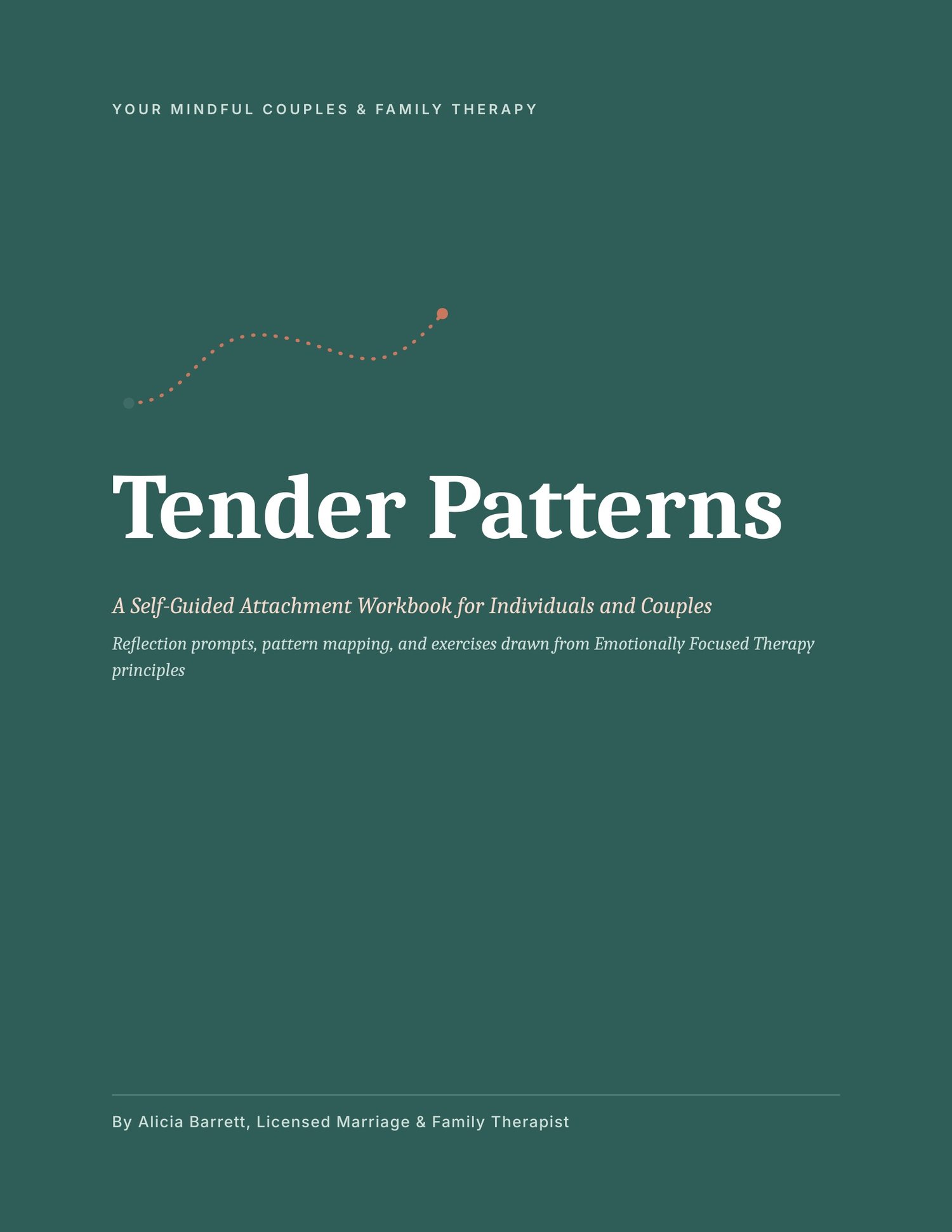
Tender Patterns A Self-Guided Attachment Workbook for Individuals and Couples
Ever notice the same painful moment showing up in different relationships? You reach harder, they pull back (or the other way around), and everyone ends up lonely in the same familiar place.
Tender Patterns helps you understand why. It’s built on attachment theory and Emotionally Focused Therapy (EFT) ideas, written in plain English by a licensed marriage and family therapist. There’s no jargon to decode and no pop-psychology labels to wear. It’s a warm, practical guide to your own patterns.
What’s inside (33 pages):
- A gentle self-check to help you notice whether you lean anxious, avoidant, or a mix (a reflection tool, not a clinical test)
- Guided prompts about the stories you learned early on and how they still show up
- A five-step “moment map” for slowing down a hard moment and seeing what really happened
- Body-based tools for the moments when you’re flooded and can’t think straight
- EFT-informed exercises for finding the softer feeling under anger, shutdown, or anxiety
- A four-conversation section for couples to do together
- Pattern-specific pages for anxious, avoidant, and fearful-avoidant tendencies
- A 21-day practice with one small action per day
- A feelings word bank, phrases to borrow, and space for your own notes
Who it’s for:
- Anyone curious about their attachment style and relationship patterns
- Individuals working on their own, and couples who want to start together
- People who like to reflect, journal, and take things at their own pace
How it works: It’s an instant-download PDF. Print it and write in it, or type into it. One part per sitting is plenty, and the whole thing fits comfortably into three weeks.
A note from me: I’m Alicia Barrett, a licensed marriage and family therapist. I’ve sat with many loving, committed people stuck in the same loop. The loop makes sense, and it can change.
This workbook is educational and not a substitute for therapy or mental health care. It isn’t the right tool if your relationship involves violence, threats, or fear. Safety resources are included inside.