
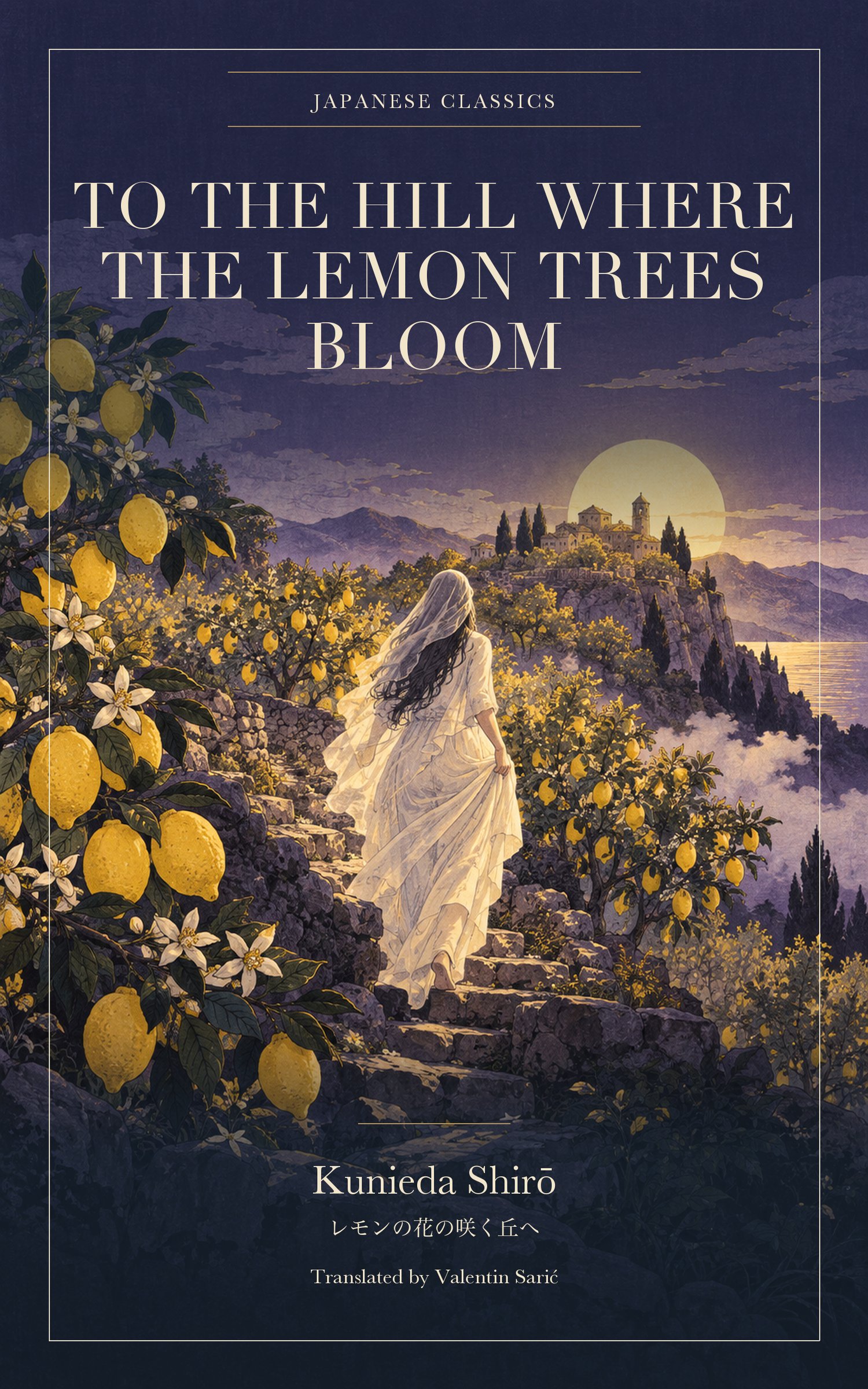
To the Hill Where the Lemon Trees Bloom
Kunieda Shirō is remembered for enormous swordsman serials. This was his first book, printed in 1910 when he was twenty-three, and there is not a sword in it. It is a volume of symbolist theatre called Exotic, dedicated to his elder brother Saburō, the one man who had loved him and sheltered him, and it opens with two poems set in place of a preface — a shamisen going through an autumn city, and Kimiyo-san of eighteen years with a tortoiseshell comb too old for her.
The Dying Mermaid is set in the age of knighthood, in the southern land where the lemon trees bloom. A Prologue in a priest's black robe with a crimson rose at his breast describes a festival of turquoise in mother-of-pearl boxes and a thousand voices chanting Santa Maria, and promises a play built on secret and violent love. A white-haired musician with a silver lyre walks into the Lord's hall, plays in F sharp minor — the measure of hell, he says, after which comes sleep and then death — and puts every knight and musician in the room to sleep on one knee. Then his white hair turns gold and his robe turns purple: he is F, the Sorcerer, and the Maiden follows him out into a moonlit poppy field on the tips of her feet.
For That Day has four walls painted grey, a pale blue light slanting from the ceiling, iron doors, and a barred window through which a black tower and a water gate can be seen. A maiden weaves at a loom on threads of five colours while her small brother Johanaan asks her, over and over, what is in the tower, and she keeps answering that there is no tower and nothing at all. Water flows in at the gate and never comes out again into the bright world. The play ends with a boy's hands on the bars, a voice going faint over the water, and a pitiless silence.
Everything here is borrowed from Europe and read at a distance — lemons, gondolas, poppies, blood-roses, Salome's Johanaan — by a young man who had never seen any of it. First English translation, complete and unabridged: both plays, the dedication and the two prefatory poems.
English-language digital edition. Translated by Valentin Sarić.
You receive: a 127-page PDF and an EPUB edition.
Digital download only. No physical book is shipped.