
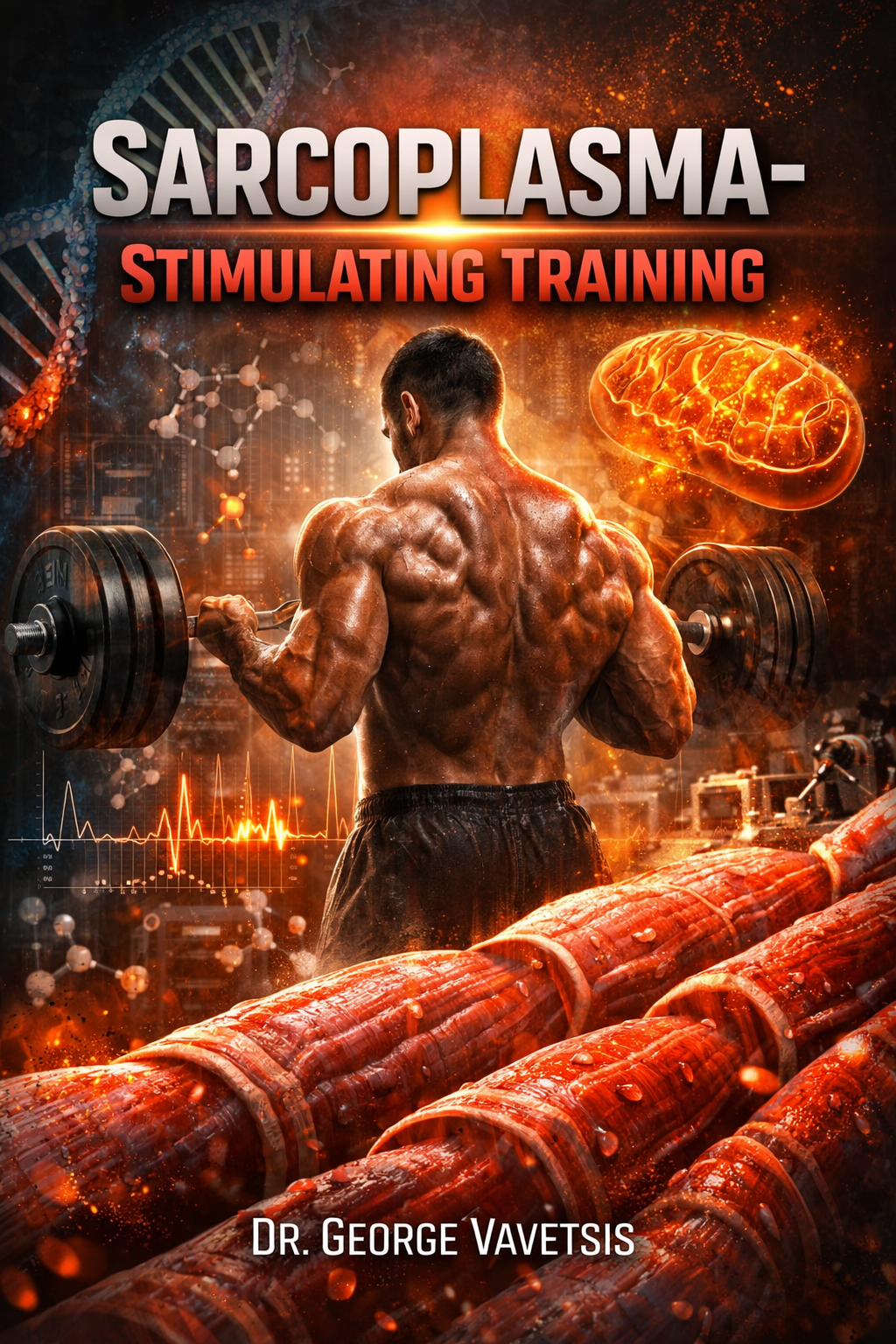
Sarcoplasma-Stimulating Training
Pages: 1180
Sarcoplasmic hypertrophy has long occupied an ambiguous position in the science of strength and conditioning. While myofibrillar accretion and the enlargement of the contractile apparatus have traditionally been regarded as the primary determinants of force production, power, and athletic performance, a growing body of cellular, molecular, and applied evidence demonstrates that the expansion of the sarcoplasmic compartment represents a distinct, highly functional, and strategically valuable form of muscular adaptation. Sarcoplasma-stimulating training does not merely “inflate” muscle fibers; it reorganizes the metabolic, ionic, enzymatic, vascular, and neuromuscular infrastructure that supports repeated force production under conditions of high energetic turnover and fatigue.
The sarcoplasm constitutes the dynamic biochemical environment in which excitation–contraction coupling, ATP resynthesis, calcium handling, redox signaling, and substrate trafficking occur. Increases in its volume and functional density alter diffusion distances, buffering capacity, enzyme concentration, mitochondrial distribution, and intracellular hydration, thereby reshaping the performance envelope of the muscle fiber. For the strength and conditioning coach, this adaptation is not an aesthetic or secondary phenomenon, but a critical determinant of power–endurance, repeated-sprint ability, fatigue resistance, and recovery kinetics across both training cycles and competitive seasons.
This book is founded on the premise that sarcoplasmic hypertrophy is governed by specific cellular and molecular mechanisms that differ qualitatively from those driving myofibrillar growth. Osmotic pressure shifts, glycogen-bound water accumulation, volume-regulated ion channels, mTORC1 spatial localization, HIF-mediated metabolic remodeling, mitochondrial proliferation, sarcoplasmic reticulum plasticity, and redox-sensitive signaling pathways collectively form a coherent biological framework for volumetric muscle adaptation. These processes are not random by-products of high-volume work; they are regulated, dose-dependent, and trainable through precise manipulation of load, density, time under tension, hypoxia, and metabolic stress.
From a neuromechanical standpoint, sarcoplasma-stimulating training reshapes the way motor units are recruited, sustained, and coordinated under conditions of progressive metabolite accumulation. Afferent feedback from group III–IV fibers, rate coding collapse, altered gamma-loop sensitivity, and central drive modulation converge to create a unique neural environment in which time under tension is prolonged and intracellular perturbations are amplified. The result is a training stimulus that preferentially expands the non-contractile but performance-critical components of the muscle fiber: glycolytic enzymes, buffering proteins, ion transporters, capillary networks, mitochondrial membranes, and sarcoplasmic reticulum cisternae.
For elite sport, the practical implications are profound. Volleyball rallies, repeated accelerations in soccer and basketball, prolonged clinches in combat sports, and sustained power outputs in endurance disciplines all depend on the ability of muscle to maintain force production in the presence of declining pH, rising inorganic phosphate, calcium cycling stress, and partial hypoxia. Sarcoplasmic density determines how effectively these challenges are buffered, how rapidly substrates are replenished, and how resilient excitation–contraction coupling remains under cumulative load. In this context, volumetric adaptation is not antagonistic to strength or power; it is the biological foundation upon which their repeatability and stability are built.
The purpose of this volume is therefore threefold. First, it aims to present a rigorous cellular and molecular explanation of sarcoplasmic hypertrophy, integrating contemporary knowledge from muscle physiology, biochemistry, neurobiology, and systems biology. Second, it seeks to translate these mechanisms into advanced loading paradigms, density models, and metabolic engineering strategies that can be implemented by high-performance coaches with precision. Third, it provides a monitoring and decision-making framework, incorporating ultrasound, bioimpedance, near-infrared spectroscopy, lactate kinetics, velocity loss, autonomic indices, and endocrine markers, allowing the practitioner to quantify sarcoplasmic adaptation rather than infer it indirectly.
Sarcoplasma-stimulating training must be viewed not as an isolated phase but as a strategically periodized component of long-term athletic development. When sequenced correctly with myofibrillar, neural, and tendon-focused blocks, it enhances the structural and metabolic readiness of the athlete, increases tolerance to training density, and stabilizes performance during congested competition calendars. Conversely, when misapplied, excessive volumetric stress can blunt rate of force development, disrupt calcium handling, and impose endocrine and autonomic strain. Mastery of this method therefore requires both biological understanding and programming sophistication.
Ultimately, this book is written for the strength and conditioning professional who seeks to move beyond simplistic dichotomies of “strength versus endurance” or “size versus function.” The sarcoplasm is not passive filler; it is an adaptive, plastic, and highly regulated medium that determines how effectively a muscle fiber survives, resists fatigue, and expresses power repeatedly. By elucidating its cellular foundations and providing evidence-based strategies for its targeted development, this work aims to equip the practitioner with a deeper, mechanistically grounded approach to training design—one that recognizes volumetric muscle adaptation as a central pillar of high-performance preparation in sarcoplasma-stimulating training.