
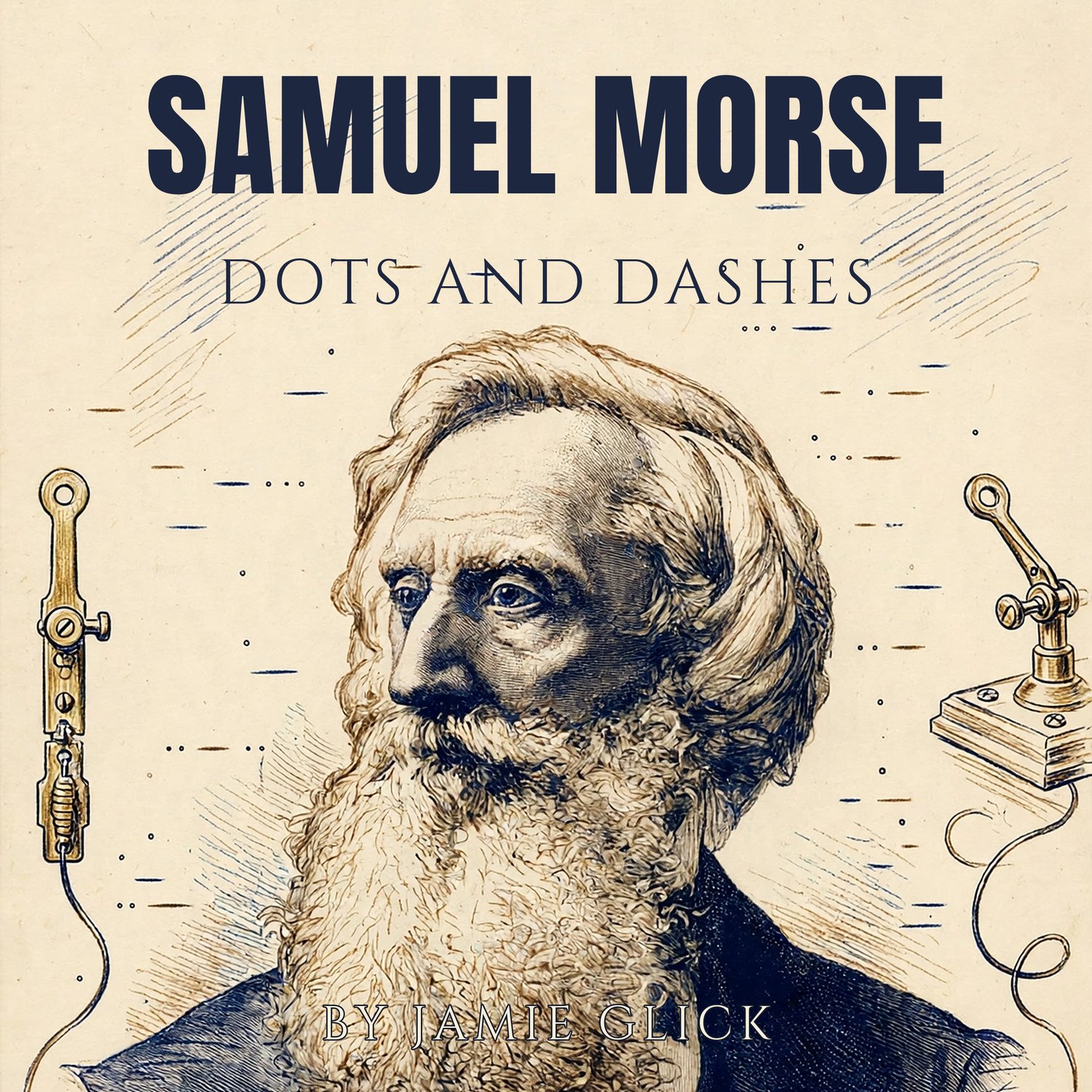
Samuel Morse: Dots and Dashes (Audiobook)
In February 1825, Samuel Morse was in Washington, painting the Marquis de Lafayette, when a letter finally reached him from home. His wife Lucretia was dead — had been dead for days, and was already buried. The news had traveled from Connecticut no faster than a horse could carry it, and Morse rode home carrying a lesson he never put down: the people we love can vanish while the word of it is still on the road.
Seven years later, aboard the packet ship Sully, a dinner-table conversation about electricity lit the fuse. Before the voyage ended, Morse had sketched a machine that could send intelligence instantly over a wire and record it at the far end. What followed was eleven years of poverty, ridicule, and refusal — a professor cooking his own meals beside his coils of wire, a Congress that joked about funding mesmerism while his bill hung by a thread — until, on the last night of the session in 1843, the Senate voted him thirty thousand dollars. On May 24, 1844, his line from Washington to Baltimore clicked out four words taken from the Book of Numbers: What hath God wrought.
In this sweeping audiobook biography — 10 chapters, over 10 hours of listening (10 hours 36 minutes, unabridged) — Jamie Glick traces the complete life of the painter who lost his wife to the speed of a horse and spent nineteen years building a machine that could outrun death itself: the minister's son who became America's most ambitious painter and founded its National Academy of Design; the widower, the dreamer, and the relentless promoter; the man whose partners and rivals — Alfred Vail, Joseph Henry, Ezra Cornell — made and nearly broke him; and the patriarch honored by the nations of Europe while the wires he strung carried a nation through civil war.
Inside, you will discover:
Chapter 1: A Minister's Son (1791–1811) — Born in Charlestown, still scarred by Bunker Hill, to the father of American geography — and raised in a parsonage that was half public building.
Chapter 2: The Painter's Ambition (1811–1815) — London, Benjamin West, and four years of talent, ambition, and money that never quite stretched far enough.
Chapter 3: Portraits and Heartbreak (1815–1825) — The portraits that built his name, the marriage that anchored his life — and the letter that arrived days too late.
Chapter 4: The Academy and the Atlantic (1825–1832) — Founder of the National Academy of Design, professor, and the art-world battles that left him celebrated and still broke.
Chapter 5: The Voyage of the Sully (1832–1837) — A dinner-table conversation about electricity on a packet ship, and a sketch that became the telegraph.
Chapter 6: The Partner and the Patent (1837–1840) — Alfred Vail in the workshop, Joseph Henry in the science, and the first hard questions of who invented what.
Chapter 7: The Thirty Thousand Dollars (1840–1844) — Congress jokes about mesmerism while his bill hangs by a thread — until the last night of the session.
Chapter 8: What Hath God Wrought (1844–1848) — May 24, 1844: four words from the Book of Numbers click down the wire from Washington to Baltimore.
Chapter 9: The Wire Wars (1848–1858) — Rival lines, patent battles, the Atlantic cable — the network grows faster than any one man can control it.
Chapter 10: The Patriarch of the Telegraph (1858–1872) — Honored by the nations of Europe, wealthy at last — and the harder chapters of his later years, told plainly.
The disputed stories are told with both sides in view, and the shameful ones plainly. Whether you know him only as a name attached to a code of dots and dashes, or have always wondered how a portrait painter rewired the world, this is essential listening — the life behind the machine that shrank the planet.
From the Bedtime Biographies library of more than one hundred full-length lives — history's most fascinating lives, told whole.
Format: MP3 audiobook, unabridged, 10 hours 36 minutes. Yours to download and keep forever — listen on any device, no subscription required.