
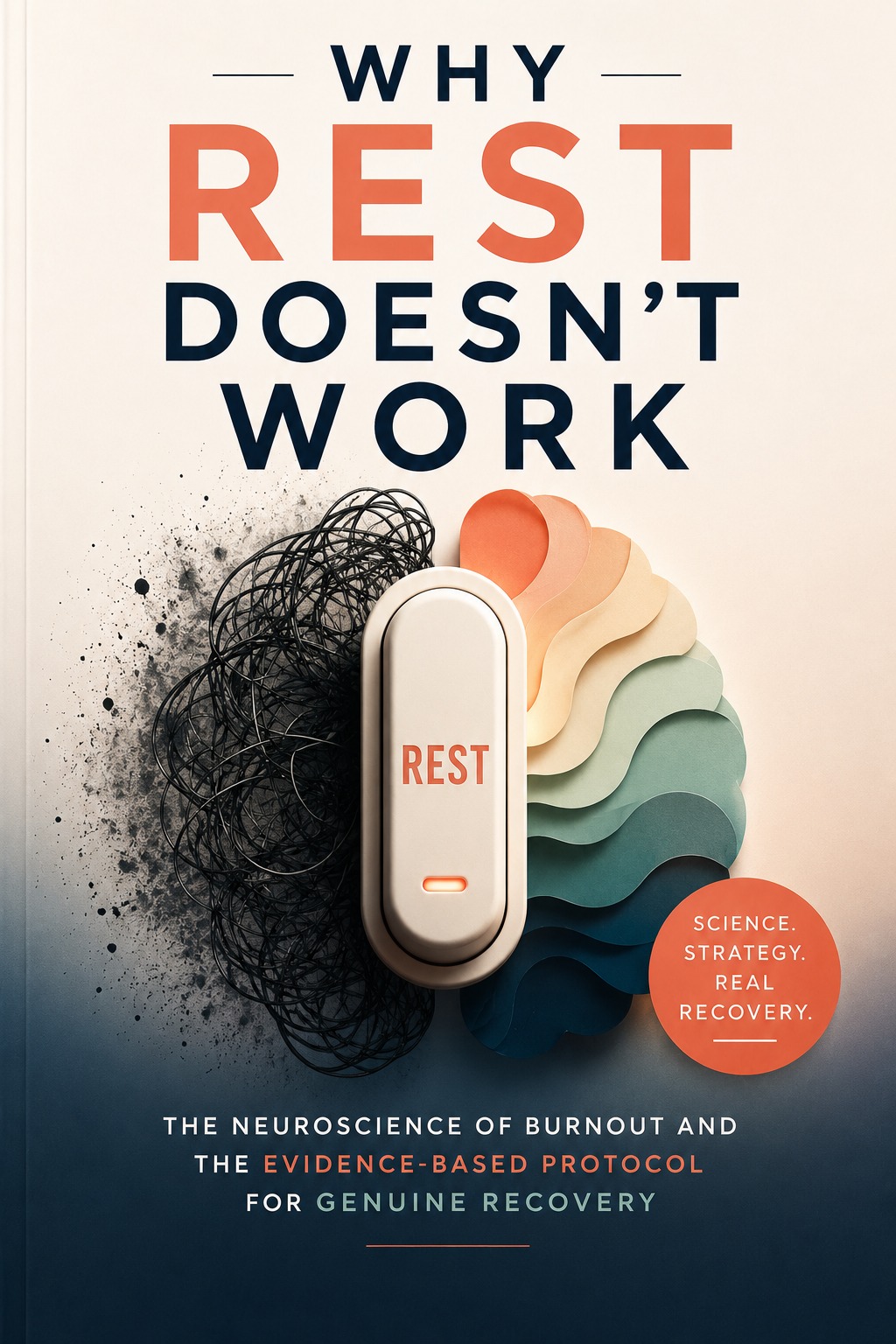
Why Rest Doesn't Work: The Neuroscience of Burnout and the Evidence-Based Protocol for Genuine Recovery
📘 [Format: Instant PDF Ebook Download]
You took the holiday. You slept in. You gave yourself permission to do nothing. And you came back just as exhausted as when you left.
This is not a personal failing. It is the recovery paradox — the defining feature of genuine burnout that most recovery advice completely ignores.
Burnout is not tiredness. It is a nervous system chronically locked in sympathetic overdrive — with a dysregulated stress response system, depleted vagal tone, a structurally compromised prefrontal cortex, and a default mode network that cannot find the gear of genuine rest even when all external demands are removed. Passive rest addresses the absence of demands. It does not address any of these biological changes. Which is why it fails — consistently, predictably, and without any reflection on the character or resilience of the person experiencing it.
Genuine recovery requires active recalibration. This guide provides it.
Why Rest Doesn't Work is a 50-Page Step-by-Step Guided Digital Workbook that covers:
— The burnout loop — how chronic stress becomes a self-reinforcing nervous system problem and why the loop tightens even when workload reduces
— The neuroscience of exhaustion — what burnout specifically does to the prefrontal cortex, amygdala, HPA axis, and default mode network — and why understanding these changes is the prerequisite for reversing them
— The four burnout profiles — Exhausted Achiever, Cynical Detacher, Anxious Overloader, and Empty Caregiver — with a personal audit to identify your pattern and prioritise your recovery tools
— The recovery paradox — why passive rest fails burned-out people and what the hierarchy of active recovery actually looks like
— The physical recovery toolkit — the physiological sigh protocol, the twenty-minute walk, and the sleep restoration system that is the foundation of every other recovery intervention
— The cognitive and emotional toolkit — cognitive defusion, the rumination interrupt, expressive writing, broaden-and-build practices, and the self-compassion protocol that accelerates recovery outcomes
— Structural changes that prevent relapse — workload management, boundary-building, the digital boundaries protocol, and social connection as biological recovery infrastructure
— The identity work — dismantling the achievement identity that made burnout inevitable and building the values-based identity that makes recovery permanent
— The long game — five daily anchor practices, the early warning system for relapse prevention, and the burnout-resilience framework that builds genuine long-term recovery capacity
Who this guide is for:
Anyone who has been burned out — or is burning out right now — and found that the standard advice to rest more, stress less, and take better care of themselves has not produced the recovery it promised. Anyone who is exhausted in the specific, hollow, flat way that only burnout produces. Anyone who is ready for the explanation that finally makes the recovery make sense.
You are not lazy. You are not weak. You are not broken.
You are a nervous system that has forgotten how to recover. This guide teaches it to remember.
📥 Buy your ebook now and instantly download your copy tonight to break the burnout loop and teach your nervous system how to recover.
Disclaimer
The information contained in this book is for educational and informational purposes only. It is not intended to serve as medical advice, psychological treatment, or a substitute for professional healthcare. The content reflects the author's research and understanding of publicly available scientific literature and is presented for general self-improvement purposes.
If you are experiencing severe exhaustion, depression, anxiety, or any other physical or mental health symptoms, please consult a qualified healthcare professional before making any changes to your lifestyle, routine, or treatment plan.
The strategies and tools presented in this book are evidence-informed but are not a replacement for professional medical or psychological care. Results vary between individuals and no specific outcome is guaranteed.
Pretty Minds and the author accept no liability for any loss, injury, or damage arising from the application of information contained in this book.