
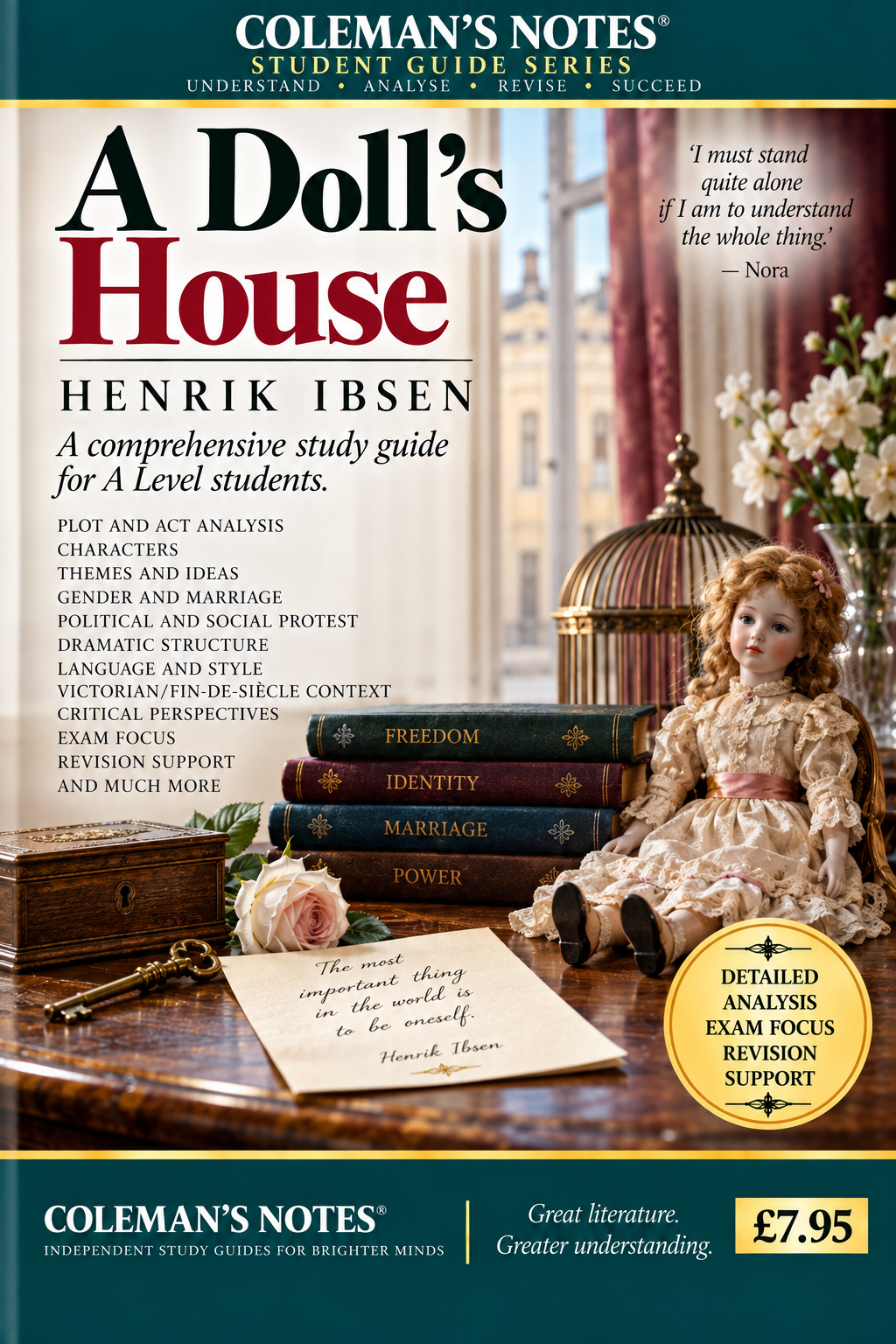
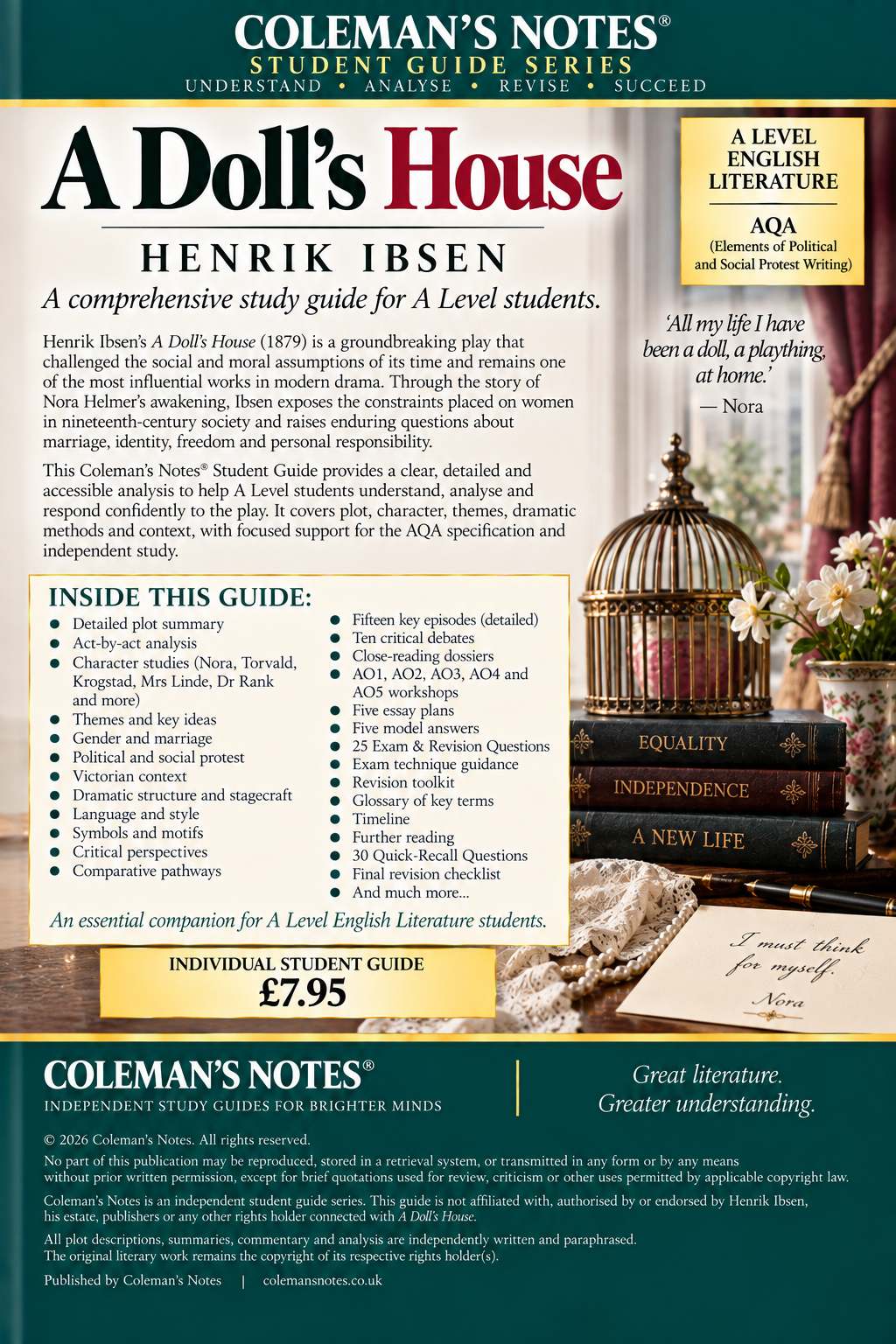
A Doll’s House — Henrik Ibsen | Coleman’s Notes A Level Student Guide
Marriage. Money. Respectability. Identity. And one of the most famous departures in modern drama.
Henrik Ibsen’s A Doll’s House transformed nineteenth-century theatre through its examination of marriage, gender roles, individual freedom and the pressures of respectable society.
At first, Nora and Torvald Helmer appear to enjoy a comfortable marriage. Gradually, however, the audience discovers the secret behind Nora’s financial dealings and the risks she took to save her husband. When Krogstad threatens to reveal what she has done, the foundations of the Helmers’ apparently happy household begin to collapse.
The resulting crisis forces Nora to reconsider not only her marriage but the identity that has been constructed for her as wife, mother and woman.
This Coleman’s Notes® Student Guide helps A Level students understand the play while developing the analytical skills needed to examine Ibsen’s dialogue, symbolism, dramatic structure, stagecraft and social context.
Inside This Guide
- Complete Plot Summary
- Detailed Act-by-Act Analysis
- The Helmer Household — Essential Reference Guide
- Main Characters & Relationship Map
- Nora Helmer in depth
- Torvald Helmer
- Nils Krogstad
- Kristine Linde
- Dr Rank
- Anne-Marie and the Helmer children
- Nora & Torvald’s Marriage
- Nora & Mrs Linde
- Krogstad & Mrs Linde
- Marriage & Domestic Life
- Gender Roles & Patriarchy
- Power & Control
- Money, Debt & Financial Dependence
- Freedom & Individual Identity
- Appearance versus Reality
- Secrets, Lies & Deception
- Reputation & Respectability
- Love, Duty & Sacrifice
- Parenthood & Responsibility
- Morality, Law & Social Judgement
- Self-Discovery & Transformation
- The Individual versus Society
- The Christmas Tree
- The Tarantella
- The Letterbox
- Macaroons
- Doors & Domestic Space
- Costume, Props & Symbolism
- Dramatic Irony
- Dialogue & Stage Directions
- Structure, Tension & Revelation
- Realism & the Well-Made Play
- The Significance of the Ending
- Nineteenth-Century Social & Historical Context
- Women, Marriage & Property
- Ibsen and Modern Drama
- Key Quotations & Analysis
- Essay Planning
- Model Answers
- 25 Exam & Revision Questions
- Quick Recall Revision
- Key Scenes for Close Analysis
- Critical Debates & Alternative Interpretations
- Exam Technique
- Final Revision Checklist
From the Doll’s House to the Closing Door
Is Nora initially a victim of Torvald’s control, or does she already possess significant independence? Does Torvald genuinely love Nora, or does he love the role she performs within his ideal household? How does money influence relationships throughout the play? Why are Mrs Linde and Krogstad important alternatives to the Helmers?
And how should we interpret Nora’s decision at the end of the play?
The guide helps students develop these questions into sophisticated A Level arguments, connecting character and theme with dramatic structure, symbolism, dialogue, stagecraft and historical context.
Perfect For
A Level English Literature students • examination revision • essay preparation • drama and literary analysis • teachers • tutors • independent learners
Coleman’s Notes® Student Guide Series
Designed to help students:
UNDERSTAND • ANALYSE • REVISE • SUCCEED