
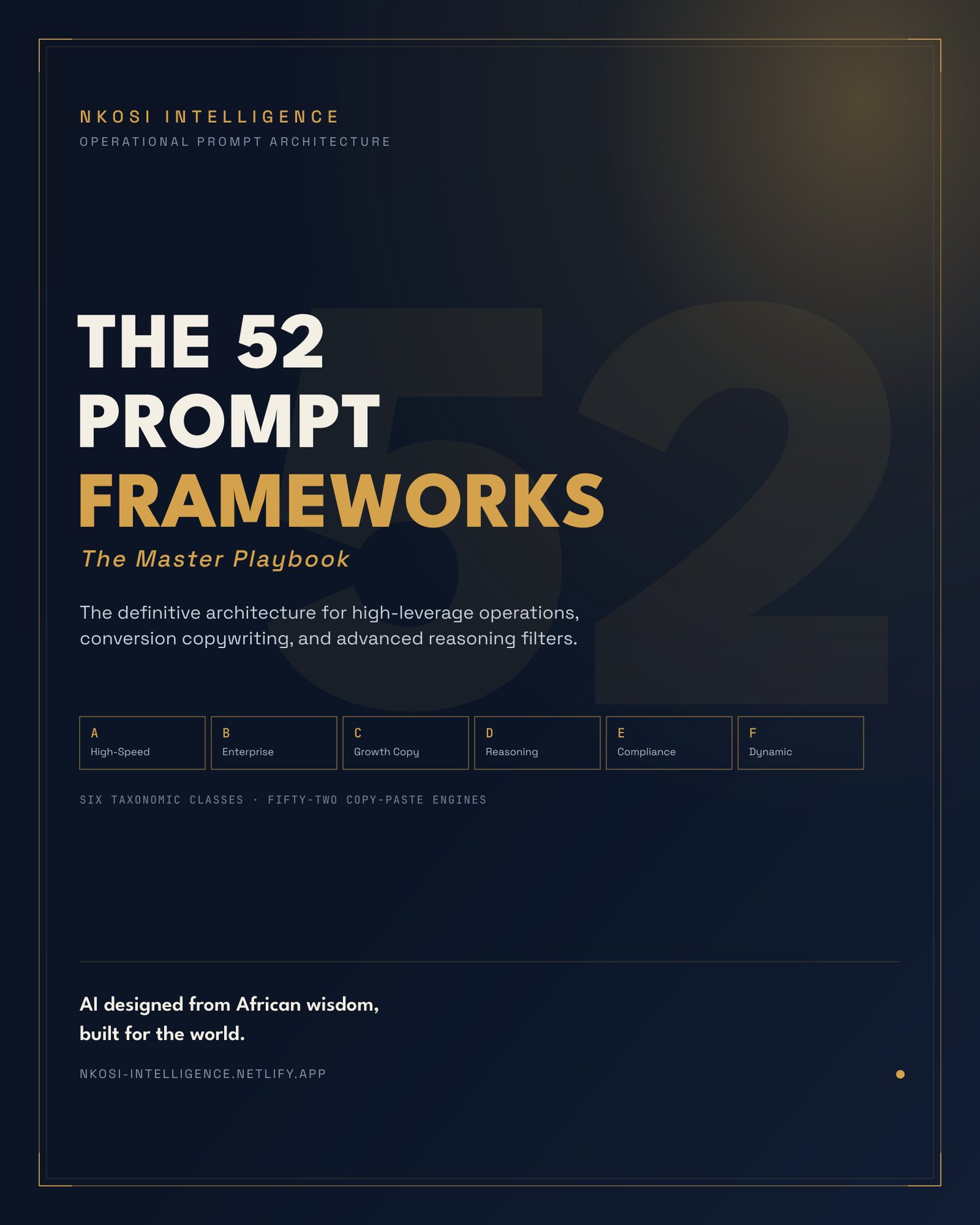
THE 52 PROMPT FRAMEWORKS: The Master Playbook
Most people treat AI like a casual search engine — typing vague, conversational commands and getting back equally vague, generic text. Then they spend hours manually rewriting it so it doesn't sound like a machine wrote it. That's not automation. That's a manual drafting problem traded for a tedious editing loop.
Large language models aren't creative thinkers. They're structural engines that respond to boundaries. Feed them an unorganized prompt and they default to the most generic, average text in their training data. Feed them an ironclad framework, and you activate a completely different processing path — one built for precision, not guesswork.
THE 52 PROMPT FRAMEWORKS: The Master Playbook is the structural reference that makes that shift permanent. It's not a list of "prompt tips." It's 52 named, tested, copy-paste engines — the same structural patterns used by elite consultants, forensic analysts, and direct-response copywriters — organized into six taxonomic classes so you always know exactly which engine to deploy and why.
Inside:
- The 10-Second Decision Matrix — match your task to the right class before you open a single template
Six taxonomic classes, 52 frameworks:
- Class A — High-Speed Efficiency (8 engines): rapid drafts, memos, zero-overhead admin
- Class B — Logic & Enterprise Strategy (8 engines): SOPs, workflow architecture, technical handoffs
- Class C — Growth Marketing & Copywriting (11 engines): direct-response copy, thought leadership, offers that convert
- Class D — Cognitive & Advanced Reasoning (13 engines): forensic analysis, multi-variable calculations, hallucination-proofing
- Class E — Guardrails, Risk & Compliance (7 engines): POPIA/regulatory audits, prompt-injection defense, system-level firewalls
- Class F — Dynamic & Interactive Loops (5 engines): AI-led discovery interviews, meta-prompting, cross-domain problem-solving
- Every framework includes a named engine, its strategic function explained in plain terms, and a ready-to-paste template with bracketed context tokens
- Five fully worked before/after examples — see the exact amateur prompt, the flawed generic output it produces, the architected version, and the locked, execution-ready result
- The Copy-Paste Execution Rules — the three protocols (Bracket Rule, Single-Run Rule, Chain Rule) that keep long-form builds from drifting
- Appendix: Thin-Tech Integration Layer — for anyone routing these frameworks through automated webhooks (n8n, Make, custom scripts)
Who this is for:
Consultants, agency operators, technical solopreneurs, and anyone using Claude, ChatGPT, or Gemini for real client-facing work — not casual chat. If you're still manually cleaning up AI output, this replaces that habit with a system.
Format: 38-page PDF, instant download. Bonus editable Word version included.