
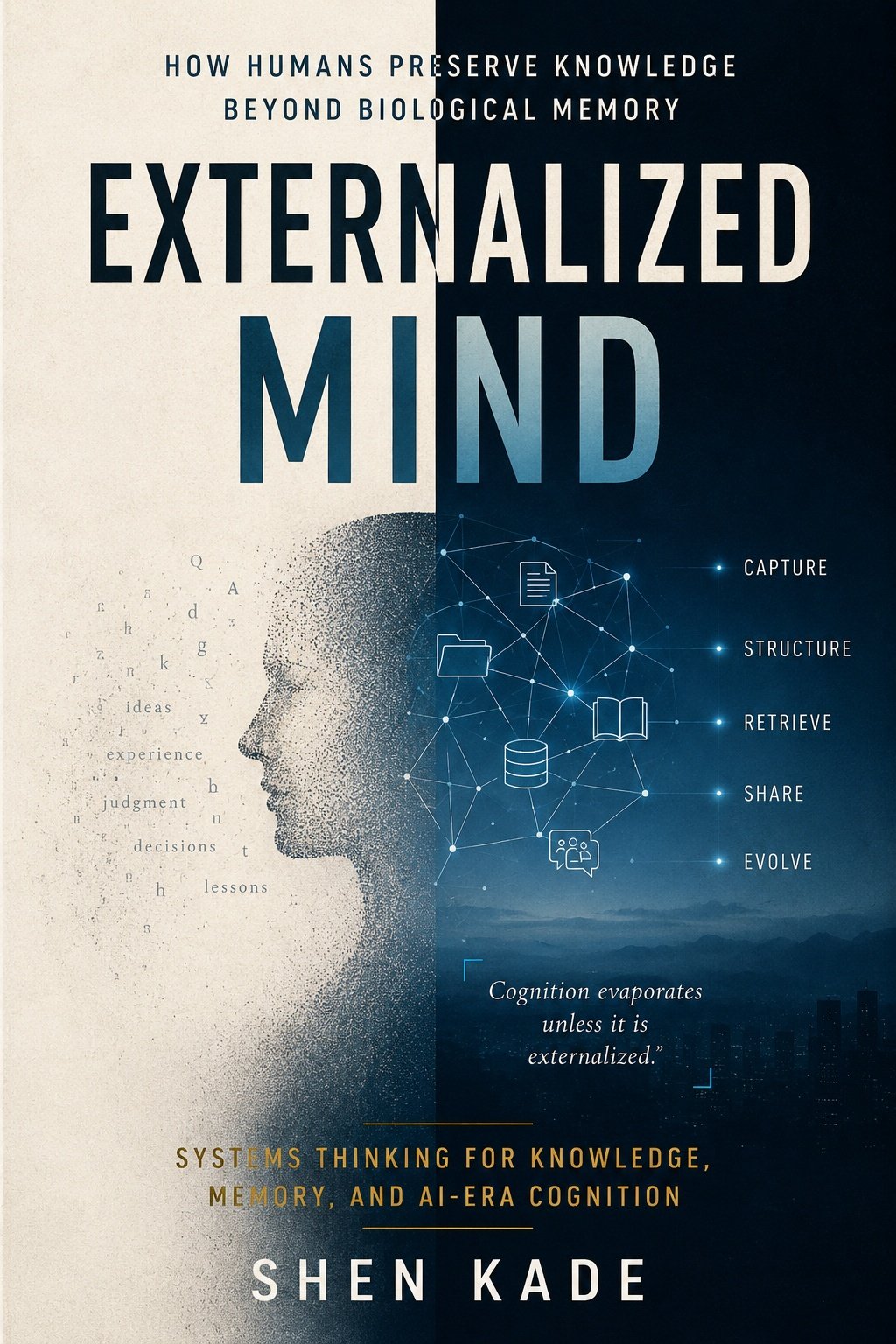
Externalized Mind
What if the biggest problem of modern knowledge work is not lack of information—but the evaporation of cognition itself?
In Externalized Mind, Shen Kade explores a simple but unsettling idea:
Human beings are not designed to store stable intelligence entirely inside biological memory.
We forget decisions. Teams repeat mistakes. Hard-earned judgment disappears. Organizations lose context faster than they create it. The modern world produces enormous amounts of information, yet very little durable operational wisdom.
This book argues that cognition survives only when it is externalized into systems that can be revisited, corrected, shared, and reused.
Blending systems thinking, organizational learning, cognitive science, personal knowledge management, and practical case studies, Externalized Mind examines:
Why experience alone does not create wisdom
Why judgment evaporates faster than facts
How low-friction capture systems preserve valuable thinking
Why shared documents become collective memory
How decision records prevent organizations from relitigating the past
Why most knowledge systems fail
How AI is transforming the political economy of memory
What it means to build “living knowledge” instead of dead archives
Rather than offering productivity hacks or rigid note-taking methods, this book presents a philosophy of cognition designed for real life: imperfect, overloaded, collaborative, and constantly changing.
For readers interested in:
systems thinking
personal knowledge management
organizational learning
note-taking systems
knowledge work
AI workflows
decision-making
digital memory
operational thinking
Externalized Mind is both a practical field manual and a philosophical exploration of how human intelligence survives across time.
read more at Externalized Mind — Systems Thinking for Knowledge & Memory