
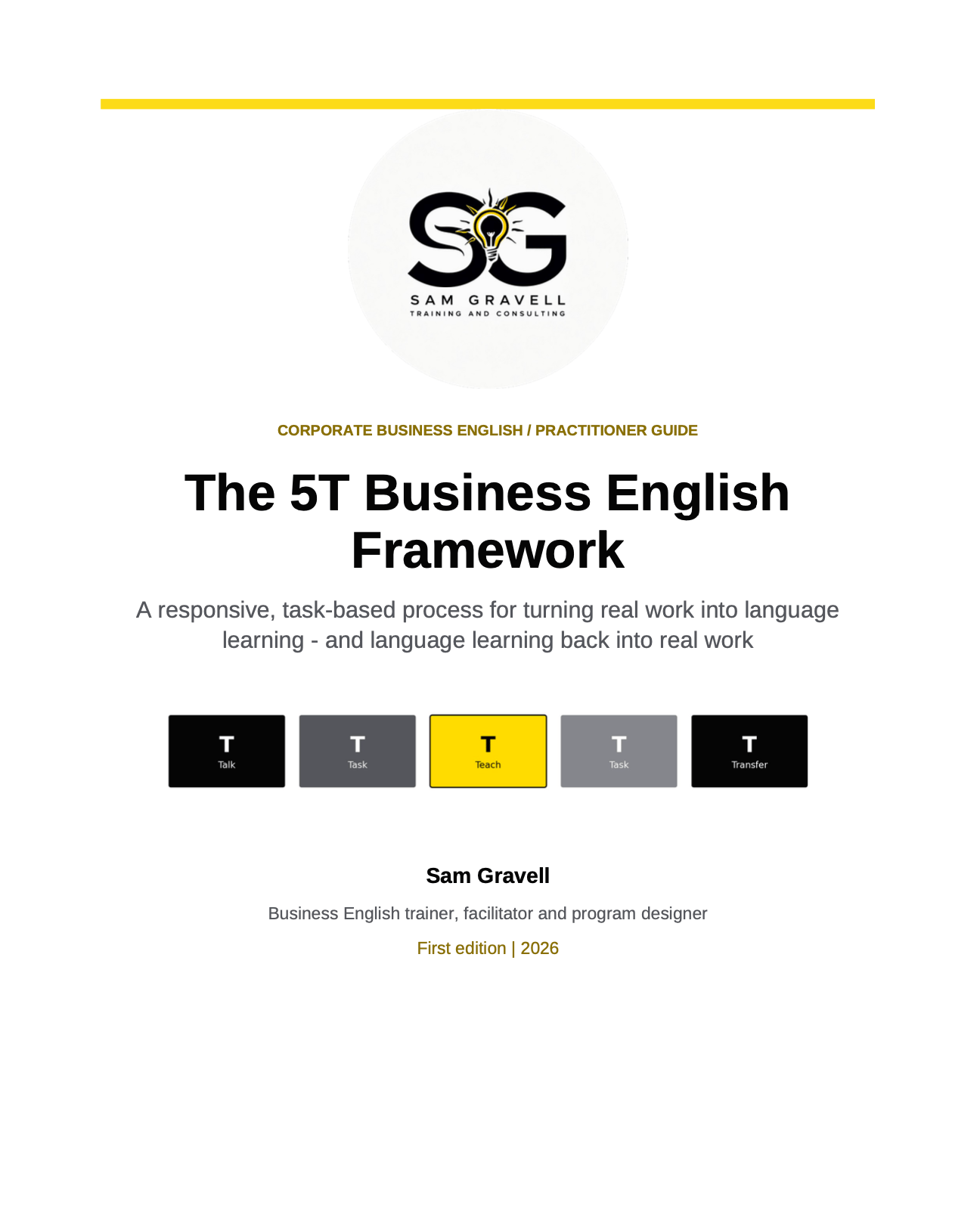
The 5T Business English Framework
The 5T Business English Framework
A practical guide to teaching around the work your learners actually need to do.
You’ve prepared a lesson. Then a learner arrives with a presentation tomorrow, an email they’re struggling to write, or a meeting that went badly. Half the group is missing. The people who attend have different roles and priorities.
How do you turn that into a coherent lesson—and feel confident that something useful will follow?
The 5T Business English Framework offers a dependable process for working with these everyday realities of corporate language teaching.
Written by Business English trainer and trainer developer Sam Gravell, this 76-page guide shows how to turn workplace conversation into meaningful tasks, focused teaching, improved performance, and planned application at work.
Does any of this sound familiar?
- You spend hours preparing materials that barely get used.
- You feel guilty when an urgent learner need takes the lesson away from your plan.
- Your initial needs analysis becomes outdated as projects, responsibilities, and participants change.
- Learners say they “just want to talk,” and you want to give that conversation a clear learning purpose.
- You notice plenty of emergent language but struggle to decide what deserves attention.
- Feedback becomes a long list of corrections, with little opportunity to apply them.
- Learners perform well in class, then struggle with the same communication at work.
- You need to explain the value of responsive teaching to managers, HR, or training providers.
The guide helps you make the decisions behind these moments: what to ask, what to build a task around, what to teach, what learners should attempt next, and how the learning can enter their working lives.
Five stages. A clear direction. Room for real people.
Talk: Discover what is happening in learners’ work. Use conversation to build relationships, explore current needs, and notice language.
Task: Turn a relevant situation into something learners need to accomplish: a decision, explanation, message, meeting, or plan.
Teach: Select language and communication support from the performance you observed.
Task again: Give learners another opportunity to apply that support. Repeat with a purposeful change or continue into the next natural step in the workplace workflow.
Transfer: Plan where and how learners will use the learning. Create practical resources together and bring their workplace experience back into the next session.
The sequence gives your teaching a stable structure while the content responds to the people and priorities in the room.
Developed through practice
My journey toward 5T began with CELTA and continued through the challenges of corporate training.
Discovering Dogme and Teaching Unplugged was freeing. Conversation, learners’ experiences, and the language emerging in the room could become the starting point for learning. Alongside that freedom, I needed a clearer structure for explaining the learning process to corporate stakeholders.
Task-Based Language Teaching gave me a powerful way to organize learning around purposeful performance. Implementing it also reinforced how often I needed to revisit needs analysis as learners’ work changed.
Over thousands of hours of training, observing lessons, supporting trainers, and exchanging ideas with colleagues, these influences gradually came together as 5T. The framework keeps conversation and people at the center, uses realistic tasks and research-informed language pedagogy, and gives workplace transfer deliberate attention.
This guide brings that evolving practice into a form other trainers can use.
Inside the guide
- Six chapters explaining the framework and each of its five stages.
- Workplace cases involving meetings, supplier emails, project updates, manufacturing data, and difficult conversations.
- Guidance for choosing emergent language and giving focused feedback.
- Two pathways for the second task: repetition with increased challenge and a dependent workflow follow-up.
- Practical tools for ongoing needs analysis, task design, feedback selection, and transfer planning.
- Twelve complete corporate task chains.
- Common failure modes, discussion questions, and suggested reading.
Who it’s for
Business English teachers, in-company trainers, teacher educators, and training managers who want a practical way to connect responsive teaching with purposeful workplace learning.
You can read the guide from beginning to end or start with the stage that causes you the most difficulty.
Download the guide and bring one current workplace challenge into your next lesson—with a clear process for helping learners work through it.