
Creator Payout Reconciliation & Bank Deposit Matcher
Creators get paid by five, eight, ten platforms at once — Gumroad on the 6th, Patreon on the 5th, YouTube on the 21st, Fiverr whenever it clears — and the money lands in one bank account as a pile of deposits with cryptic descriptions.
The question nobody can answer from memory is the simple one: did every payout I was promised actually arrive, in full, on time? Creators waste 3–4 hours every month reconciling payments from YouTube, TikTok, Patreon, and brand deals across multiple bank accounts — and the usual way it ends is a payout nobody noticed was missing until months later.
This workbook answers that question in one place. List the payouts each platform says it sent, list the deposits your bank actually received, and the Match sheet pairs them up by payout reference and tells you what is matched, what arrived short, what is overdue, and what deposit has no payout at all.
WHAT YOU GET
A formula-driven Excel workbook with 5 sheets:
- Start Here — the method, the matching rules in one paragraph, the worked example, why November 2026 is the moment, and the boundary with the other creator tools.
- Expected Payouts — one row per payout a platform owes you. Copy the gross amount, the fees withheld, and the expected date from the platform's payout statement. Expected net is formula-driven (gross minus fees). The payout reference is the key: it must match exactly what appears on your bank statement.
- Bank Deposits — one row per deposit in your bank account for the month. Copy the date, the account, the description exactly as the bank shows it, and the amount. Type the payout reference on each deposit. A deposit with no payout reference is not an error — it is the workbook doing its job, flagging money you cannot explain yet.
- Match & Exceptions — formula-driven, do not type in it. For each expected payout it looks up the deposit by reference and shows what arrived, the variance, how many days late it was, and a status: Matched, Partial (arrived short — check the difference), Overdue (nothing arrived and the expected date has passed), or Waiting (nothing arrived yet and the expected date has not passed).
- Dashboard — headline numbers: total expected, total received, still to arrive, match rate by payout count, reconciliation rate by money, unmatched deposits, overdue total, one next action, and a by-platform table so you can see which platform is the one that keeps you waiting.
WORKED EXAMPLE INCLUDED
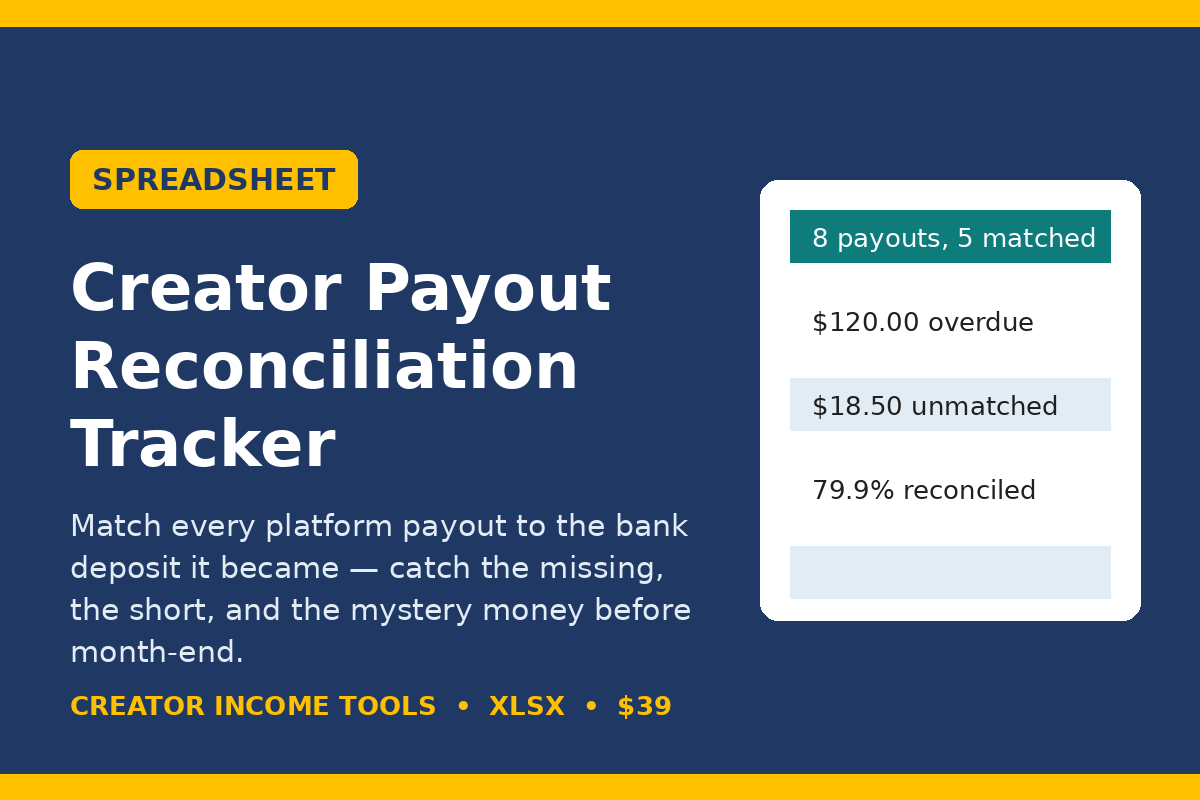
A fictional creator's October 2026 payouts, as-of 2026-11-25 — all formula-checked. Eight payouts expected: gross $967.00, fees withheld $91.63, expected net $875.37. Seven bank deposits totalling $717.61, six of them matched to a payout. Result: 5 Matched, 1 Partial (TikTok TT-1112 arrived $61.85 against $63.20 expected — $1.35 short), 1 Overdue (Fiverr FV-1115, $120.00, expected 2026-11-15, nothing arrived), 1 Waiting (Payhip PH-1120, $54.91, expected 2026-11-26). Received $699.11, still to arrive $176.26, match rate 62.5% by count, reconciliation rate 79.9% by money. One deposit is unmatched: $18.50 labelled STRIPE TRANSFER with no payout reference — investigate before spending it. Ko-fi KF-1108 arrived one day late and still counts as Matched. Delete the example rows and start with your own month.
THE MATCHING RULES, IN ONE PARAGRAPH
A payout is Matched when the deposit equals the expected net to the cent. It is Partial when money arrived but the amount differs — a short payment, a currency conversion, a fee you did not expect — and the variance column shows exactly how much is missing. It is Overdue when nothing arrived and the expected date is in the past: that is the one to chase first, with the platform's support and the payout reference in hand. A bank deposit with no payout reference is Unmatched: it might be a payout whose reference you mistyped, a refund, or money from a platform you forgot to list — find out which before you spend it. Run this once a month, on the same day, and a missing payout can never hide for more than thirty days.
WHAT IT IS NOT
This tracker records expected payouts, bank deposits, and their match. It is general information, not accounting, tax, or legal advice: payout schedules, fees, thresholds, and holding periods change by platform and by country, so check each platform's payout page for your own terms. Fees in the worked example are the platform's stated rates as reported in November 2026 (Fiverr 20%, Ko-fi 5% platform fee, Payhip 5%) — your own statements are the source of truth, and the fees column is yours to correct. Never invent a payout or a deposit: every row must come from a platform statement or a bank statement. A Matched status means the amounts agree, not that the platform paid you correctly — if a platform under-reports the gross, the tracker cannot see it. Reconcile monthly, keep the statements, and ask a qualified accountant if a missing payout affects your tax position.
Run it once a month, on the same day. A missing payout found in week one is a support ticket; the same payout found in month three is a dispute.