

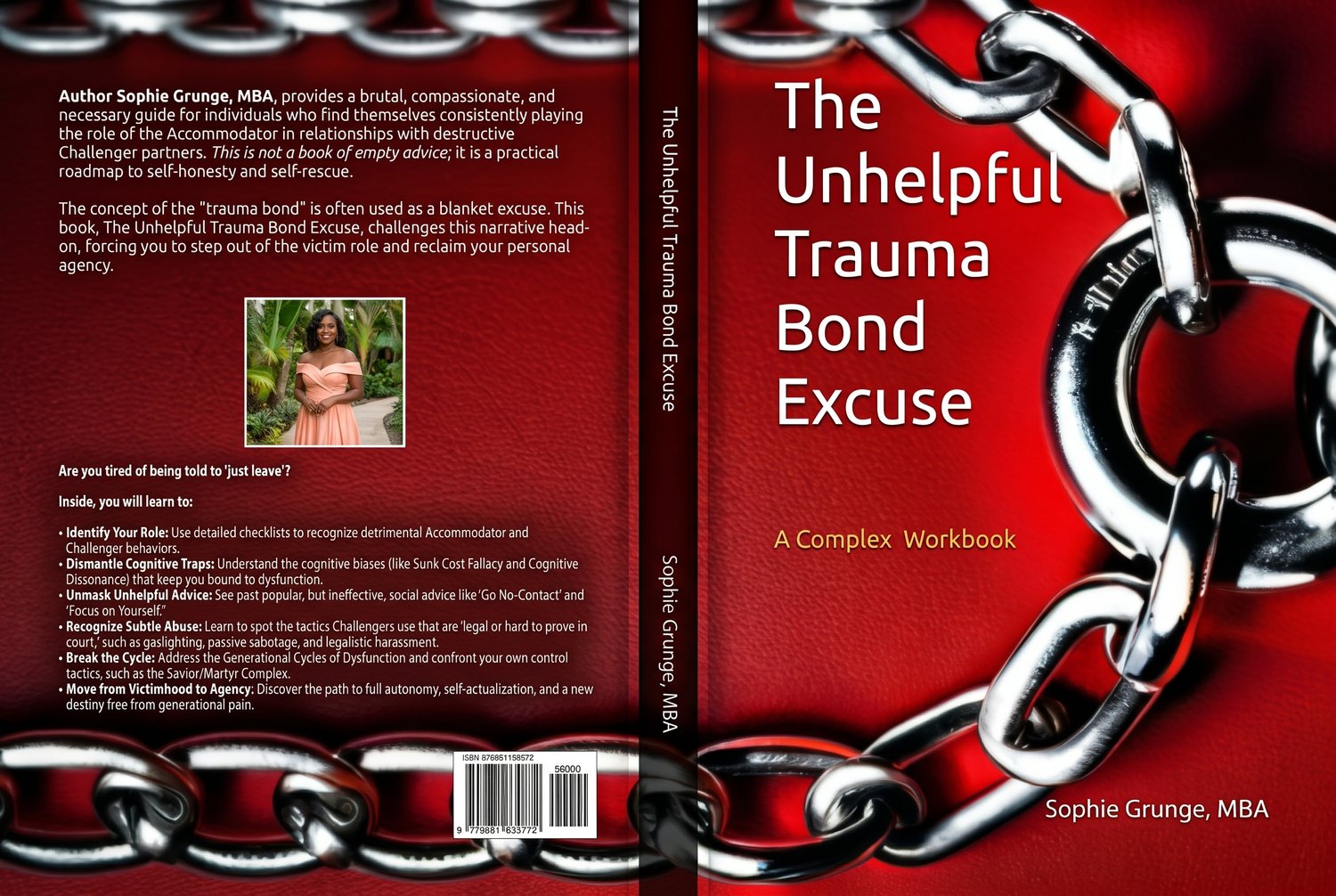
The Unhelpful Trauma Bond Excuse (ebook)
Author Sophie Grunge, MBA, provides a brutal, compassionate, and necessary guide for individuals who find themselves consistently playing the role of the Accommodator in relationships with destructive Challenger partners. This is not a book of empty advice; it is a practical roadmap to self-honesty and self-rescue.
Are you tired of being told to "just leave"?
The concept of the "trauma bond" is often used as a blanket excuse. This book, The Unhelpful Trauma Bond Excuse, challenges this narrative head-on, forcing you to step out of the victim role and reclaim your personal agency.
Inside, you will learn to:
- Identify Your Role: Use detailed checklists to recognize detrimental Accommodator and Challenger behaviors.
- Dismantle Cognitive Traps: Understand the cognitive biases (like Sunk Cost Fallacy and Cognitive Dissonance) that keep you bound to dysfunction.
- Unmask Unhelpful Advice: See past popular, but ineffective, social advice like "Go No-Contact" and "Focus on Yourself."
- Recognize Subtle Abuse: Learn to spot the tactics Challengers use that are "legal or hard to prove in court," such as gaslighting, passive sabotage, and legalistic harassment.
- Break the Cycle: Address the Generational Cycles of Dysfunction and confront your own control tactics, such as the Savior/Martyr Complex.
Move from Victimhood to Agency: Discover the path to full autonomy, self-actualization, and a new destiny free from generational pain.
Introduction & The Core Signs: The Anti-Validation Warning
- In the opening sections and the first chapter, Sophie Grunge immediately establishes a zero tolerance policy for emotional coddling. She argues receiving validation for being in a trauma bond actually keeps individuals trapped within it. If a reader seeks gentle reassurance from a therapist, she explicitly advises them to put the book down. Her confrontational and highly pragmatic approach uses a self assessment checklist right out of the gate to force the reader to confront the frequency of their dysfunction. This shifts the focus from feeling to actual events.
Chapter 1: The Unhelpful Trauma Bond Excuse
- Grunge then dismantles the traditional Abuser versus Victim binary, replacing it with the Challenger versus Accommodator dynamic. She posits the term trauma bond acts as a crutch excusing the active participation of the Accommodator in the dysfunction. She argues that when both parties enter consensually, the martyr complex and enabling behaviors of the Accommodator are equally responsible for perpetuating the cycle that the "trauma bond" excuse fails to address. With a clinical and direct tone, she utilizes structured reflection checklists forcing the reader to rate their own detrimental behaviors. This effectively strips away their perceived victimhood.
Chapter 2: Social Responsibility and Solutions
- The second chapter critiques how human psychology and standard societal advice fail those in harmful dynamics. Grunge tears apart common platitudes calling them vague, victim blaming, and fundamentally useless without guaranteed logistical and financial support. She shifts from diagnosing the problem to demanding social responsibility, outlining exactly how friends and communities must offer concrete safety nets like money, shelter, and transportation rather than empty advice.
Chapter 3: Challengers and Solutions
- Moving into the third chapter, she takes a cold and calculating look at Challengers and how they exploit legal gray areas including infidelity, passive sabotage, and legalistic harassment. She rejects the idea these behaviors are innocently accidental and factually proves them as calculated predatorial tactics. The reading experience may feel tactical and controversial as she advocates for unconventional deterrence. She encourages certain situations where mirroring the behavior of the Challenger to expose double standards, documenting intelligence, and orchestrating community level shunning are necessary. The material reads less like a psychological support guide and more like a tactical, strategic manual for survival.
Chapter 4: Accommodators and Solutions
- The fourth chapter tackles the darkest and most lethal aspects of domestic dysfunction. She argues Accommodators often act like prey, which inherently emboldens Challengers to escalate their predatorial behaviors. The author asserts Challengers can be deterred if the Accommodator transforms into an equal threat by enforcing severe and strategic consequences. When addressing physical violence or lethal threats, she introduces the Death or Prison dilemma and the Disappear and Sacrifice strategy. The tone remains strictly survivalist, stripping away all romanticized notions of love to focus purely on self preservation, strategy, and assessing lethality.
Chapter 5: Breaking Generational Cycles of Dysfunction (GCD)
- The fifth chapter flips the script on the Accommodator by highlighting the hidden power and control they wield. She argues Accommodators control the duration and intensity of the dysfunction using tactics like the Fixer trap, people pleasing, and inconsistent intimacy avoidance. She also tackles the morality of procreation, stating having children in these environments is an act of carelessness and egoism. Her deeply psychological approach introduces the Radical Honesty Filter and the Reverse Dictate tactic, forcing the reader to aggressively confront their own covert manipulation and the ethical weight of passing trauma onto a new generation.
Chapter 6: Recognizing Unhelpful Distinctions (Part 1)
- In the sixth chapter, the author forces the reader to confront their own self deception through harsh dichotomies. She demands the reader differentiate between Verifying the character of a partner versus being Careless during the vetting process, genuine Attraction versus Ideation, and healthy Acceptance versus harmful Tolerance. She argues denial is not confusion, noting it is an active and self imposed psychological defense sustaining generational cycles. Her interrogative style uses comparative frameworks to corner the reader into admitting where they have abandoned objective reality in favor of a comfortable and destructive fantasy.
Chapter 7: From Victimhood to Agency
- The seventh chapter makes a rigid distinction between being an undeniable victim of an event, having a victim mentality using past trauma to avoid present accountability, and victim blaming driven by the need to control an unpredictable world. She introduces the concept of Response Ability denoting the absolute control one has over their reaction to uncontrollable external events. Empowering and stern, she utilizes the Control Spectrum to map out exactly what is and is not within human control. She demands the reader stop trying to manage the dysfunction of their partner and start managing their own values and autonomy.
Chapter 8: Recognizing Unhelpful Distinctions (Part 2)
- The eighth chapter attacks popularized pop psychology labels. She argues the Empath label is often a mask for a superiority complex, adding that Mercy shown by staying with a broken partner is actually an act of cruelty to both the partner, self, and any future children. She breaks down trauma responses to prove these are nervous system reactions rather than personality traits. Grunge systematically destroys Generational Fantasy Cycles with brutal reality checks in a highly deconstructive manner, forcing the reader to abandon magical thinking and commit to incremental and unglamorous daily effort.
Chapter 9: Personal Advice from the Author
- In the final chapter, she delivers her most controversial critique by attacking the mental health industry reliance on intrinsic self worth and validation (how the industry fails to use the word love which dismisses the primary cause of remaining in relationships in the first place). She argues therapists who tell struggling individuals to never settle, or else they must have low self worth/esteem/respect, are blind to socioeconomic reality. She introduces Extrinsic Value detailing the reality that environment, wealth, and social standing severely determine the range of options for a person. This makes their choice to stay in a bad relationship a rational survival calculation rather than a character flaw or poor self-view of their intrinsic value. Philosophical and socio economic, she targets the Stay and Complain epidemic, forcing the reader into a binary choice to either radically accept the relationship and find joy in a situation they are consciously choosing to remain in despite various other options, or strategically leave. Complaining is framed as an unacceptable and energy wasting purgatory that creates isolation from those that wish to help or offer genuine support.