
GMAT Verbal Drill Book
The GMAT Verbal section has seven Critical Reasoning question types. Most prep resources mix them together. This book drills them one at a time.
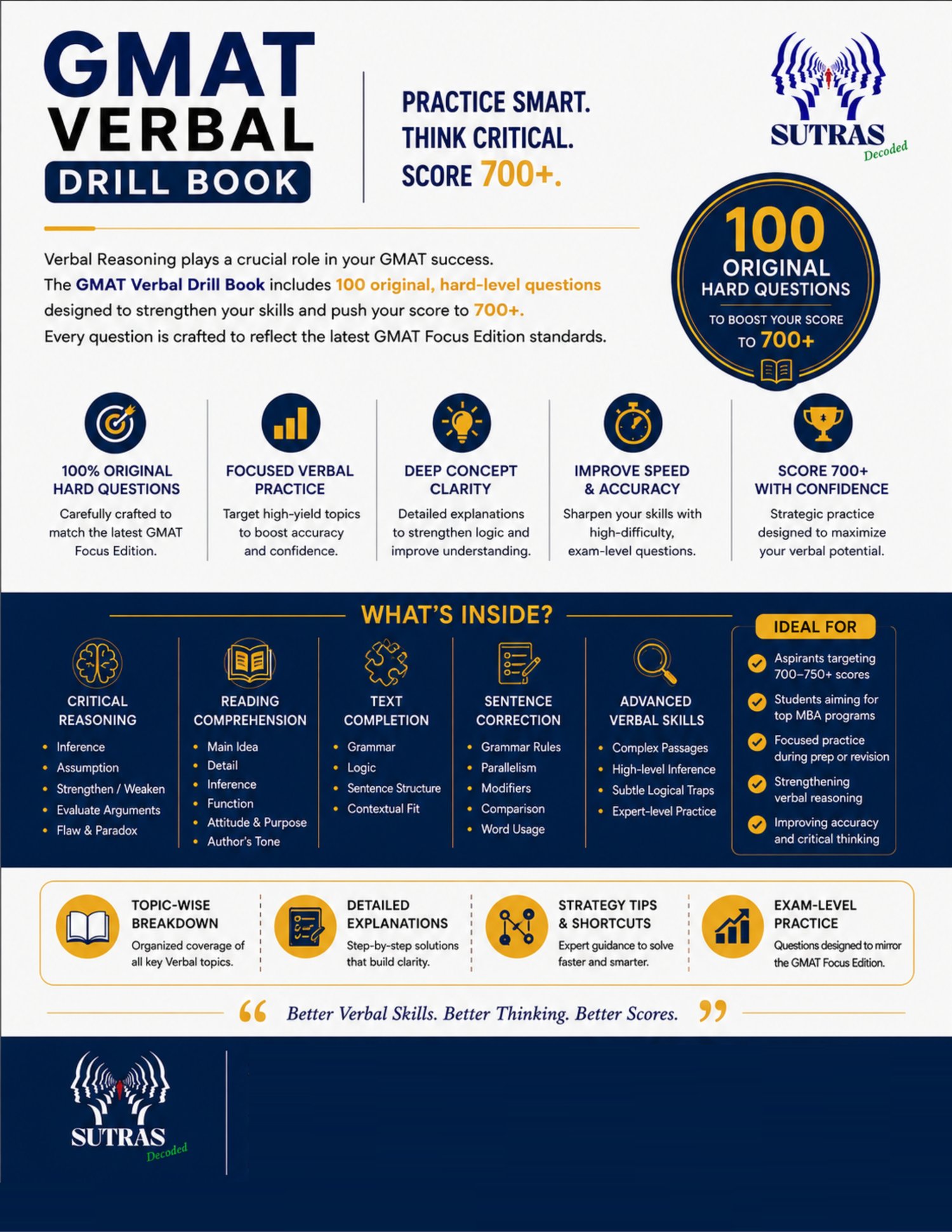
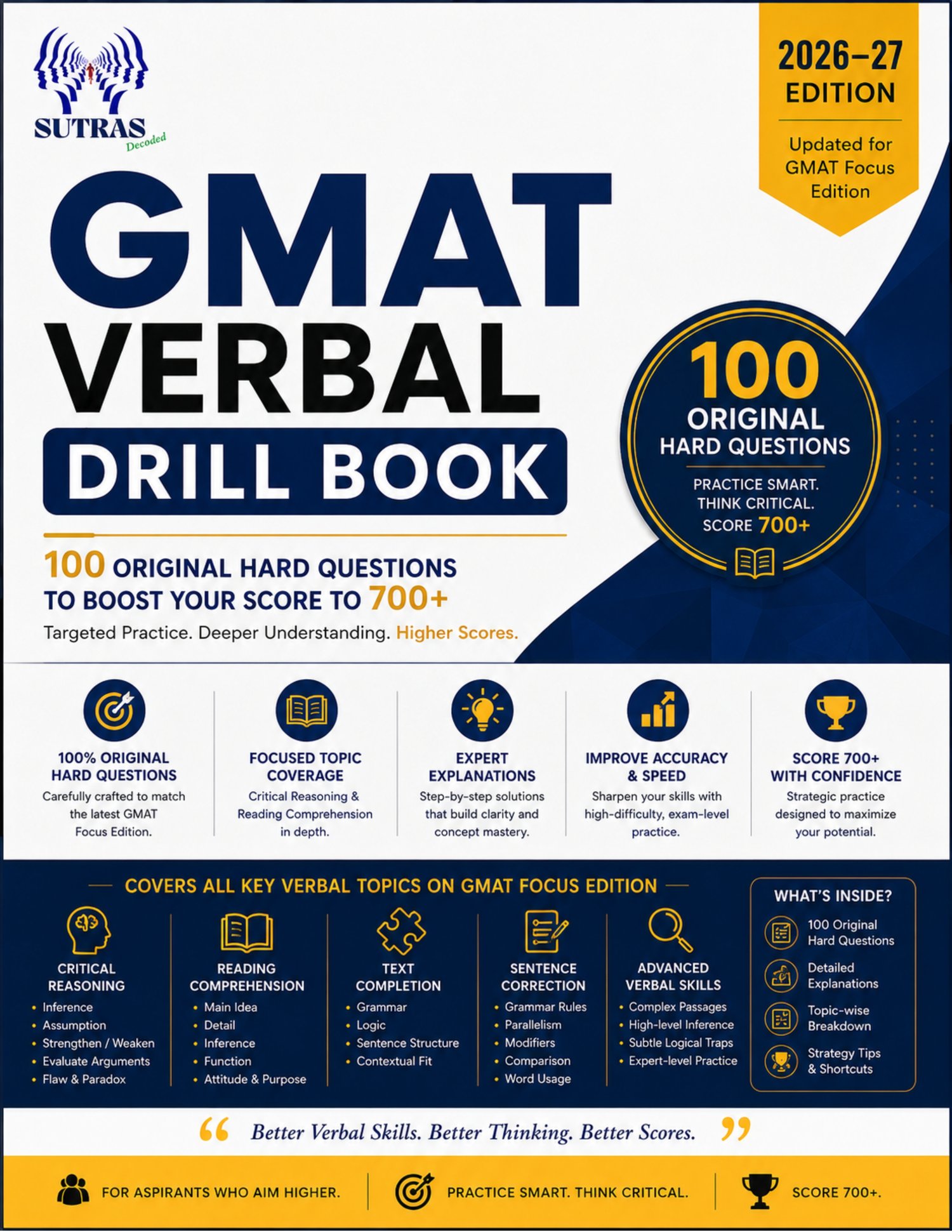
Sutras: The Verbal Drill Book is 100 original GMAT Focus Edition Verbal questions organized by type. Seventy CR questions in seven dedicated sets of ten. Thirty RC questions across five original academic passages.
The seven CR sections:
Weaken, 10 questions. Each question presents an argument and asks which answer choice most damages the conclusion. The set targets the specific structural attack patterns that work across different argument types.
Strengthen, 10 questions. Structurally related to Weaken but mechanically opposite, and more commonly confused with Assumption questions than any other CR pairing. This set makes the distinction clear through repetition.
Assumption, 10 questions. Split between Necessary Assumption and Sufficient Assumption sub-types, which require different approaches and are frequently conflated. The explanations address each sub-type explicitly.
Flaw, 10 questions. Asks you to name the logical error in the argument in abstract terms, which is a different skill from weakening it. This distinction trips up most students at the Hard and Very Hard level.
Evaluate, 10 questions. Asks which additional piece of information would most help determine whether the conclusion is valid. The correct answer is not the one that strengthens or weakens the argument most. It is the one that creates the most decision-relevant uncertainty.
Boldface, 10 questions. Requires identifying the structural role of two highlighted sentences within the argument. The answer choices use abstract language, and the primary skill is mapping that language onto argument structure precisely.
Inference, 10 questions. Asks what must be true based only on the stated information. The common error is selecting answers that are probably true or likely true rather than provably true. This set drills the discipline of strict inference.
The five RC passages cover natural science, social science, business theory, history of ideas, and policy analysis, with six questions per passage covering the full range of RC sub-types.
Every question includes a complete explanation. Every wrong answer is addressed. Every CR section opens with a type-specific strategy guide and the most common distractor pattern for that type.
Best for: GMAT Focus Edition students who know the CR types conceptually but are still missing questions under timed conditions. If your Verbal score has plateaued, uneven CR type accuracy is almost always the cause.