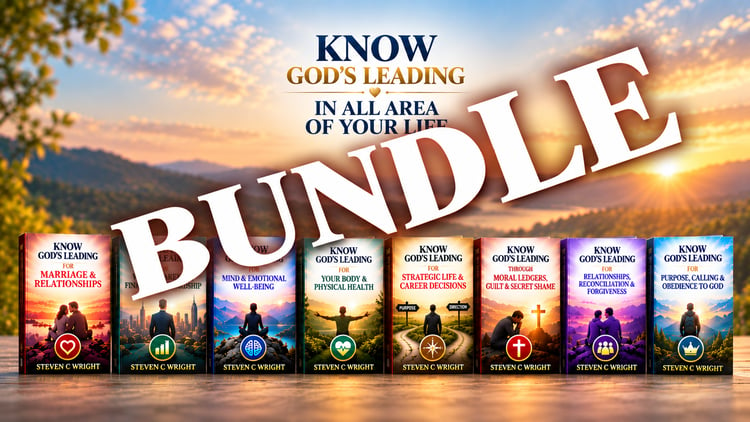

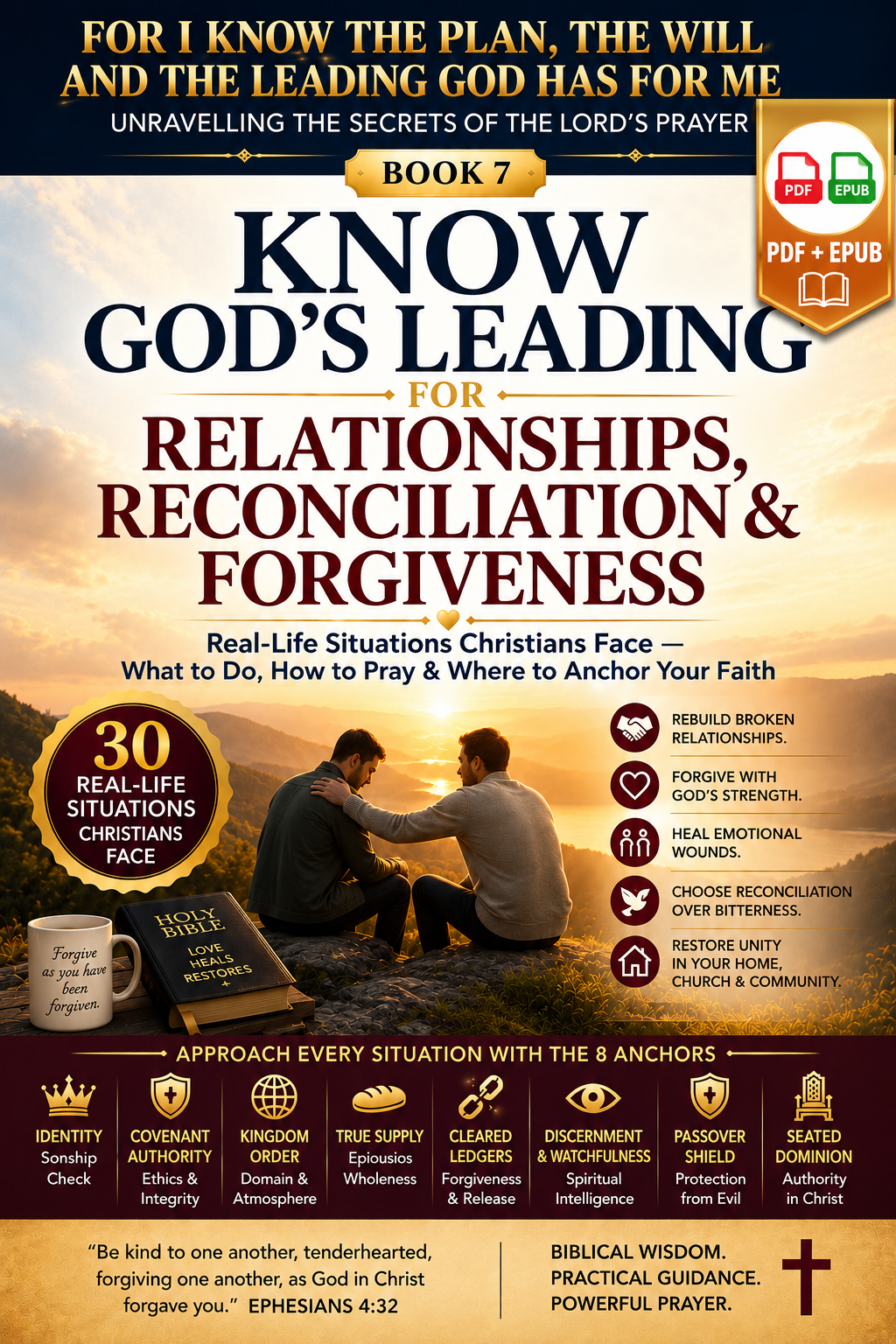
Know God's Leading for Relationships, Reconciliation & Forgiveness
How to Discern God's Direction When Relationships Are Broken, Complicated or in Need of Restoration
Should I reach out—or give them space?
Should I forgive and rebuild the relationship?
Should I try to reconcile—or let the relationship go?
When is forgiveness required, and when are boundaries necessary?
Can a relationship be restored after trust has been broken?
And how do you know what God is leading you to do when your heart is still hurting?
Relationships can bring some of life's greatest joys—and some of its deepest wounds.
Friendships end.
Families become divided.
Trust is broken.
Words are spoken that cannot be taken back.
People disappoint us.
Sometimes we hurt others.
Sometimes we are the ones who have been hurt.
And sometimes the most difficult question is not "Who is right?"
It is:
"Lord, what are You asking me to do now?"
KNOW GOD'S LEADING FOR RELATIONSHIPS, RECONCILIATION & FORGIVENESS is a practical Christian guide to discerning God's direction when relationships become difficult, damaged, distant, or broken.
It explores how to pursue forgiveness and reconciliation without confusing them with pretending nothing happened, removing healthy boundaries, or returning to relationships that remain harmful.
Forgiveness Does Not Always Mean Going Back
One of the most difficult misunderstandings about forgiveness is the belief that forgiveness automatically requires restored closeness.
But forgiveness, reconciliation, trust, and relationship restoration are not necessarily the same thing.
You can forgive someone without immediately trusting them again.
You can seek reconciliation while recognizing that rebuilding trust takes time.
You can love someone while maintaining appropriate boundaries.
You can release bitterness without reopening a relationship that should remain closed.
And sometimes God's leading may be toward restoration.
Other times, it may be toward release.
The challenge is learning to discern the difference.
When Your Heart Is Hurt, Discernment Becomes Difficult
Pain can influence our decisions.
Anger can make us want to retaliate.
Fear can make us avoid necessary conversations.
Pride can prevent us from apologizing.
Guilt can make us accept responsibility for things that are not ours to carry.
Loneliness can make us return to relationships that are unhealthy.
And resentment can make forgiveness seem impossible.
This book helps you step back from the emotional intensity and ask what a faithful response might look like.
What You Will Discover
Inside, you will explore how to:
- Understand the difference between forgiveness, reconciliation, restoration, and trust
- Discern when God may be leading you to initiate reconciliation
- Know when it may be appropriate to wait rather than force a conversation
- Recognize the difference between humility and unhealthy self-blame
- Forgive without denying the reality of what happened
- Establish healthy boundaries without allowing bitterness to control you
- Understand why restored trust may require time and consistent change
- Recognize when an apology is needed—and when you should not take responsibility for another person's actions
- Deal with anger, resentment, disappointment, and betrayal in a healthier way
- Respond when someone who hurt you refuses to acknowledge what happened
- Navigate difficult family, friendship, workplace, and community relationships
- Discern whether a relationship should be repaired, redefined, limited, or released
- Learn how to pursue peace without compromising truth
- Recognize when reconciliation is possible and when separation may be necessary
- Move forward without allowing another person's actions to determine your emotional or spiritual direction
Reconciliation Requires Truth
True reconciliation is not built on pretending.
It requires honesty.
It may require confession.
It may require apology.
It may require accountability.
It may require changed behavior.
And sometimes it requires time.
You cannot rebuild genuine trust simply by saying, "Let's forget what happened."
Forgiveness may be offered immediately.
Trust may take much longer.
Reconciliation may require both people to participate.
Restoration may not always be possible.
Understanding these differences can help you respond with both grace and wisdom.
What If the Other Person Will Not Change?
One of the hardest situations is wanting reconciliation when the other person does not want it.
You cannot control another person's heart.
You cannot force someone to apologize.
You cannot make someone accept responsibility.
You cannot manufacture trust.
And you cannot carry the entire burden of restoring a relationship by yourself.
Sometimes faithful obedience means making the invitation toward peace while accepting that the response belongs to the other person.
Sometimes you may need to forgive without receiving an apology.
Sometimes you may need to establish distance.
Sometimes you may need to release the relationship into God's hands.
And sometimes the most courageous act of faith is knowing when to stop trying to control an outcome you cannot control.
Forgiveness Is Not Weakness
Forgiveness does not mean saying that what happened was acceptable.
It does not mean denying your pain.
It does not mean removing every consequence.
It does not mean allowing someone to repeatedly hurt you.
And it does not mean abandoning wisdom.
Forgiveness is a decision to release your right to remain controlled by resentment and revenge.
It is choosing not to allow another person's wrongdoing to permanently govern your heart.
But forgiveness can coexist with truth, accountability, wisdom, and boundaries.
When You Don't Know Whether to Stay or Let Go
Perhaps you are standing at a relationship crossroads.
Someone has hurt you, but you still care.
Someone has apologized, but you are not sure whether you can trust them.
A family relationship has become strained.
A friendship has changed.
Someone wants another chance.
Or perhaps you are the one who needs to ask for forgiveness.
You may be asking:
"Should I fight for this relationship?"
"Should I walk away?"
"Should I reach out?"
"Should I wait?"
"Can this relationship be restored?"
"Lord, what are You asking me to do?"
This book will help you approach these questions with greater clarity and spiritual maturity.
From Hurt to Healing. From Conflict to Discernment.
KNOW GOD'S LEADING FOR RELATIONSHIPS, RECONCILIATION & FORGIVENESS is for Christians who want to handle difficult relationships according to God's wisdom rather than being controlled by anger, guilt, fear, pride, or emotional attachment.
You may not be able to change what someone else has done.
You may not be able to restore every relationship.
You may not receive the apology you deserve.
But you can choose how you respond.
You can forgive.
You can speak truth.
You can apologize when you are wrong.
You can establish boundaries.
You can pursue peace.
You can seek reconciliation where possible.
And you can release what you cannot control.
Because sometimes God's leading is not simply about who stays in your life.
Sometimes it is about learning how to love, forgive, speak truth, establish boundaries, and let go in a way that honors Him.
Bring your broken relationships before God.
Bring your anger.
Bring your disappointment.
Bring your questions.
And learn to discern the next step.
Forgive where you can. Reconcile where possible. Establish boundaries where necessary. Release what you cannot control. And let God lead you forward.