








Inside & Outside Bars Explained — Which one (PDF Guide)
You learned that an inside bar and a harami are the same thing. Then you marked a chart both ways and got two different lists, and assumed you had misunderstood one of them. You had not. One compares RANGES and the other compares BODIES, and roughly six in ten of each is invisible to the other word.
One measurement with two answers — is the second bar inside the first, or around it? — applied twice, once to ranges and once to bodies. That generates all four names. Across 35,944 bars: 7,022 inside bars, 6,546 harami, and only 2,716 that are both. This is a 37-page PDF that teaches Inside & Outside Bars from the first thing you see on the screen through to a written strategy with an entry, a stop and an explicit rule for when the trade is wrong.
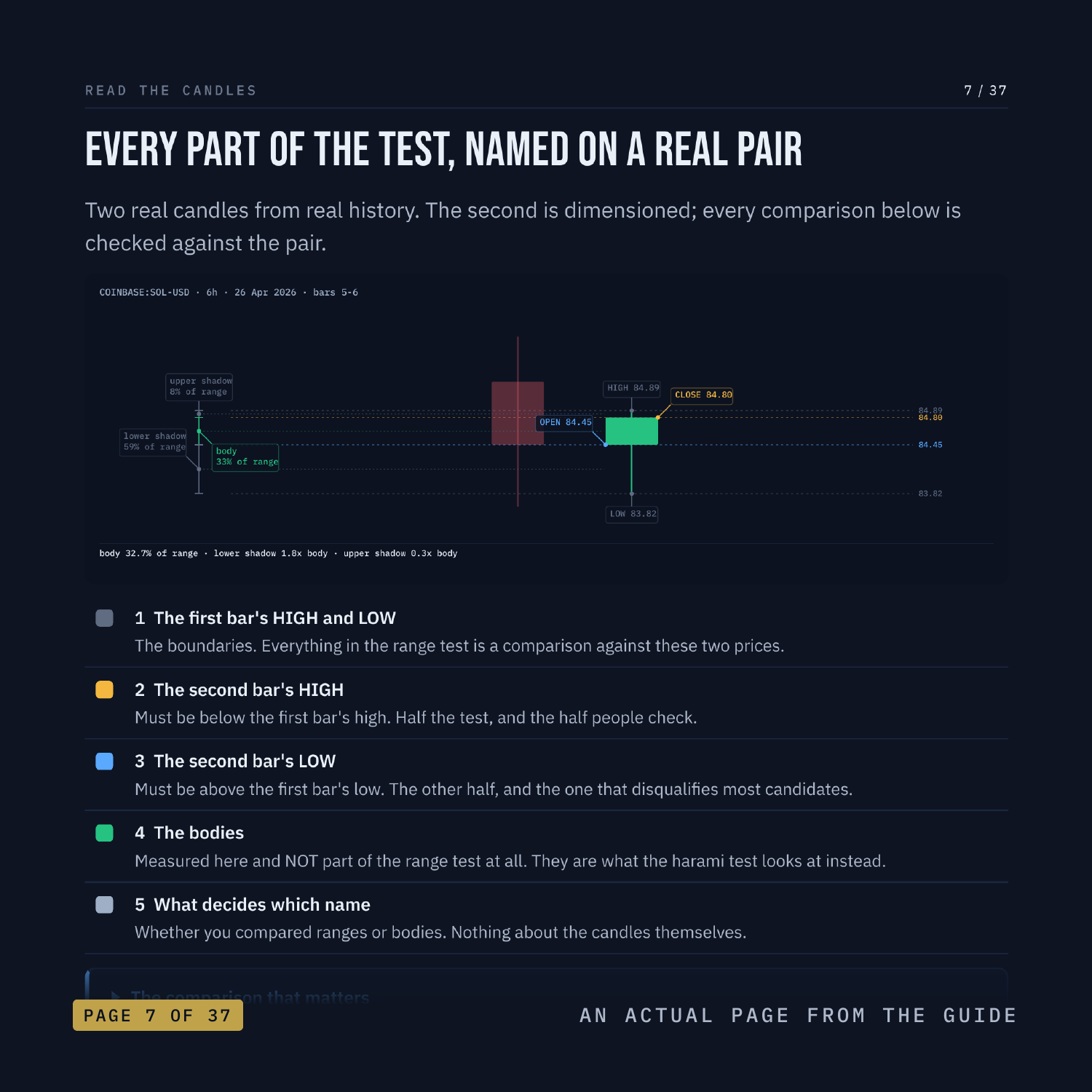
Nothing is taught underneath a chart. Every label sits on the candle, the line or the level it is describing, on real BTC, ETH, SOL and LINK charts, with the measured ranges and bodies printed on the candles. There are three quizzes on real charts, each followed by the same chart re-shown annotated with the reasoning, plus faded practice pages where the first steps are filled in and you finish the rest.
WHAT'S INSIDE
- Why the two words are not synonyms — 58.5 per cent of harami are not inside bars, and 61.3 per cent of inside bars are not harami.
- - The same split on the other side — 4,360 outside bars, 2,677 engulfing candles, and only 748 in common — 17.2 per cent.
- - How common they are — Inside bars one bar in 5, outside bars one bar in 8. Two of the most frequent things on any chart.
- - One of the two flattest results in the wave — Bullish harami +0.20 points against its own control on 3,243 cases. Not 'could not tell' — measured, and it is nothing.
- - What an inside bar actually tells you — That volatility contracted. That is a real statement about the market and it is not a direction.
WHAT YOU'LL BE ABLE TO DO
- Say whether you are comparing ranges or bodies before you name a pattern.
- - Mark inside bars and harami separately, and know why the lists differ.
- - Tell an outside bar from an engulfing pattern with a number.
- - Read a volatility statement as a volatility statement, not a signal.
- - Explain the whole four-name family to somebody else in two sentences.
AN HONEST NOTE
Inside & Outside Bars is a clue, not a crystal ball. It describes what price has already done. This guide contains no win-rates, no backtest results and no promises about what you will make, because nobody can verify those and you should not trust anyone who prints them. What it hands you instead is a set of rules you can test yourself on TradingView in an afternoon. Educational, not financial advice.
Instant download. 37 pages, PDF.