

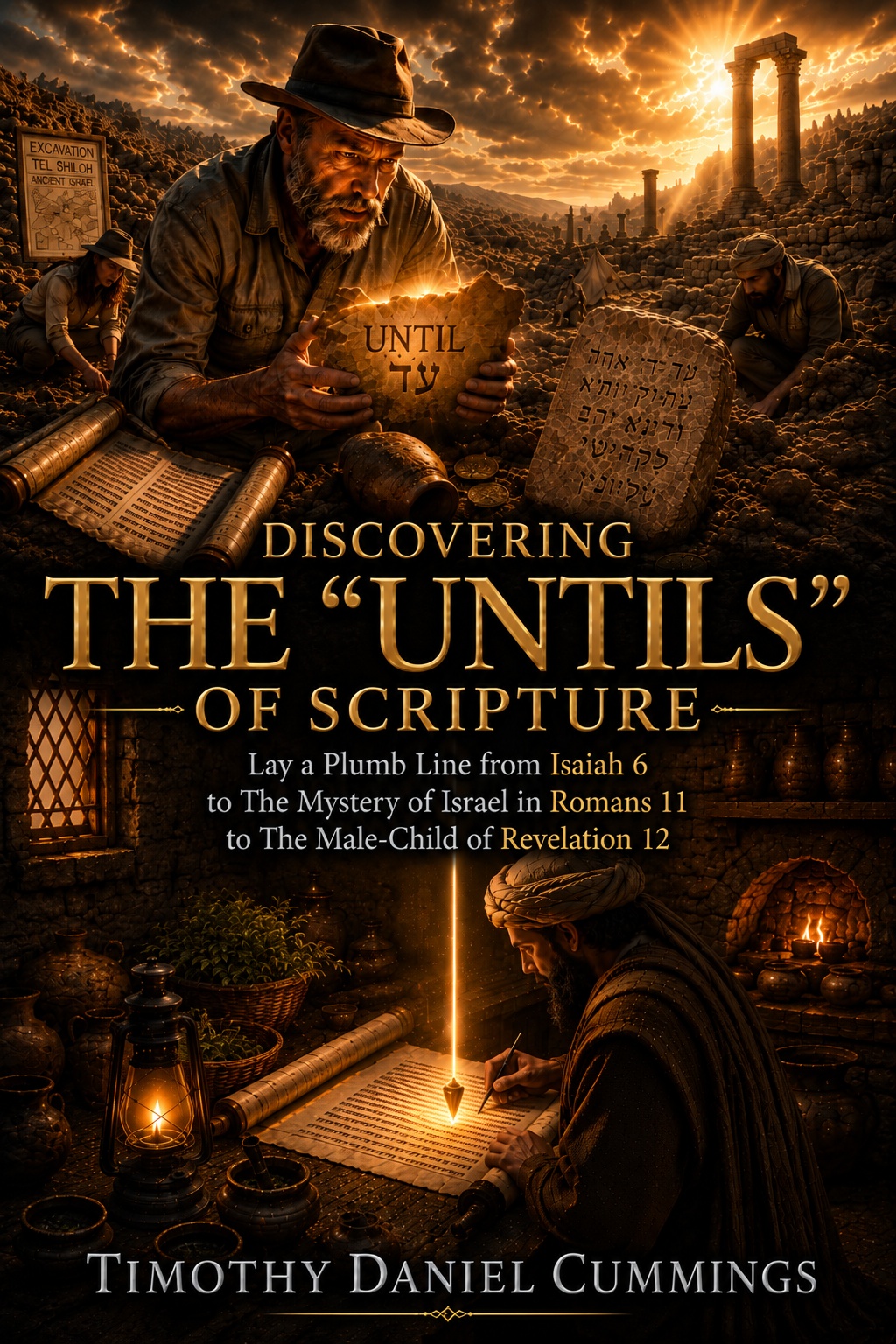
Discovering The "Untils" Of Scripture
When it comes to Israel, relatively few believers have taken the time to rightly divide the Scriptures concerning God’s eternal purposes for Israel and the nations. Much confusion arises when individual passages are isolated from the larger prophetic framework through which God has revealed His purposes. And when you add a very confused GEO-politics of the Middle East and of the United States, we can have a conundrum on our hands. I believe one of the most important keys to understanding this mystery is found in Isaiah 6. It serves as a biblical plumb line and foundational passage—what I call the Epicenter of the Mystery of Israel and the Church.
The significance of Isaiah 6 cannot be overstated. God brings Isaiah into the Throne Room, where the prophet encounters the Lord of Glory, high and lifted up, surrounded by the worship of the seraphim, and uniquely the year that King Uzziah dies. Yet this extraordinary revelation of divine glory is immediately followed by an equally extraordinary commission. Isaiah is sent to a people upon whom judgment is pronounced: “Hear ye indeed, but understand not; and see ye indeed, but perceive not” (Isaiah 6:9). Their eyes would be unable to perceive, their ears unable to hear, and their hearts unable to understand.
This was far more than a judgment confined to Isaiah’s generation. The words spoken in the Throne Room would reverberate throughout not only the remainder of Scripture, but also the remainder of history for they are still blind as a nation to this very day.
Jesus Himself appeals to Isaiah 6 when explaining the spiritual blindness He encountered among His own people, and the apostles likewise return to this passage when confronting Israel’s rejection of the Gospel. What began as Isaiah’s prophetic commission therefore becomes an important key to understanding the continuing biblical mystery of Israel’s blindness, the Gospel going to the nations, and God’s ultimate purpose of restoration and fullness.
In this sense, Isaiah’s calling carries both apostolic and prophetic significance. He is sent from the Throne Room with a divine message of judgment, yet that judgment is not the end of the story. Centuries later, the Apostle Paul—the apostle uniquely commissioned to carry the Gospel to the Gentile nations—would confront this same mystery. Paul warns the Gentile believers in Romans 11:25–29 not to be ignorant of it, lest they become wise in their own conceits. Israel’s blindness is described as being “in part” and connected to a divine purpose that continues until the fullness of the Gentiles comes in.
The prophetic thread continues from Isaiah 6 into Isaiah 7, where the northern kingdom of Israel—particularly Ephraim—comes into view. The approaching judgment upon Ephraim opens another dimension of the mystery, one that reaches far beyond the immediate historical circumstances of Isaiah’s day. Judah and Ephraim, judgment and scattering, blindness and restoration, Israel and the nations all become strands within a much greater biblical tapestry.
Following these strands ultimately brings us back to the Throne Room, as will be revealed in this piece of Literature.
The judgment pronounced from that Throne in Isaiah 6 becomes a prophetic backdrop for understanding the blindness described by Paul in Romans 11. Yet Scripture also points toward the completion of God’s purposes. The God who pronounced judgment is also the God who is able to bring His purposes to their appointed fullness.
Therefore, Isaiah 6 should not be viewed merely as the record of one prophet’s dramatic calling. It is a doorway into one of Scripture’s greatest mysteries—a mystery involving Israel, Judah, Ephraim, the Gentile nations, the Church, judgment, blindness, restoration, and fullness. What begins before the Throne of God in Isaiah ultimately helps us understand Paul’s declaration that “the gifts and calling of God are without repentance” (Romans 11:29).
What We Will Learn
- Why Isaiah 6 is a biblical plumb line for understanding the Mystery of Israel and the Church.
- Why Isaiah’s Throne Room encounter is more than a prophetic calling, and how it establishes a pattern that echoes throughout Scripture.
- How Jesus and the apostles return to Isaiah 6, demonstrating that Isaiah’s commission reaches far beyond his own generation.
- The apostolic and prophetic dimensions of Isaiah’s calling, and how his sending anticipates themes later encountered in the ministry of the Apostle Paul and the Apostle John.
- Why Romans 11:25–29 is essential to understanding Israel, particularly Paul’s warning that believers must not be ignorant of this mystery or become wise in their own conceits.
- The distinction between Judah and Ephraim, and why understanding the northern kingdom of Israel is essential to following the prophetic storyline.
- How Isaiah 6 flows into Isaiah 7, moving from the judgment pronounced upon Judah into the prophetic crisis involving Ephraim.
- Why the nations are an essential part of the Mystery of Israel, rather than a separate subject disconnected from Israel’s prophetic story.
- How the mystery ultimately points back to the Throne Room, where judgment originates and from which God’s purposes move toward their appointed completion.
- Why God’s judgment does not mean the abandonment of His purposes, but must be understood alongside His covenant faithfulness and His ability to bring what He began to its intended fullness.
- How Israel, the Church, and the nations fit within one unfolding biblical story stretching across the prophets, the Gospels, and the writings of the apostles.
- Why Romans 11:29—“the gifts and calling of God are without repentance”—is crucial to understanding the ultimate direction of the Mystery of Israel.