



The Autobiography of a Baiter: Confessions of a Self-Aware Manipulator (Pre-Order)
Preface: Confessions of a Self-Aware Baiter
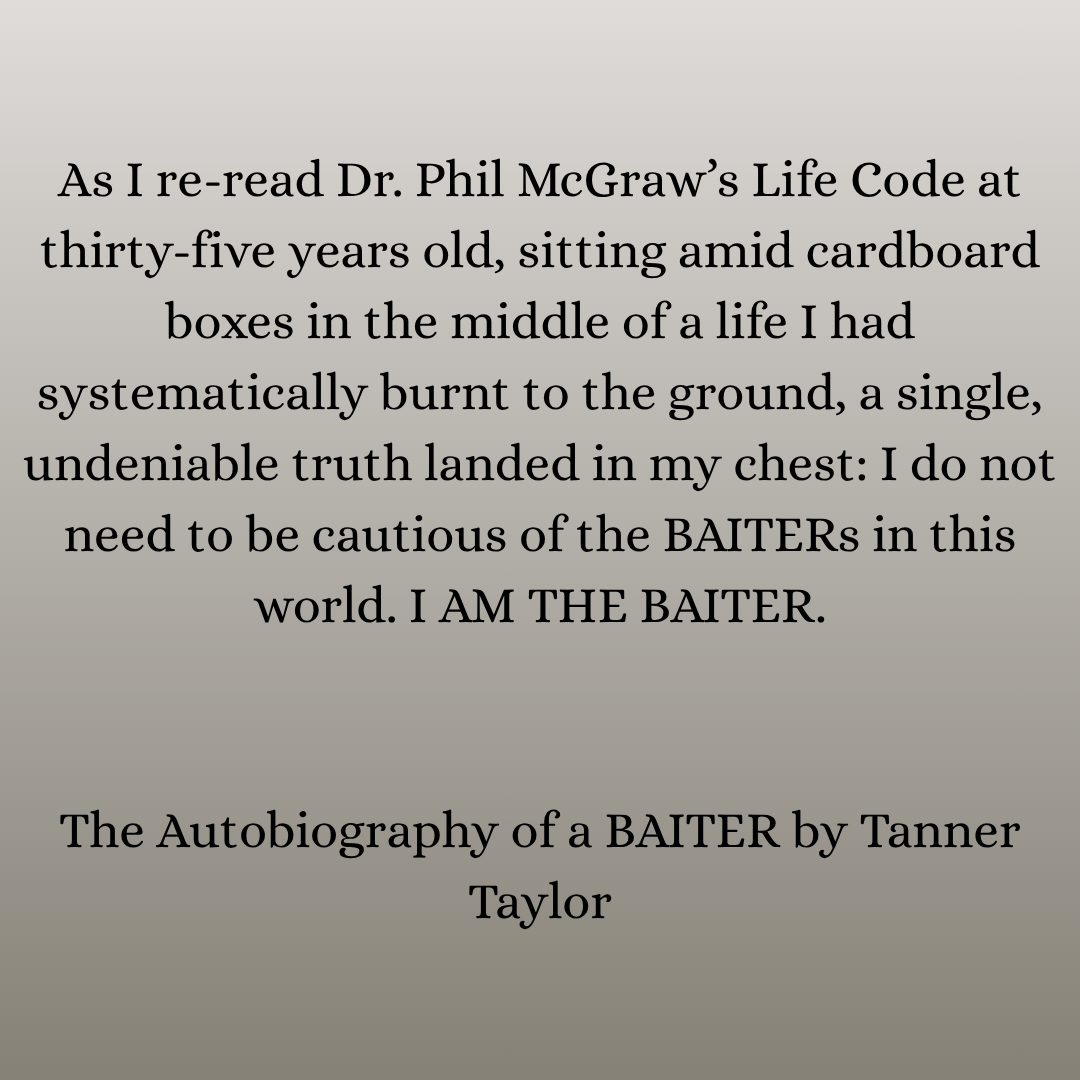
As I re-read Dr. Phil McGraw’s Life Code at thirty-five years old, sitting amid cardboard boxes in the middle of a life I had systematically burnt to the ground, a single, undeniable truth landed in my chest:
I do not need to be cautious of the BAITERs in this world. I AM THE BAITER.
To understand what that means, you have to understand the acronym. In Dr. Phil’s framework, a BAITER is a Backstabber, Abuser, Imposter, Taker, Exploiter, or Reckless entity— someone who uses covert, deceptive, and transactional tactics to manipulate human beings for personal gain, control, or self-preservation.
Most people read that definition, nod along, and immediately start scanning their lives for the narcissists, the toxic exes, the parasitic coworkers, or the manipulative friends who fit the description. They look outward to protect themselves.
I looked in the mirror.
How did I become this person? How does a child born into heartbreaking tragedy transform into an adult who tells a thousand lies a week without her conscience making a sound? How do you travel the long, destructive road from hoe to housewife, from liberal to conservative, from delusional to delusional-but-self-aware?
This story is an unvarnished account of how I evolved from one extreme dynamic to the other, navigating my way through life by using people, manipulating people, and lying compulsively. You can live vicariously through me, you can sit back in your comfort zone and judge me, or you can try to understand me. I am going to share significant, raw life events in full detail: how they impacted my mind, how I dealt with them, the dark realities of post-natal depression where I found myself staring at my own infant daughter with terrifying impulses, an obscene dynamic drinking a billionaire’s urine, and the ultimate, devastating betrayal of a best friend.
This is not a glamorous story. To be capable of deceiving people on this magnitude indicates the presence of a severe personality disorder—or, at the very least, a deeply entrenched, hyper-vigilant trauma response.
Normal people do not weave intricate webs of deceit every single day while their internal moral alarm stays completely silent. My thought processes were not ordinary. This book is not about glorifying the sugar daddy lifestyle. It is not about bragging about how I outsmarted incredibly intelligent people or manipulated incredibly stupid ones.
This book is about how I finally recognized that I was messed up in the head. It is about the revelations that hit me at age thirty-five, when I finally understood why I became the predator instead of the prey, and why I so often chose to suffer in silence rather than seek the justice I actually deserved.
From Armor to Surrender
The truth is, reading Life Code at thirty-five wasn’t the first time I had encountered the concept of a BAITER. Ten years earlier, when I was twenty-five and actively living, breathing, and weaponizing that lifestyle, I watched the Dr. Phil show religiously. I was drawn to him. I felt like I was learning from him, growing through his advice, and absorbing his lessons on human behavior. I always felt like I was on his good side—like I was one of the smart ones in the audience doing the work.
Then he began promoting Life Code. For a year, he mentioned it on air, breaking down the characteristics of toxic manipulators. Intrigued, I finally bought the book.
I remember the exact day I read it for the first time. I was twenty-five, sitting on a trampoline in my grandmother’s backyard. It was a light, breezy, sun-drenched afternoon. I was wearing a short, floral sundress—my uniform at the time, designed to draw eyes and secure attention. I sank into the black canvas of the trampoline with the book in my lap, expecting to learn how to spot bad people.
I opened to the chapter detailing the specific behavioral characteristics of a BAITER.
By the third characteristic, the sun overhead seemed to dim. A strange, physical heaviness settled in my torso. It wasn’t a racing, frantic heartbeat; it was a slow, dense, sickening pulse deep in my chest.
He’s describing me.
Panic seized me. For the very first time in my adult life, the delusion of my invincibility cracked open. A cold terror washed over me: What if I haven’t actually tricked anyone? What if the people in my life already know? What if my family knows I’m a liar and they’re just not calling me out? (Which was a terrifyingly plausible reality, given that my family operated entirely on enabling and silence—no one ever held anyone accountable for anything).
I felt completely blindsided. Dr. Phil, the man I trusted to validate my intelligence, had just exposed my secrets to the world. I was terrified that somehow, he would find out about me, pull me up on stage, and use me as his textbook example of a covert manipulator.
And then, my brain did what it had been trained to do since early childhood: it adapted to protect the armor.
Instead of stopping, I doubled down. I rationalized it. Dr. Phil doesn’t get it, I told myself as I closed the book on that warm afternoon. He’s wrong. I’m not doing this because I’m a bad person. I’m doing this to survive. I have to do this. This is the only way I can get what I need in a world that takes everything from you.
That moment didn’t reform me; it perfected me. I refined my tactics. I got smarter, colder, and far more deliberate. Every time I heard the word BAITER over the next decade, a quiet flash of recognition went off in my brain, instantly smothered by a wall of self-justification.
It took another ten full years of chaos, deceit, transactional sex, emotional burnouts, and internal decay before I picked up that same book again at thirty-five while unboxing clothes in a new room.
By thirty-five, I didn’t read it with panic or self-justification. The difference wasn’t that I discovered a new truth; the difference was that I was completely, utterly exhausted.
I was worn out from maintaining the lies. I was defeated by the weight of my own defense mechanisms. I finally saw the brutal math of my life: I was never going to win this way. The armor that had kept me safe as a terrified child had become the prison that was suffocating me as an adult.
It took me way too long to surrender. But at thirty-five, I finally put down my weapons.
The Original Dullness
Why did I need to lie constantly? Why did I give my body to men so readily? Why was I a whore? Why did I enjoy being a whore? Why did I yearn so desperately for validation? Why was I so damn insecure underneath it all? And why did my conscience stay completely silent through decades of emotional carnage?
If only I had found the real answers to those questions when I stepped into adulthood, rather than waiting until middle age. I could have saved myself so much grief.
For years, I mistook attention for intimacy and sexual availability for power. Looking back, I can see the frantic math my brain was doing: if I gave myself away first, no one could take anything from me by force. I wasn’t just seeking validation—I was building armor out of bad behavior.
To trace the lineage of a BAITER, you have to go back before the lies, before the affairs, before the sugar daddies, and look at the foundation.
My earliest atmospheric memory of my childhood is: dull.
That is the only word I have for it: a thick, oppressive, sickening dullness. It was a physical sensation—a low, sinking feeling in the pit of my stomach that carried a constant threat of nausea. There was never any light in that feeling, never any joy, never any warmth. It was the ambient frequency of a house steeped in profound trauma.
I was born Tanner Taylor. I was born into sadness. I was born into dysfunction. I was born into heartbreak. I was brought into this world specifically to replace one of four children my parents had lost to a sudden, tragic death three years earlier. I was handed a dead sibling’s ghost before I even learned to breathe.
That heavy, nauseating “dullness” became the emotional wallpaper of my life. To this day, thirty years later, that exact same heavy, dull feeling occasionally washes over me out of nowhere—even in moments of deep physical intimacy, like lying in the missionary position with my partner. My nervous system suddenly trips a wire, traveling straight back to the living room of my childhood, reminding me of the inescapable weight of a home that was broken long before I arrived.
Before the external physical abuse began, the silence of my home had already taught me that existence was fragile, painful, and unsafe.
The Superpower of the First Lie
If your environment is dull, scary, and powerless, you find ways to build a new reality.
I remember the exact moment I realized I had the power to rewrite my world. I was a young schoolgirl, living in a house shadowed by poverty, grief, and domestic instability. My classmates were coming back from holidays talking about their trips, their families, their bright, happy lives.
I looked at my teacher and my classmates, and I told them a story.
I told them that my family had just returned from a massive holiday to the Gold Coast, Australia. I didn’t just mention it; I constructed it out of thin air. I described the flight. I told them about riding the roller coasters at Movie World and petting the tiger cubs at Dream World. I detailed the blazing sunshine and the warm water. I gave them every single detail they asked for, reading their faces as I spoke.
They were captivated. They were impressed. They were genuinely happy for me.
In that single afternoon, I experienced a high I would spend the next thirty years chasing. The lie worked. It was instant magic. It completely shielded me from the shame of being poor. It protected me from their pity. It made me important. It made me feel safe.
Lying wasn’t a moral failing to my young mind; it was a superpower. It was the armor I put on so nobody could look through the front window of my life and see the violent, dysfunctional mess happening behind the front door.
Rising Above the Dysfunction
What makes this a success story is not that I have made millions of dollars (though with 80,000 corporate shares sitting at 14 cents, maybe one day).
Today, I am successful because I can sit across from a man and have a dignified, grounded conversation, despite being sexually violated at six years old by my thirteen-year-old neighbor.
I am successful because I can walk through the world with civil manners. I can manage a corporate team. I can socialize politely. I can be the polished, professional face of a company.
I can communicate effectively and authoritatively. But what makes me most successful?
I am an exceptional mother.
If my children grow up, look back at their childhood, and consider me a great mother, I will know with absolute certainty that I have succeeded. I have broken the generational curse of a house that felt dull, terrifying, and unsafe.
Look at how I now contribute real, tangible value to my community despite watching my step father beat my mother and younger brother until the walls shook. That is what this book is about: learning how to live with the permanent scars of extreme trauma, acknowledging without shame that you are messed up in the head, and choosing to rise above the dysfunction rather than allowing it to define the rest of your life.
Lastly, this book is about offering a clear mirror and practical pointers for lifestyle changes to anyone receptive to hearing them.
You might ask: How can I trust a word you say when you just confessed to being a compulsive liar for thirty years?
Here is why you can trust me now:
1. I worked relentlessly over three straight years to break a thirty-year, crippling habit. I am writing this to share the exact psychological shifts and practical resources that helped me step out of the matrix of deceit.
2. Lying stopped working. Eventually, the lies stop protecting you and start digging the grave deeper. My quality of life was destroyed by the very armor I built to save it. I know thousands of women are trapped in that exact same survival loop, and I want to show them the exit.
3. I am finally laying down the weight of pretense. I lived a double life for three decades. I am tired. This book is my ultimate act of radical vulnerability.
You are going to get raw, unvarnished honesty. Honesty about my lies. Honesty about my dark side. Honesty about my abnormal interpersonal behaviors. Honesty about my dysfunctional family dynamics. And honesty about the silent suffering I endured for thirty years as a result of having a mother who repeatedly chose her boyfriends over her own children.
However, in the process of drafting out this book, a bigger issue was identified. As I sat down to write these pages, expecting to simply lay out the facts of my life, I ran face-first into another uncomfortable, unavoidable mirror. Reading back through my initial drafts, I caught myself doing something: I was rationalizing. I was subtly defending the men who crossed boundaries, violated my trust, and abused me. I was softening their blows, making excuses for their behavior, and instinctively carrying the weight of their choices on my own shoulders.
You will notice this throughout your read of the book. You may not like reading it, and you may disagree with how I frame it in the moment. But unfortunately, I am hung up on that part of the recovery process.
It annoyed me when I first made this discovery. This wasn’t an issue I foresaw or planned to acknowledge in this book;spotting my own tendency to minimize their actions and sanitize what they did to me. It actually became an inconvenience. Thank goodness it struck me, and I was sensible enough to look into it, pinpointing the exact problem areas. Otherwise, I would have skipped a vital part of my rehabilitation.
Better late than never!
You will pick where I minimize what happened, rationalize the inexcusable, and try to make sense of senselessness.
For decades, minimizing assault and abuse was my quiet survival strategy. (See, I think I just did it). If I could explain away their behavior, I didn’t have to face the terrifying, powerless reality of what was actually done to me. I did it at the time, and I do it now.
You will even see when faced with a choice to seek justice; I choose no.
After the realization though, I am well aware how holding onto this skewed mindset doesn’t just stall individual healing —it contributes to the very culture that allows abuse to thrive. By refusing to call sexual violence and trauma for what it truly is and procrastinating the judicial process, I add to the problem and make it harder for others to claim the truth. I know. This book is my active unlearning. While I am still doing the hard work to reframe how I view my own past, I at the very least acknowledge; by doing that, I am a contributing part of the problem. I know there’s still a lot of work to do.
No single experience in this book is unique to me. Combined, perhaps they form a dark, rare tapestry—but individually, millions of women are carrying these exact same secrets.
I am not looking for your pity. I don’t want your sympathy.
I want you to see exactly how I became a BAITER—so you can either spot the armor you’re wearing yourself or finally put it down for good.
Pre-Order Now to Keep Reading Part 1
(The complete manuscript will be delivered directly to your email address December 1st 2026)