
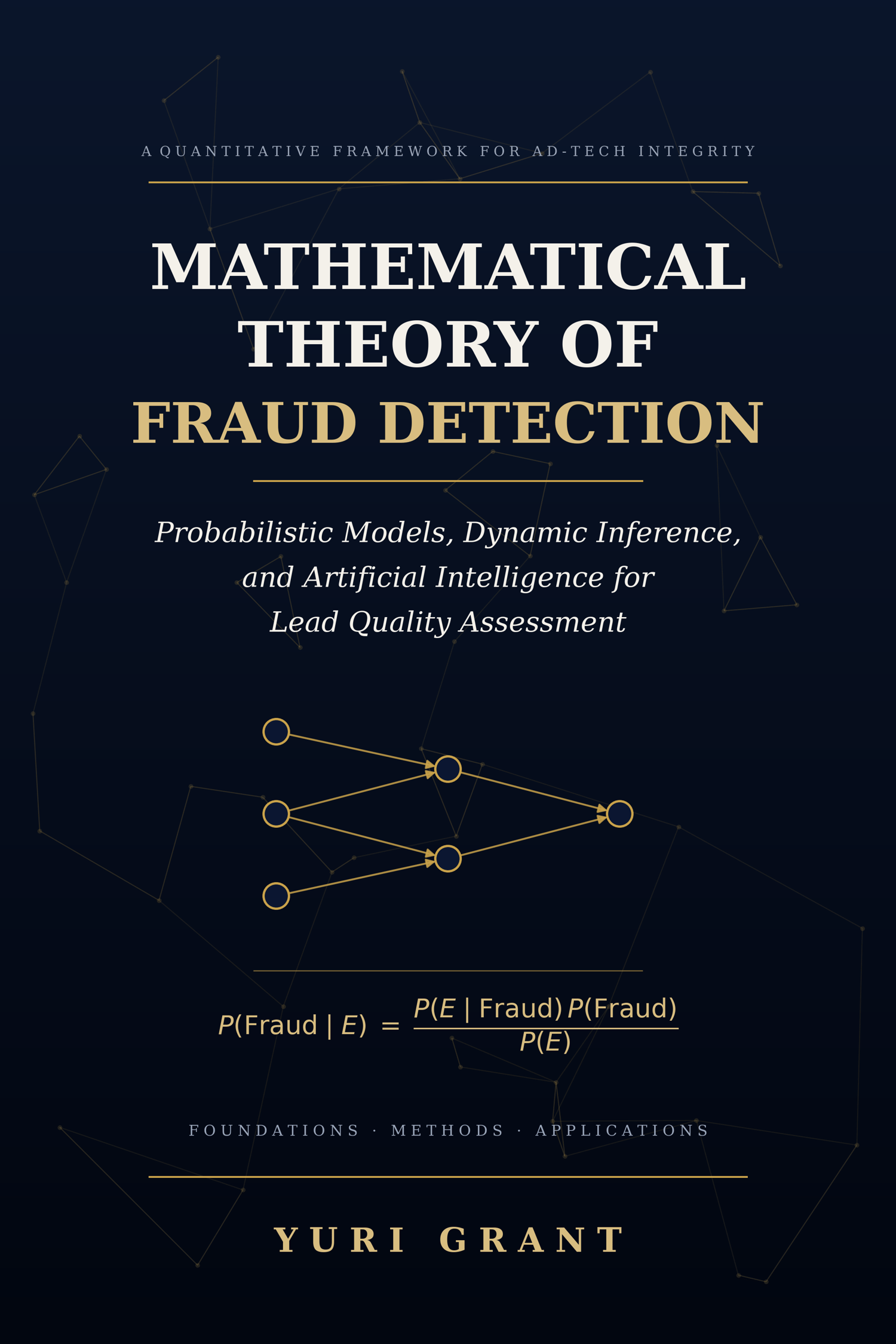
MATHEMATICAL THEORY OF FRAUD DETECTION
Every year, billions of dollars in advertising and lead-generation spend leak into fraudulent clicks, fake conversions, and synthetic leads — and most detection systems still rely on brittle, ad hoc rules.
Mathematical Theory of Fraud Detection
presents a rigorous, quantitative alternative:
a unified probabilistic framework for identifying and scoring fraud across the full lifecycle of a lead, from publisher and campaign to consumer, device, and buyer.
Authored by a Professor of mathematics, computer science and expert with decades of combined experience in math and modeling.
Grounded in Bayesian inference, Dynamic Bayesian Networks, and modern AI methods, this book treats fraud not as a binary label but as a latent state that evolves over time and must be inferred from noisy, observable evidence — IP behavior, mouse and keystroke dynamics, browser fingerprints, and conversion patterns.
Inside this book, you'll find:
- A formal taxonomy of fraud types — human, machine, and economic — and how they combine into coordinated fraud rings and mixed schemes
- Dynamic Bayesian Network formulations linking publisher, campaign, consumer, device, and buyer states across time
- Techniques for dynamic inference and state estimation under uncertainty
- Applications of machine learning and AI to lead quality scoring and real-time fraud detection
- Worked derivations and formulas suitable for direct implementation, from Bayes' rule to full network inference
- Where artificial intelligence is already reshaping fraud detection, and where the industry is headed next
Written for quantitative analysts, data scientists, fraud and risk teams, and researchers in ad-tech, affiliate marketing, and lead generation, this book bridges academic probability theory and the operational realities of protecting marketing spend at scale. Whether you're building a fraud-scoring pipeline or studying the mathematics of sequential inference, it offers both the theory and the tools to do it rigorously.
Who this book is for:
- Software engineers and solution architects building or maintaining lead generation platforms
- Data scientists and machine learning engineers working on lead scoring, fraud detection, or pricing models
- Product managers and marketplace operators who need to understand the fraud nature behind the business
- Fraud analysts, risk managers, and compliance professionals in the lead generation and AdTech space
- Technology consultants, system integrators, and anyone evaluating or building a fraud protection in marketplace from the ground up