
Multi-hazard Dynamic Performance of Fiber-Reinforced and Nano-Engineered Concrete: Experimental, Numerical and Design Perspectives
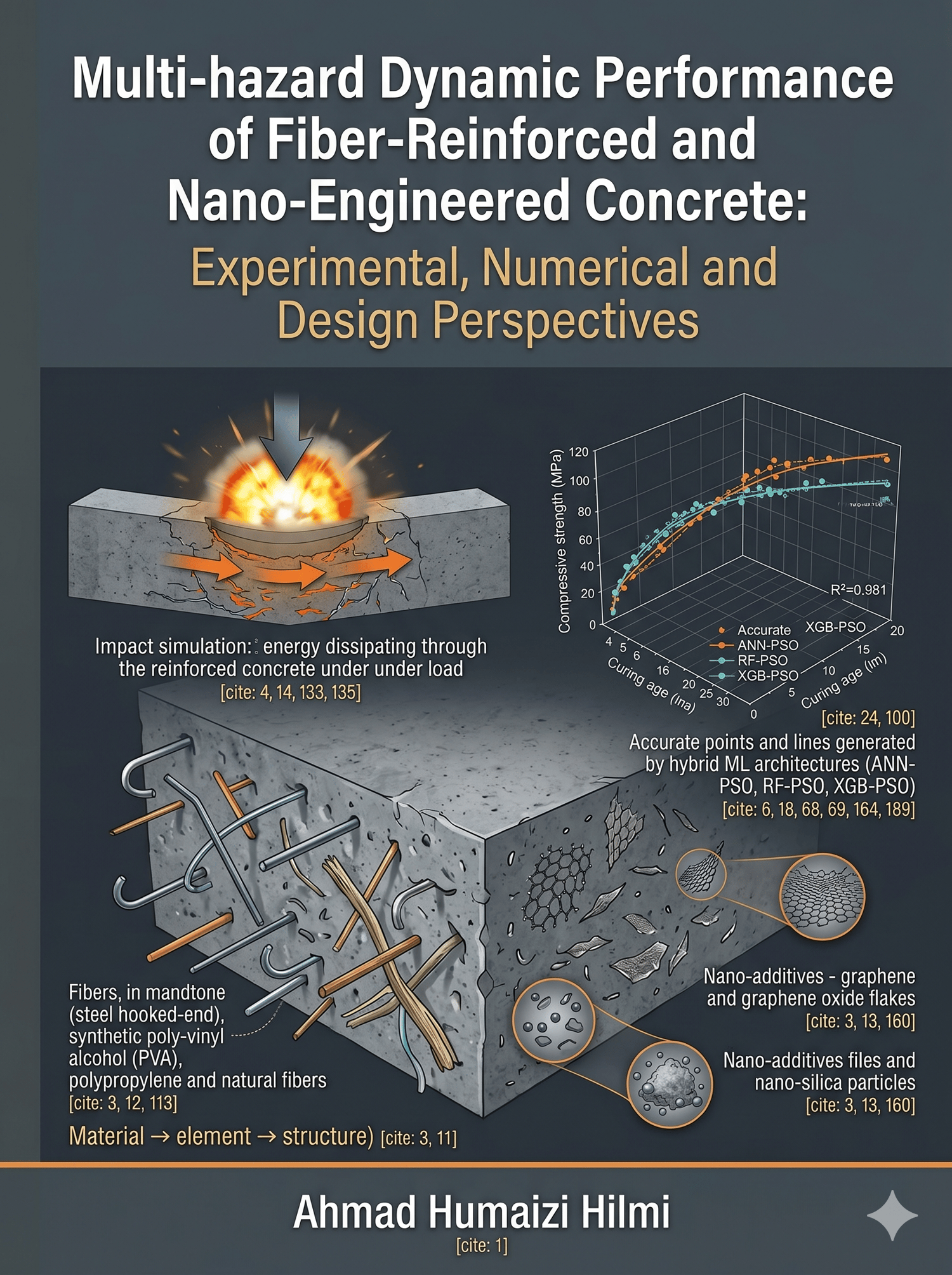
This review examines multi‑hazard and time‑dependent performance of fiber‑reinforced concretes and nano‑engineered systems across material, element and structural scales, covering steel, synthetic, natural and recycled fibers and nano‑additives such as graphene and graphene oxide. It synthesises experimental evidence for thermal ageing, freeze–thaw, impact and blast, cyclic/fatigue and corrosion regimes, and it evaluates numerical and data‑driven modelling approaches used to predict pre‑ and post‑crack behaviour, transport properties and life‑cycle outcomes. Key findings show that nano‑additives can refine pore structure, reduce chloride ingress and improve freeze–thaw resistance while increasing thermal conductivity for specialised applications, and that dispersed fiber families and SIFCON-type mixes markedly increase toughness, shear and impact resistance. Hybrid machine‑learning ensembles, notably XGB‑PSO and RF‑PSO, achieve high predictive accuracy for mechanical, environmental and economic outputs when datasets encode cement content, curing age and fiber factors. The review highlights practical trade‑offs including reduced workability at high fiber dosages, age‑dependent transitions from pull‑out to rupture, and steel fiber corrosion. It concludes with implications for design parameters (orientation factors, κk,max) and identifies needs for standardized multi‑hazard datasets, calibrated aging constitutive models and improved representation of fiber orientation in structural FEA.
Keywords: fiber‑reinforced concrete, graphene oxide, residual flexural strength, fiber orientation, machine learning, durability, recycled aggregate