
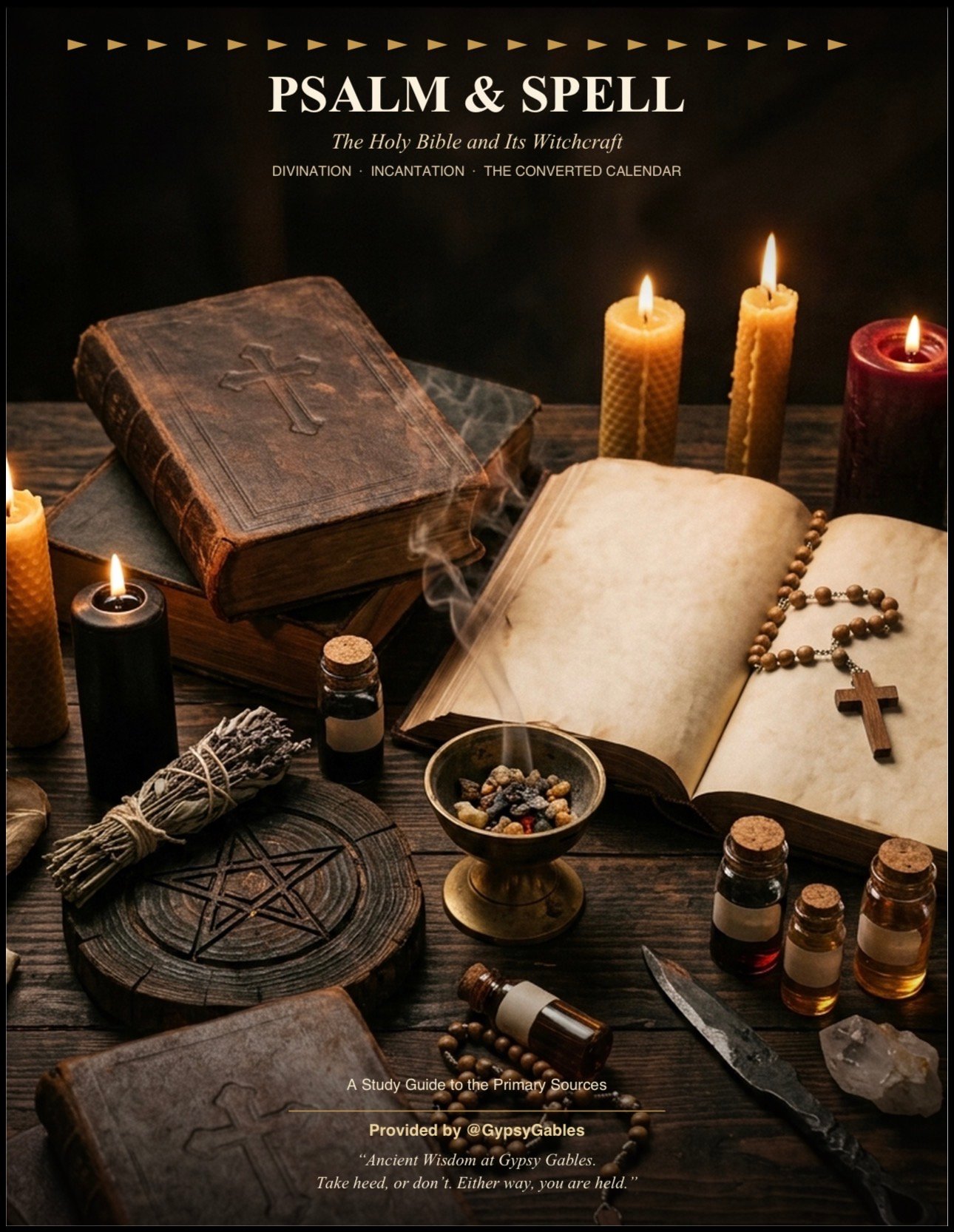
Psalm and Spell The Holy Bible and Its Witchcraft
Psalm & Spell: The Holy Bible and Its Witchcraft
A study guide to the places where scripture itself records divination, incantation, and ritual operation — and where Christian observance absorbed the older seasonal religion it found already in place. Every passage is quoted in full in the King James, so the wording can be examined directly rather than taken on someone’s summary. Seventeen entries across five parts, each ending in the manuscripts, editions, archives, and museums needed to verify it.
The Converted Calendar. Christmas against Saturnalia, Sol Invictus, and Yule, with the Chronography of 354 listing the birthday of the Unconquered Sun and the birth in Bethlehem on the same December date in the same volume. Easter’s lunar reckoning and the single Bede passage that is the only ancient source for Ēostre. All Hallows and Samhain. Candlemas, Beltane, Midsummer fires, mistletoe. Anchoring all of it: Pope Gregory I’s letter of 601 CE ordering that pagan temples be purified and reused rather than destroyed, and the sacrificial feasting kept — the conversion policy in the words of the pope who set it.
Divination Inside Scripture. Deuteronomy 18:10–12 with all nine Hebrew specialist terms unpacked, then the sanctioned practice that sits alongside the prohibition: the Urim and Thummim lot-oracle, casting lots from the scapegoat to the apostles, Joseph’s silver scrying cup using the same Hebrew root the law forbids, teraphim, liver-reading and arrow-divination named in Ezekiel, dream incubation, Gideon’s fleece. And Endor, quoted at length — where the necromancy works, and the raised prophet’s oracle comes true.
Ritual Acts That Operate as Magic. The rod contest where Egyptian magicians succeed too. Nehushtan, the bronze serpent commanded, then destroyed. The bitter-water ordeal of Numbers 5, where a written curse is dissolved into liquid and drunk — the exact mechanism of written magic for the next two thousand years. Blessings that cannot be recalled, curses that take effect, and the Ketef Hinnom silver scrolls: the oldest biblical text ever recovered, worn as amulets.
The Psalms as a Book of Incantations. The strongest documentary chain in the guide. 11Q11 from Qumran, copied in the first century, four psalms grouped for exorcism with Psalm 91 at the end and adjuration language throughout. Psalm 91 named in both Talmuds as the song for those stricken by demons. Then Sefer Shimmush Tehillim — a psalm-by-psalm operational manual assigning each psalm a divine name, a condition, and a method; printed 1551, placed on the Index, carried to Pennsylvania, absorbed into Braucherei and then into hoodoo as Secrets of the Psalms, still in print and in use. Then incantation bowls from Nippur, the Cairo Genizah amulets, and biblical names working as words of power inside the Greek Magical Papyri.
Trees, Groves, and High Places. Jeremiah 10:2–5 in full — the tree cut from the forest, fixed upright, decked with silver and gold, called the way of the heathen — with the cult-statue reading set beside it. Then Deuteronomy’s own material at 16:21 and 12:2–3 on the asherah, Josiah tearing one from the temple, the Kuntillet Ajrud inscriptions invoking YHWH and his asherah, and women at the temple gate weeping for Tammuz.
No conclusions are drawn for the reader. Where scholars divide, both sides are named so the argument can be followed to its sources.
Provided by @GypsyGables — “Ancient Wisdom at Gypsy Gables. Take heed, or don’t. Either way, you are held.”