
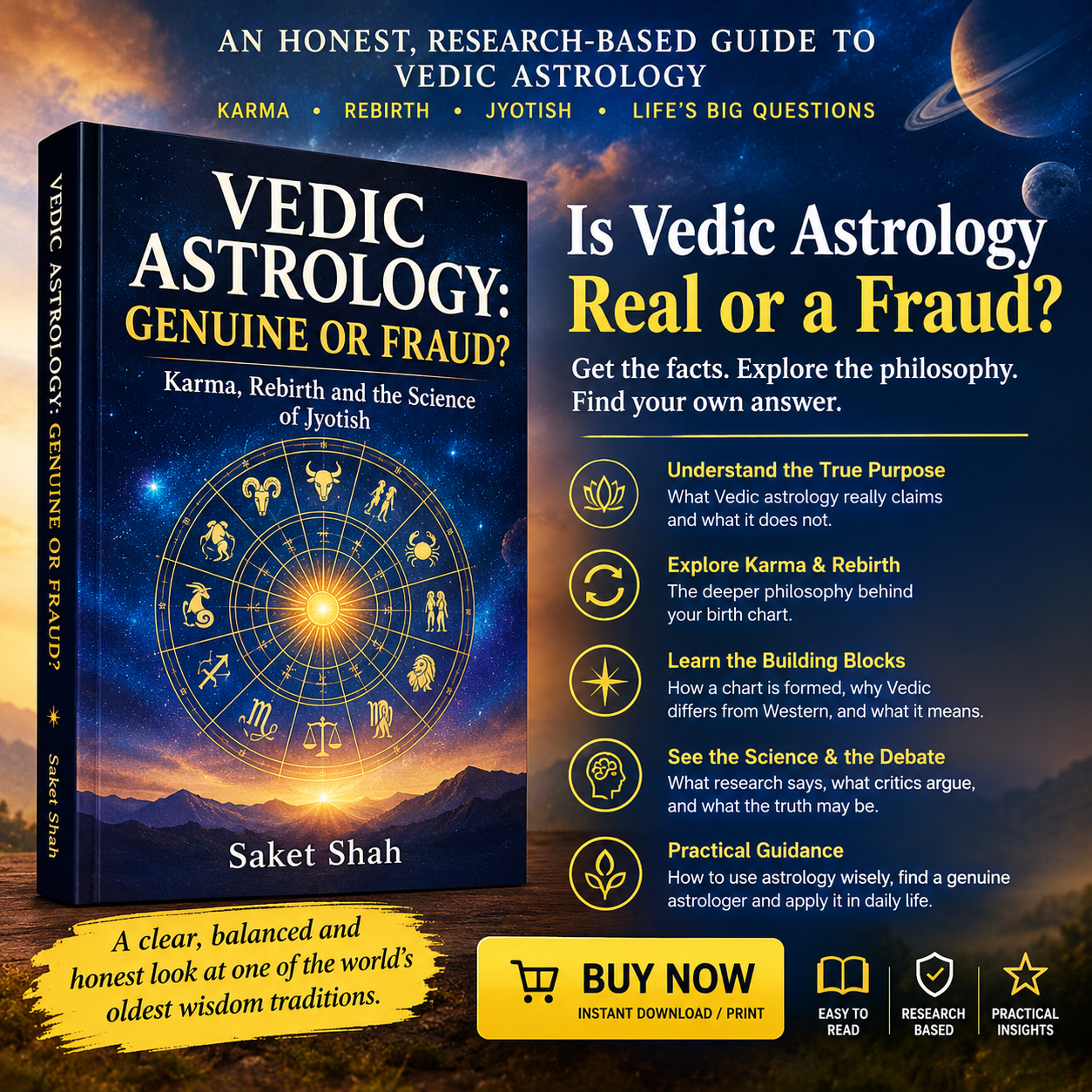
Vedic Astrology: Genuine or Fraud? Karma, Rebirth and the Science of Jyotish
Vedic Astrology: Genuine or Fraud?
Karma, Rebirth and the Science of Jyotish
By Saket Shah
Is Vedic Astrology a genuine source of wisdom—or a belief system that deserves deeper questioning?
For centuries, Jyotish has guided people in India through questions of destiny, karma, marriage, career, spiritual purpose and the timing of important life events. Yet one question continues to challenge believers and sceptics alike:
Is Vedic Astrology genuine, or is it fraud?
In this thought-provoking book, Saket Shah explores this important question through the philosophical foundations of Jyotish, the principles of karma and rebirth, the structure of the Vedic birth chart, and the ongoing debate surrounding astrology and scientific evidence.
This is an invitation to investigate, reflect and form your own understanding—not simply to believe everything you hear.
DISCOVER THE DEEPER PHILOSOPHY OF JYOTISH
Vedic astrology is more than the interpretation of planetary placements. Within its traditional framework, the birth chart is connected with karma, the soul's journey, the timing of experiences and the relationship between destiny and human effort.
This book takes you through these ideas step by step, explaining the traditional worldview while also acknowledging the questions and criticisms that every serious student should consider.
Whether you are a devoted astrology student, a practising astrologer, a spiritual seeker or a curious sceptic, this book offers an accessible introduction to the central questions surrounding Jyotish.
WHAT YOU WILL EXPLORE INSIDE
1. Is Vedic Astrology Genuine or Fraud?
Examine the central question behind astrology, distinguish sincere practice from dishonest claims, and learn why blind belief and blind rejection can both prevent thoughtful investigation.
2. Jyotish: The Eye of the Vedas
Discover the place of Jyotish in the Vedic tradition, its historical branches, its classical foundations and its connection with astronomical calculations and the Hindu calendar.
3. The Sidereal Zodiac and the Western Zodiac
Understand the difference between the sidereal and tropical zodiac, the role of ayanamsa, and why Vedic and Western astrologers may assign different signs to the same planet.
4. The Building Blocks of a Vedic Birth Chart
Explore the twelve rashis, nine grahas, twelve bhavas, twenty-seven nakshatras, planetary combinations and divisional charts. Learn how these components form the foundation of traditional chart interpretation.
5. The Law of Karma
Discover the traditional distinctions between sanchita, prarabdha and kriyamana karma, and explore how Jyotish connects planetary symbolism with the philosophy of cause and effect.
6. Rebirth, Past Lives and the Soul
Examine the role of rebirth in Indian philosophy, the traditional interpretation of past-life indications, and the arguments and questions surrounding reported past-life memories.
7. The Vimshottari Dasha System
Learn how planetary periods and subperiods are traditionally used to interpret the timing of life events, alongside planetary transits.
8. How Could Astrology Work?
Explore the ideas of planetary correspondence, synchronicity, natural cycles and symbolic information as explanations proposed by astrology's defenders.
9. The Scientific Debate
Consider the Carlson experiment, the Barnum effect, confirmation bias, the disputed Mars effect and the limitations of the evidence. This chapter addresses criticism rather than asking readers to ignore it.
10. The Nine Planets as Karmic Teachers
Explore the traditional symbolism of the Sun, Moon, Mars, Mercury, Jupiter, Venus, Saturn, Rahu and Ketu—and the lessons associated with each graha.
11. Common Questions About Astrology
Examine questions about prediction, exact event timing, Mangal Dosha, scientific evidence, health-related claims and how to begin studying astrology responsibly.
12. Astrology in Indian Life
Discover the role of the panchang, nakshatras, marriage matching, auspicious timing and astrological customs in Indian culture.
13. Karma in Everyday Practice
Explore practical reflections on intention, responsibility, self-discipline, forgiveness, service and patience.
14. Free Will and Destiny
Consider the relationship between the birth chart, personal choices and the traditional belief that human effort remains meaningful.
15. Remedies and Their Limits
Explore the traditional purpose of astrological remedies and the importance of approaching them thoughtfully rather than through fear.
The book also includes guidance on finding a genuine astrologer, reading your life as a karmic story, a glossary of terms, selected reading and practical questions to ask an astrologer.
WHY THIS BOOK IS DIFFERENT
- A balanced approach: Traditional explanations are presented alongside important criticisms.
- Philosophy and practical learning: Connect the concepts of karma and rebirth with the foundations of chart interpretation.
- A structured introduction: Move from the basic components of Jyotish to dashas, transits, remedies and free will.
- An honest discussion of scientific evidence: Understand the difference between astronomical calculation and claims about astrological prediction.
- Protection against misleading claims: Learn why guaranteed predictions, fear-based remedies and unquestioning acceptance deserve caution.
- A path to independent judgment: Develop your own perspective instead of relying entirely on another person's beliefs.
WHO SHOULD READ THIS BOOK?
This book is suitable for:
- Students beginning their journey into Vedic astrology.
- Practising astrologers interested in the philosophical foundations of Jyotish.
- Readers exploring karma, rebirth and the concept of destiny.
- People comparing Vedic astrology with Western astrology.
- Spiritual seekers who want to understand the traditional Indian worldview.
- Sceptics who want to understand what Jyotish claims before evaluating it.
- Readers looking for a thoughtful introduction to the debate about astrology and science.
WHAT YOU WILL TAKE AWAY
By the end of this book, you will have a clearer understanding of how Vedic astrology is structured, why karma and rebirth are central to its traditional philosophy, how planetary periods are interpreted, and what questions arise when astrology is examined critically.
Most importantly, you will be encouraged to approach Jyotish with curiosity, discernment and independent thought.
AN INVITATION TO THINK DEEPLY
Must you accept every astrological prediction to appreciate Jyotish? Must you reject an entire tradition because some practitioners make exaggerated claims?
This book invites you to look more carefully.
Explore the philosophy. Understand the chart. Examine the arguments. Consider the evidence. Then reach your own conclusion.
GET YOUR COPY TODAY
Vedic Astrology: Genuine or Fraud? — Karma, Rebirth and the Science of Jyotish
Author: Saket Shah
Begin your exploration of one of India's most enduring astrological traditions and discover the ideas, questions and debates that surround it.
Add this book to your astrology library today.
Note: This book explores traditional astrological and philosophical perspectives; it does not establish astrology as scientifically proven. Astrological interpretations should not replace professional medical, financial or other qualified advice.
Keywords
Vedic Astrology, Jyotish, Vedic Astrology Book, Is Astrology Genuine, Vedic Astrology Explained, Karma and Rebirth, Science of Jyotish, Is Vedic Astrology Real or Fraud, Genuine Vedic Astrology and Astrology Scams, Karma and Rebirth in Hindu Philosophy, Vedic Astrology for Beginners, Sidereal Zodiac vs Western Zodiac, Understanding Vedic Birth Charts, Vimshottari Dasha System Explained, Vedic Astrology and Scientific Evidence, Nine Planets in Vedic Astrology, Free Will and Destiny in Jyotish, Traditional Indian Astrology Philosophy, How to Find a Genuine Astrologer