
Both Flowers Are Real: Being Autistic, Understanding Your Kiddo Beyond the Diagnosis
Both Flowers Are Real: Being Autistic, Understanding Your Kiddo Beyond the Diagnosis
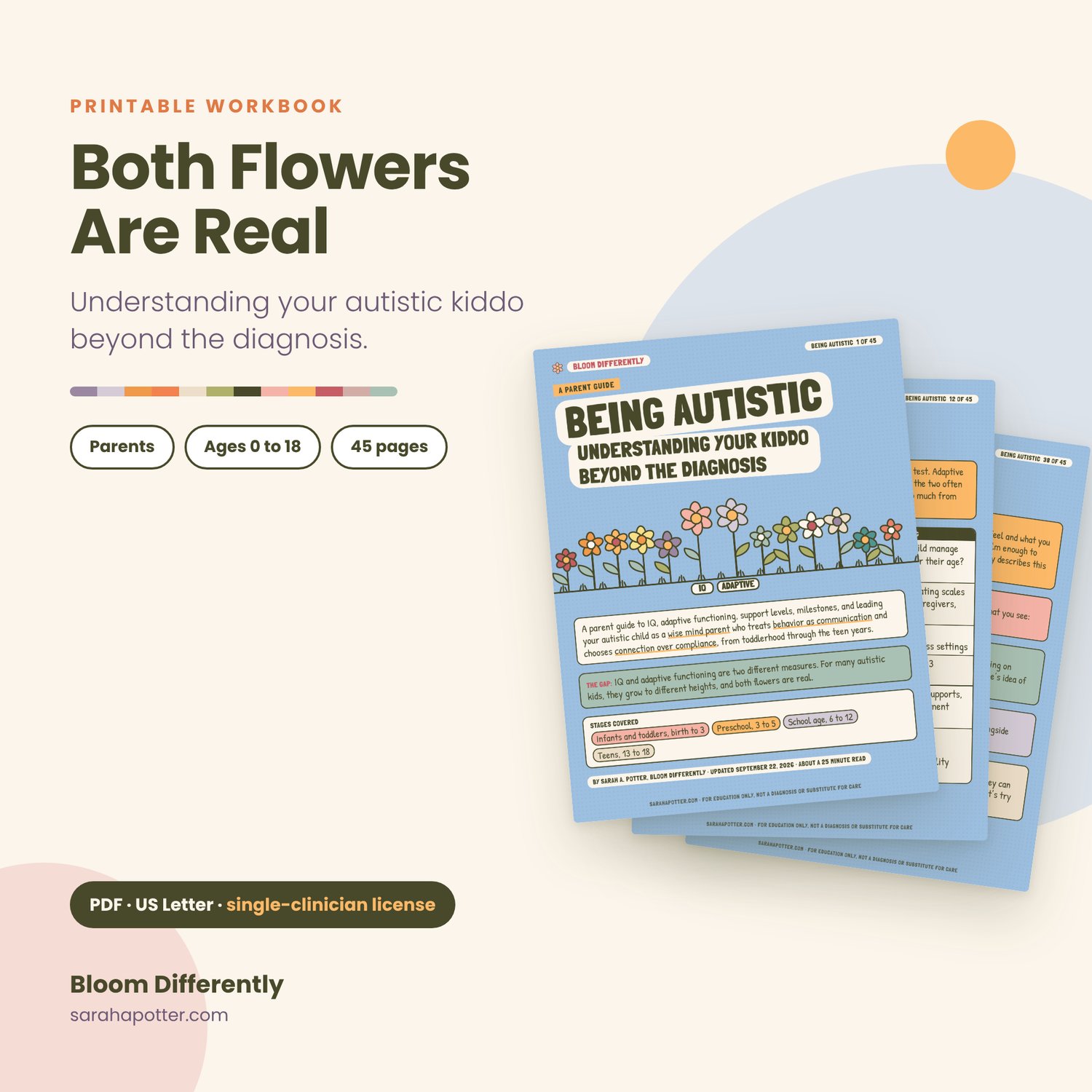
A parent workbook on IQ, adaptive functioning, support levels, milestones and connection over compliance, from toddlerhood through the teen years.
An autism diagnosis often comes with a pile of numbers and labels: an IQ score, adaptive scores, a support level. For many autistic kids, IQ and adaptive functioning grow to different heights, and both are real. This 45-page workbook helps parents understand what those measures do and don’t say. It shows how to read behavior as communication and how to lead from a wise mind, matching demands to capacity at every age.
What’s inside
- Start here: 8 key takeaways, and the two lenses for the whole guide: behavior is communication, and the wise mind parent.
- Part 1, IQ: what an IQ test actually measures, what it doesn’t, why it can mislead, and what it means at each stage.
- Part 2, Adaptive functioning: what it is, the IQ-adaptive gap, why daily life can cost autistic kids more (executive functioning, sensory load, masking), and expected skills by stage.
- Part 3, IQ vs. adaptive functioning and support levels: why the difference protects kids from the “too smart to need help” trap, illustrated examples, and what the DSM-5-TR levels mean and don’t mean.
- Part 4, What autistic adults want parents to know: “Don’t Mourn for Us,” why acceptance and skill-building belong together, what autistic adults say about therapies, and kids with high support needs.
- Part 5, Milestones and when to check in: signs to talk about from birth to 5, milestones from 6 to 18, and when losing skills means calling the doctor.
- Part 6, Erikson’s stages: the emotional work of each age (trust, autonomy, initiative, industry and identity) and how compliance pressure can work against it.
- Part 7, Compliance, demands and capacity:Why demands hit neurodivergent kids harder.
- Why affirming doesn’t mean permissive.
- Stage-by-stage “compliance version vs. what the behavior may be communicating” pages.
- Declarative language.
- A quick capacity check before any demand.
- Teaching kids to handle other people’s demands and advocate for themselves.
- Parent questions: answers to the most common questions.
- Sources: a full APA reference list.
Who it’s for
- Parents of newly diagnosed autistic children and teens.
- Parents confused by evaluation reports, IQ scores or support levels.
- Families who want an alternative to compliance-based approaches.
- Therapists, early intervention providers and parent coaches looking for a comprehensive, affirming parent resource.
Ways to use it
- As a post-diagnosis parent resource, read in parts over several weeks.
- Alongside an evaluation report, to help parents make sense of the numbers.
- As a parent-coaching curriculum, one part per session.
- Jump to your child’s stage in Parts 1, 2, 5, 6 and 7.
Why it’s different
Most parent guides either explain the diagnosis or offer strategies. This one does both, and it adds a perspective many leave out: what autistic adults want parents to know. It replaces deficit language like “high or low functioning” and “noncompliant” with what a child is communicating. It shows parents how to hold acceptance and skill-building together without pressure or threat.
What you get
- 1 printable PDF, 45 pages, US Letter
- 7 parts covering birth to 18, with stage-by-stage guidance, a capacity check, a declarative language guide, parent Q&A and full references
- Single-clinician license included
Pairs well with
- Regulation Over Compliance: Big Feelings, Growing Brains
- Here and NEVER Out of Place: Autistic Teens
- Calm Is Contagious: Wise Mind Parenting
- When the Cup Overflows (Sensory Meltdowns)