
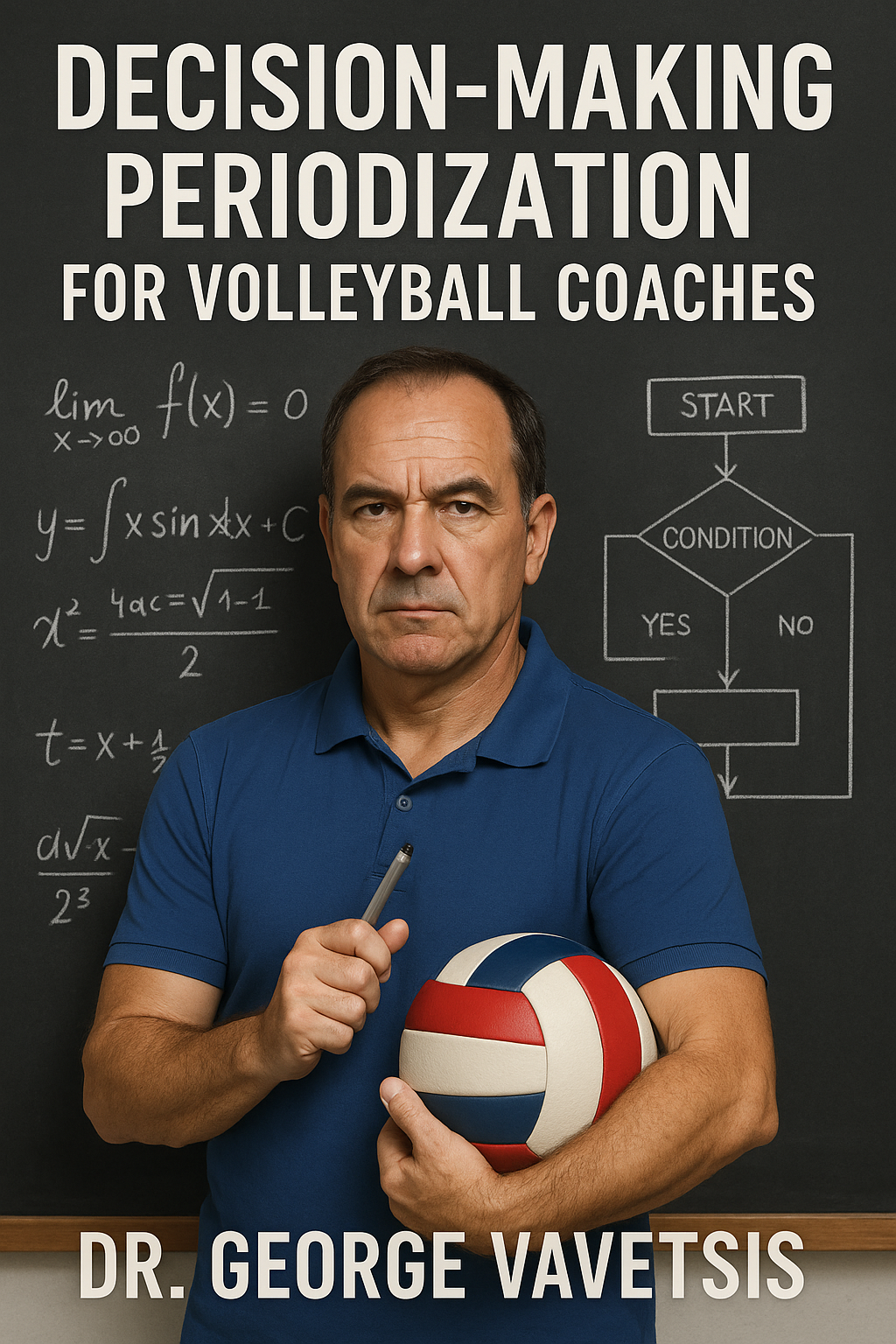
Decision-Making Periodization for Volleyball Coaches
Pages: 1438
Decision-making in volleyball is not merely a cognitive skill — it is a survival mechanism. The speed of competitive play allows athletes only fractions of a second to perceive a changing environment, extract key cues from the opposition, and generate a coordinated motor response. In a single rally, players are challenged to predict trajectories, decode deceptive intentions, and update strategic choices in real time, all while navigating immense physical and psychological pressure. As the game continues to accelerate, the future of volleyball performance lies not only in higher jumps, harder serves, or faster transitions, but in the athlete’s ability to think, decide, and execute with neurocognitive precision.
The seeds of this book were planted through countless hours in training halls, in video rooms, and at the edges of benches during tense fifth sets. Observing elite athletes operates like a moving symphony of interactions — anticipation windows opening and shutting, blockers reading shoulder-line cues, liberos decoding micro-wobbles of float serves, setters feeding attackers based on milliseconds of perceptual gain. When decisions are correct, the execution appears effortless — a pipe attack perfectly timed against a quick offense or a defensive read that transforms what looked like a point lost into a point won. But behind these split-second solutions lies a complex architecture of neural shortcuts, gaze strategies, movement heuristics, and structured communication patterns. Volleyball intelligence is not a mystery — it is a science.
Across the last decade, sport neuroscience has rapidly progressed, giving coaches unparalleled insight into how expert performers perceive and act under time constraints. Eye-tracking studies have identified gaze sequences that differentiate expert blockers from novices. Event-related brain potential research has measured how players recognise serve aerodynamics even before flight cues become visible. Machine learning models have begun to predict tactical tendencies in rotation-specific contexts with remarkable accuracy. It is now possible to design training drills backwards — starting from the decision first — and allowing the movement to emerge as a downstream solution to perceptual triggers.
Yet, in practice, coaching methodologies have not fully integrated these scientific advances. Much of volleyball decision training still relies on experience-driven intuition, trial-and-error learning, or generic tactical coaching language that fails to supply the brain with the precise cues it needs. Athletes are often instructed to “read faster,” “stay balanced,” or “watch the hitter,” without a true understanding of what to read, when to shift attention, or which decisions matter most in each phase of the rally. To elevate cognitive performance, our teaching must elevate as well.
This book offers a systematic framework for Decision-Making Periodization — a way of organizing cognitive load, perceptual cue exposure, motor-reaction complexity, and tactical variability across the long-term development of a volleyball athlete. Each chapter delves into distinct neurocognitive demands that surface in volleyball contexts: setter-driven cortical anticipation, perceptual-motor integration in blocking, angular judgement in reception, deception and constraint-adaptation out-of-system, and many more. Across positions, we explore the decision rules, cue hierarchies, and execution strategies that separate ordinary performance from elite functionality.
The structure of this book is intentionally designed for the modern coach — the one who must operate at the intersection of technology, tactical expertise, and human behaviour. Concepts are presented firmly grounded in sport science, while simultaneously translated into the applied language of the gym. Every theoretical mechanism connects to training interventions, drill progressions, communication cues, and performance KPIs that can be implemented immediately. The aim is not only to teach players how to make better decisions, but to teach coaches how to train better thinkers.
This text also reflects a broader cultural shift in high-performance volleyball. The days when a libero or setter would be valued solely for technical touch or creativity are gone. Coaches now demand athletes with exceptional perceptual literacy — individuals who can self-organize in chaotic neutral situations, actively update their predictive models during rallies, and maintain composure under neural fatigue. Those who thrive under pressure are not relying on instinct — they are relying on rehearsed cognition. They have trained decision-making as diligently as they have trained their jump height.
The motivation behind this project has always been deeply personal. Throughout my career, I have seen exceptional talents struggle not because of physical limitations, but because the game outpaced their mind. I have also seen athletes with average physiological tools rise to elite status because they made the right decision earlier than everyone else. Volleyball is beautiful in that way: intelligence and discipline often defeat raw power. By developing the decision-maker within the player, we unlock the craft of volleyball — the art within the sport.
As you begin this journey through the science of volleyball cognition, approach with curiosity and intention. Reflect on how your athletes allocate attention. Notice the timing of their decisions. Study their reactions to tactical uncertainty. Guide them to look with purpose, interpret with clarity, and move with conviction. Help them discover that winning decisions are not reactions — they are anticipations.
This book is dedicated to every athlete who aims to transform the game inside their head before transforming the game on the court — and to every coach who believes that the smartest team often wins.
Welcome to the next evolution of volleyball performance.