
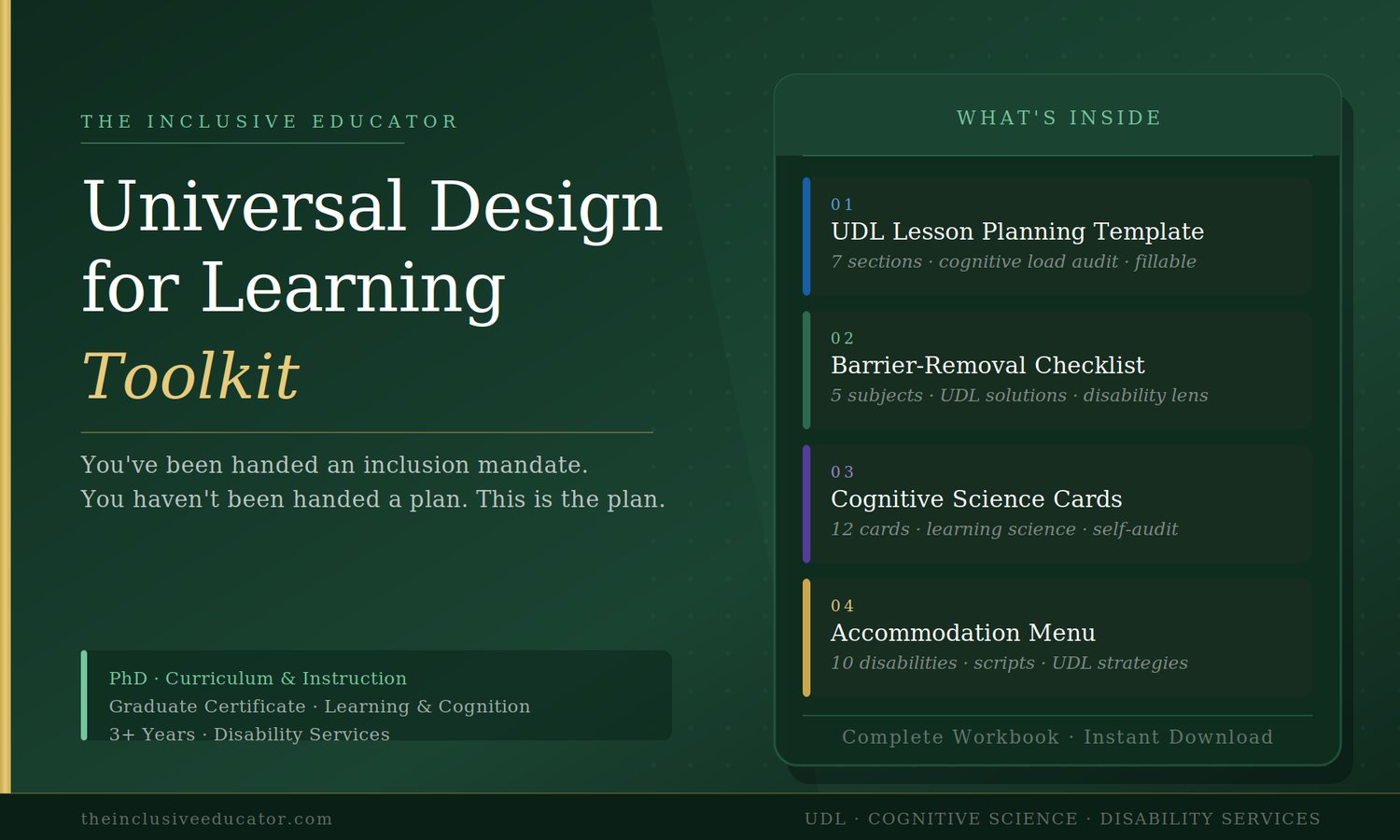
Universal Design Workbook
Most UDL resources tell you what to do. This one tells you why it
works and gives you the exact tools to do it.
The UDL Implementation Toolkit is a complete, research-grounded
workbook for K–12 and higher education teachers who want to implement
Universal Design for Learning with real fidelity. Not as a compliance
exercise. Not as an add-on to existing planning. As a genuine shift
in how instruction is designed — one that reaches every student in
the room, including those with disabilities, without requiring a
different lesson for each one.
The toolkit was developed by an education specialist with a PhD in
Curriculum and Instruction, a graduate certificate in Learning and
Cognition, and years of direct experience in
disability services. That combination matters. Most UDL tools are
written by curriculum generalists. This one connects the learning
science to the disability research so you understand not just what
to do, but why it works, and who it most directly helps.
WHAT'S IN THE WORKBOOK
──────────────────────
COMPONENT 1 — UDL Lesson Planning Template
A full structured lesson planner with seven sections built to guide
genuinely inclusive lesson design from the first planning decision.
Includes: lesson overview, learning goals with stretch targets, the
three UDL design sections (Representation, Action & Expression, and
Engagement), a six-point cognitive load audit grounded in learning
science, an accommodation integration table for students with IEPs
and 504s, a five-phase lesson sequence planner, and a post-lesson
reflection section. Editable fields throughout. Designed for digital
use in Word or Google Docs, or print and complete by hand.
COMPONENT 2 — Barrier-Removal Checklist by Subject Area
Five subject-specific one-pagers covering ELA, Mathematics, Science,
Social Studies, and a general cross-curricular section. Each entry
identifies a common instructional barrier, the UDL principle it
violates, a specific actionable solution, and a disability lens column
explaining which students are most affected and the cognitive or
neurological reason why. Use this as a pre-unit audit — before you
plan, not after you've already taught.
COMPONENT 3 — Cognitive Science Quick-Reference Cards
Twelve cards translating core principles from learning science into
concrete UDL classroom practice. Covers: Cognitive Load Theory,
Retrieval Practice, Spaced Practice, Dual Coding, Worked Examples,
Metacognition, Interleaving, Growth Mindset and Attribution, the
Curse of Knowledge, Transfer-Appropriate Processing, Automaticity,
and a master Pre-Lesson Self-Audit card that consolidates all eleven
principles into a single planning checklist. Each card includes a
plain-English explanation, a classroom application, a disability lens,
and a self-audit question.
COMPONENT 4 — Accommodation Menu for 10 Common Disabilities
Evidence-based accommodation profiles for ten of the most commonly
encountered disabilities in educational settings: Dyslexia, ADHD,
Autism Spectrum Disorder, Dyscalculia, Anxiety Disorders, Sensory
Processing Disorder, Intellectual Disability, Traumatic Brain Injury,
Hearing Impairment, and Visual Impairment. Each entry includes a
plain-English disability profile, common classroom challenges, seven
or more specific evidence-based accommodations with implementation
guidance, UDL strategies that benefit all students, and a suggested
conversation script for talking with the student directly about their
support needs.
ALSO INCLUDED
· Welcome and orientation guide
· Accommodation vs. modification explainer (critical legal
distinction most teachers get wrong)
· Two ruled note pages for professional development use
· Complete legal disclaimer and language note
WHO THIS IS FOR
───────────────
→ General education teachers who have students with IEPs or 504s
and want practical tools, not just a list of strategies
→ Special educators who want a research-grounded planning system
they can share with general ed colleagues
→ Instructional coaches and curriculum designers who are supporting
teachers in implementing inclusive practice at scale
→ Higher education faculty navigating disability services and
accommodation planning in postsecondary settings
→ Any educator who has heard "just do UDL" without ever being shown
how
THIS IS NOT FOR YOU IF
──────────────────────
→ You are looking for a surface-level tip sheet. Every element of
this toolkit is grounded in specific research and explained in
enough depth to change how you actually plan.
→ You want a passive resource to file away. This is a working
document designed to be opened every time you plan a lesson.
A NOTE ON WHAT THIS IS AND ISN'T
──────────────────────────────────
This toolkit covers accommodations — changes to how students access
or demonstrate learning — not modifications, which change what
students are expected to learn. Modifications require IEP
documentation. This toolkit is not a substitute for an IEP, 504
Plan, or formal evaluation. Always follow the specific documentation
for each student. When in doubt, consult your special education
coordinator.
FREQUENTLY ASKED QUESTIONS
───────────────────────────
What format does the workbook come in?
The workbook is delivered as a .docx file (Microsoft Word), which
opens in Word, Google Docs, and most other document editors. All
fields are editable. A PDF version for printing is also included.
Can I share this with colleagues?
This license covers a single educator. If your school or department
wants to use the toolkit across multiple classrooms, please contact
for school or district licensing options.
Is this appropriate for higher education as well as K–12?
Yes. The lesson planning template, cognitive science cards, and
barrier-removal checklists apply equally to postsecondary
instruction. The accommodation menu includes notes on how each
disability presents in higher education contexts.
I already know what UDL is. Is this still useful?
Yes — and possibly more so. This toolkit is not an introduction to
UDL. It assumes you understand the framework and gives you the tools
to actually implement it with specificity. The cognitive science
cards and barrier-removal checklist in particular are designed for
educators who are past the basics and ready to go deeper.
What is your refund policy?
Because this is a digital product delivered instantly, all sales are
final. If you experience a technical issue accessing or downloading
your files, please reach out and it will be resolved immediately.