
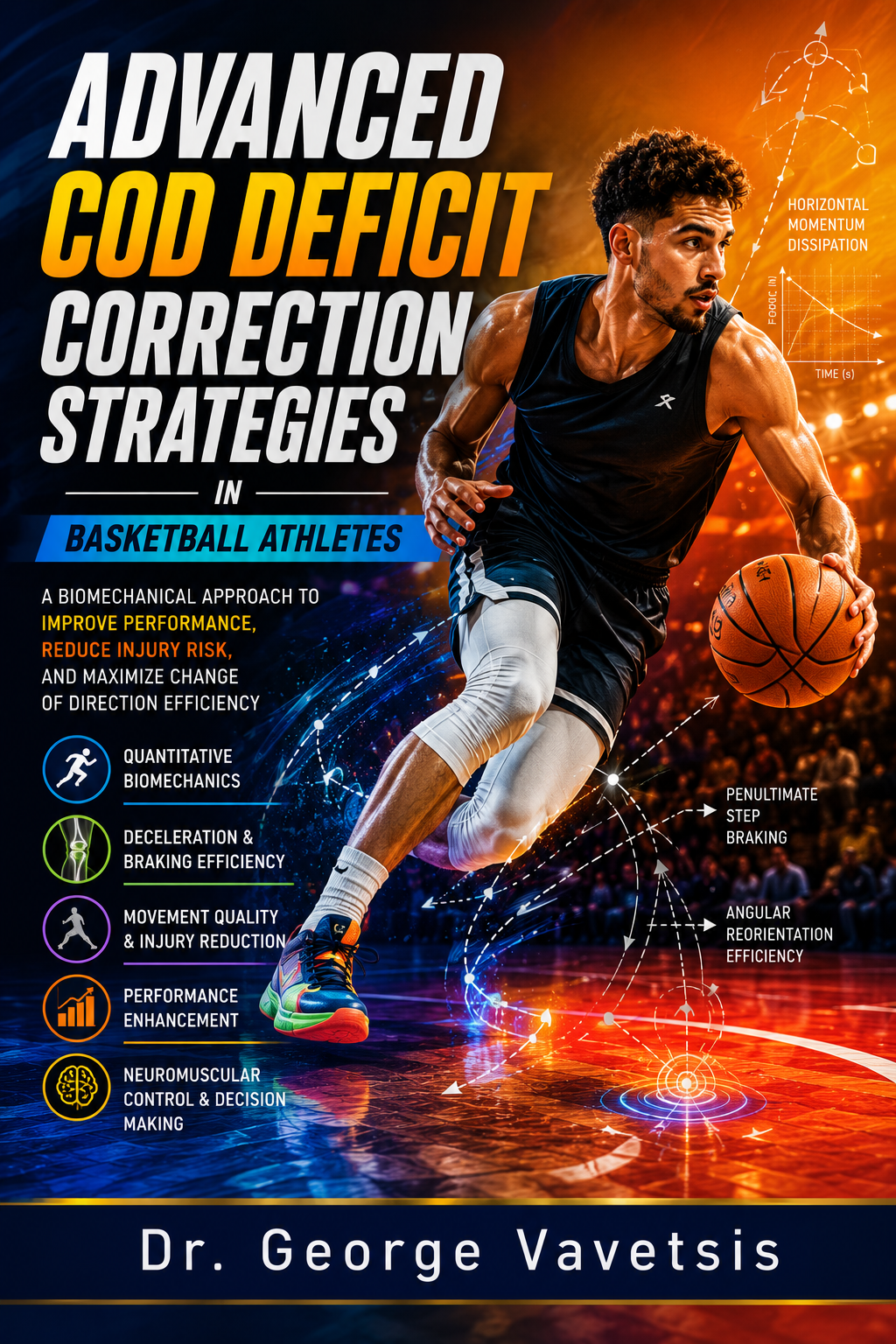
Advanced COD Deficit Correction Strategies in Basketball Athletes
Pages: 823
Basketball is no longer governed exclusively by linear sprint speed, vertical jump capacity, or generalized athleticism. Modern elite basketball is increasingly defined by the athlete’s ability to rapidly decelerate, reorganize momentum, manipulate ground-reaction forces, and redirect the body under extreme spatial and temporal constraints. Within this evolving neuromechanical landscape, Change-of-Direction (COD) deficit has emerged as one of the most important performance and injury-risk indicators in contemporary basketball performance science.
Advanced COD Deficit Correction Strategies in Basketball Athletes was written to address a major gap between traditional agility training methods and the true biomechanical complexity of multidirectional basketball movement. Conventional approaches often reduce COD development to cones, ladders, reaction drills, or generic agility tests. However, elite-level COD performance is not merely a skill of “changing direction quickly.” It is the integrated expression of eccentric braking mechanics, force-vector steering, pelvis–center-of-mass synchronization, frontal-plane stabilization, elastic energy reutilization, rotational control, and neuromuscular timing under competitive chaos.
The purpose of this book is to provide strength and conditioning coaches, sport scientists, rehabilitation specialists, and basketball performance practitioners with a scientifically rigorous and practically applied framework for understanding, diagnosing, and correcting COD deficit in basketball athletes. The text approaches COD deficit not as an isolated testing variable, but as a multidimensional biomechanical phenomenon deeply connected to injury risk, energy leakage, asymmetrical force production, and inefficient movement organization.
Basketball places extraordinary demands on deceleration efficiency. Every defensive slide, closeout, retreat step, crossover recovery, transition stop, reacceleration sequence, or rotational cut requires the athlete to absorb force, reorganize momentum, and redirect propulsion within milliseconds. The inability to efficiently perform these tasks results in increased contact times, excessive braking duration, poor elastic recycling, unstable frontal-plane mechanics, and increased mechanical stress on passive structures such as the ACL, ankle ligaments, hip capsule, and lumbar spine.
This book therefore emphasizes a principle often neglected in traditional basketball conditioning:
Elite COD performance is primarily a braking and force-management problem before it becomes a speed problem.
The athlete who cannot efficiently decelerate cannot efficiently reaccelerate. The athlete who cannot organize pelvis-to-trunk force transfer cannot effectively redirect momentum. The athlete who excessively collapses into frontal-plane instability cannot sustain high-velocity multidirectional actions across an entire competitive season.
Throughout these chapters, COD deficit is examined through multiple scientific lenses, including:
- Quantitative biomechanics
- Ground-reaction force analysis
- Horizontal braking impulse mapping
- Contact-time pathology
- Frontal-plane knee projection mechanics
- Hip internal-rotation restrictions
- Ankle dorsiflexion limitations
- Trunk inclination errors
- Center-of-mass lowering strategies
- Reactive elastic stiffness behavior
- Angular reorientation efficiency
- Deceleration sequencing
- Neuromuscular asymmetry
- Force-vector dissipation
- Movement variability under fatigue
Each concept is translated into highly applied correction strategies specifically designed for basketball athletes.
A central philosophy of this text is that COD correction cannot rely solely on increasing physical capacity. Strength alone does not automatically improve directional efficiency. Many athletes possess high force outputs in traditional weight-room environments yet display substantial COD deficits because they cannot coordinate force expression within basketball-specific movement constraints.
For this reason, the corrective framework presented in this book integrates:
- Biomechanics
- Motor control
- Eccentric strength
- Elastic-reactive behavior
- Force-vector orientation
- Joint positioning
- Technical movement coaching
- Fatigue monitoring
- Constraint-based learning
- Sport-specific deceleration exposure
The programming models outlined here are therefore not generic agility systems. They are advanced movement-engineering strategies designed to reshape how basketball athletes absorb, redirect, and reproduce force.
Particular emphasis is placed on the penultimate-step braking phase, as evidence repeatedly demonstrates that inefficient braking strategies are strongly associated with increased COD deficit and elevated lower-limb loading. Coaches will learn how to identify braking inefficiencies such as excessive heel strike, overstriding, delayed COM lowering, trunk collapse, valgus projection, force leakage, and prolonged contact durations. More importantly, they will learn how to systematically correct them through highly specific exercise prescriptions and coaching interventions.
Another major objective of this book is to bridge performance enhancement and injury reduction into a unified framework. In elite basketball, these domains cannot be separated. The same biomechanical deficiencies that increase COD deficit often increase tissue stress and injury susceptibility. Excessive frontal-plane knee projection, inadequate hip internal rotation, trunk instability, poor ankle dorsiflexion, and uncontrolled COM displacement are not merely technical inefficiencies—they are risk-amplifying mechanisms.
Consequently, this book advocates for a performance model in which injury prevention emerges from movement efficiency rather than isolated “prehab” routines.
The modern basketball athlete competes in an environment characterized by congested schedules, cumulative fatigue, repeated high-intensity decelerations, and increasingly greater tactical velocity. Under these conditions, COD quality deteriorates rapidly when the athlete lacks sufficient neuromechanical robustness. Therefore, the programming methodologies within this text prioritize not only peak COD performance, but also the preservation of movement quality under fatigue, pressure, unpredictability, and repeated exposure.
This book is intentionally detailed, technical, and performance-oriented. It was written for practitioners seeking deeper scientific understanding rather than simplified coaching clichés. The chapters integrate biomechanics, neurophysiology, motor learning, and advanced strength-and-conditioning principles into a cohesive basketball-specific framework capable of elevating both athlete performance and long-term durability.
Ultimately, Advanced COD Deficit Correction Strategies in Basketball Athletes is about more than changing direction faster.
It is about engineering more resilient movement systems.
It is about teaching athletes how to absorb force without collapsing, redirect momentum without energy leakage, and maintain biomechanical integrity while competing at the highest speeds modern basketball demands.
Because in elite basketball, the difference between separation and containment, performance and inefficiency, durability and breakdown, often occurs within a single cut.