
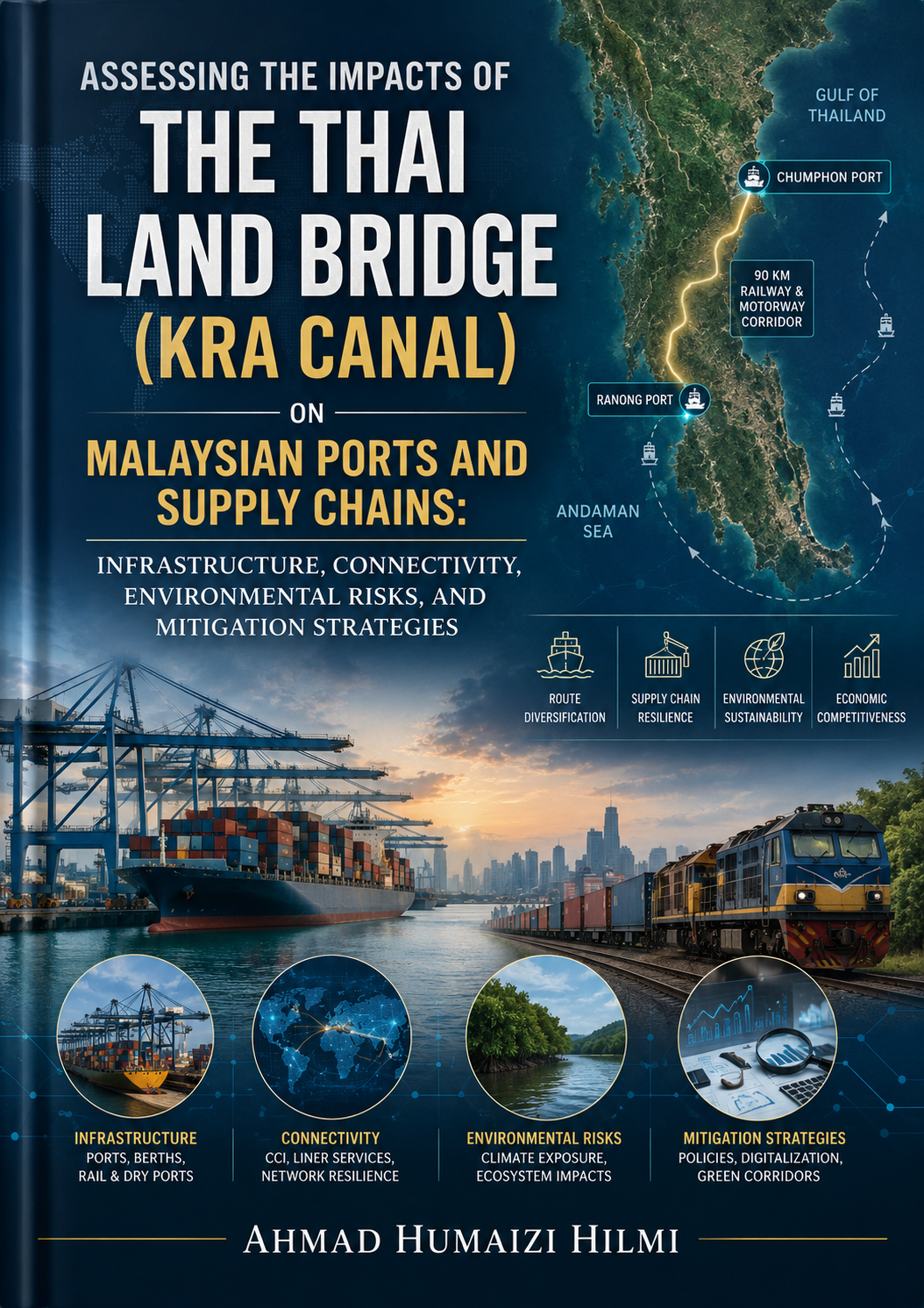
Assessing the Impacts of the Thai Land Bridge (Kra Canal) on Malaysian Ports and Supply Chains: Infrastructure, Connectivity, Environmental Risks, and Mitigation Strategies
This review evaluates how a proposed Thai Land Bridge, including Kra Canal or alternative trans‑Thailand routes, may reconfigure Malaysian port roles, liner service patterns and supply‑chain resilience by synthesising empirical precedents, infrastructure studies and modelling approaches. It argues that analysis must combine connectivity decomposition (CCI/LSCI), economy‑wide CGE assessment, efficiency frontiers (DEA/DOLS), discrete‑event and topography‑aware simulations, and systemic‑risk quantification to capture operational, sectoral and welfare effects. Major themes include likely rerouting of transshipment and gateway calls with heterogeneous impacts across container, bulk, cold‑chain and offshore energy logistics; differential investment needs for berth deepening, quay cranes, reefer capacity and dry‑port rail links; and heightened environmental and climate exposure that may concentrate systemic fragility even as sailing times fall. The literature suggests a prioritized adaptation sequence: fast, contractual and berth‑level operational changes; coordinated intermodal and dry‑port investments; and policy, tariff and digital reforms supported by green‑corridor planning and social safeguards. Robust monitoring using decomposed connectivity metrics, AIS trajectories, port asset registers and downtime indices will be essential to evaluate distributional outcomes and guide adaptive investment.