
Freelance Subcontractor Vetting & Margin Tracker
Solo freelancers hit a ceiling: there are only so many hours you can sell. The obvious next step is to subcontract overflow work to another freelancer, keep the client relationship, and keep the margin.
The difference between that working and that quietly losing you money is rarely the subcontractor. It is whether you vetted them, did the margin math, and tracked what the arrangement actually cost you. The most common mistake is comparing your billing rate to the subcontractor's rate and calling the difference profit. It is not. You also spend time briefing, reviewing, fixing, and talking to the client about work you did not do. That time is real, and it eats into the spread.
A good rule of thumb is to aim for a gross markup of 40-60% on subcontractor cost before you count your own time, and to budget 15-25% of the subcontracted hours as your own oversight time. Three practical subcontracting guides landed within weeks of each other in late 2026 — Stintly, Remote Builders, and Hustle Explained — and all three say the same thing: vet with a paid test, price with a formula that includes oversight, and keep the client relationship yourself.
This tracker does both halves: it scores subcontractors before you trust them with a client, and it prices every subcontracted project on its real margin, oversight included.
WHAT YOU GET
A formula-driven Excel workbook with 5 sheets:
1. Start Here — the method, the margin math in one paragraph, the worked example, why November 2026 is the moment, and the boundary with the other freelance tools.
2. Subcontractor Log — one row per person you might hand work to. Give them a small paid test task (2-4 hours) and score it 0-100, then rate communication and reliability 1-5. The vetting score is formula-driven: half the test score, plus communication x6, plus reliability x4, out of 100. 80 or more is Approved, 60-79 is Trial (small jobs only, watched closely), below 60 is Reject. The margin column shows what you keep at your bill rate before oversight time.
3. Project Margin — one row per subcontracted project. Enter the client bill, the subcontractor cost, your oversight hours and your hourly rate. Oversight cost, gross markup, real margin in dollars and in percent, and the verdict are all formula-driven. 25% real margin or more is Go. 10-25% means reprice or cut oversight. 0-10% is break-even — reprice before you take it. Below zero means you paid to do that project: do not take it.
4. Handoff Log — one row per handoff. Five checks: brief sent, deliverables defined, QA review done, client informed, payment terms agreed. The status is formula-driven: all five Yes is Ready to hand off, three or four is In progress, fewer is Not ready.
5. Dashboard — headline counts: subcontractors logged, approved, in trial, rejected; projects logged, total real margin, average real margin, projects below 25% margin, total oversight hours, handoffs ready, and one next action telling you what to reprice first, plus projects by verdict.
WORKED EXAMPLE INCLUDED
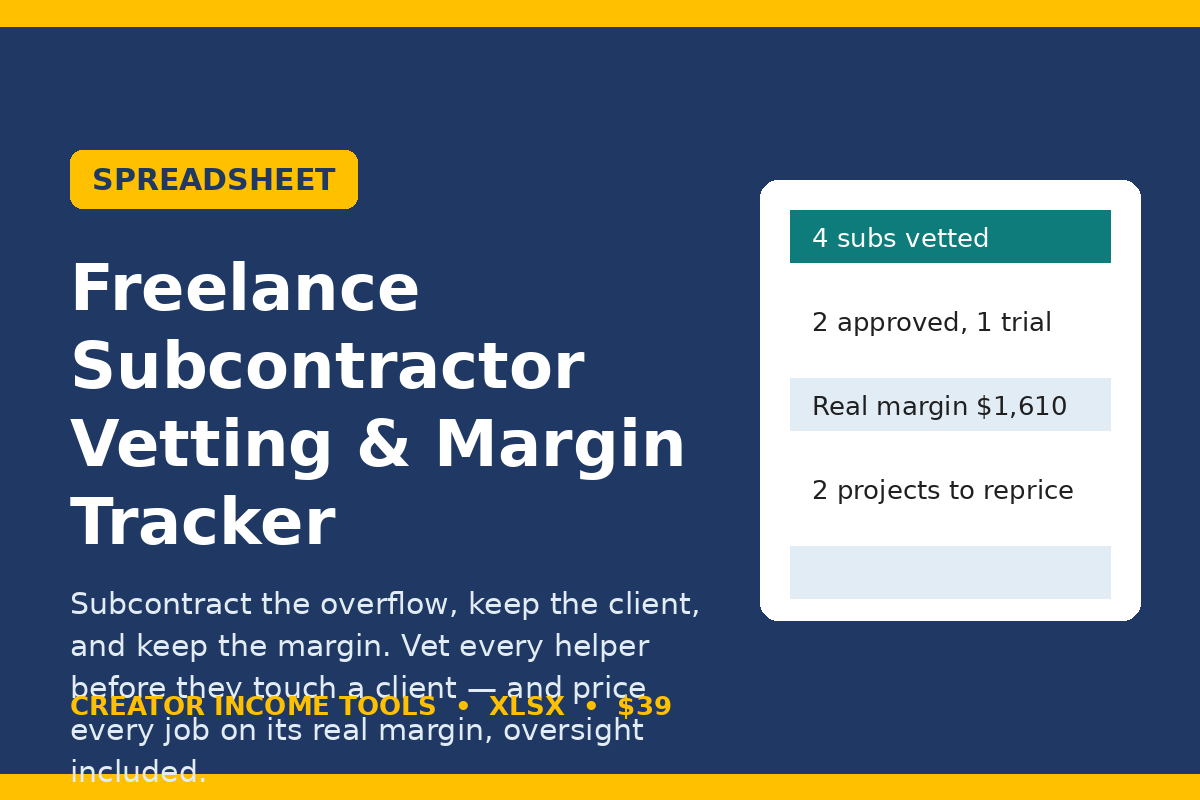
4 subcontractors and 4 projects, all formula-checked. Maya R. (copy editing, test 88, communication 5, reliability 4): vetting score 90, Approved. Daniel K. (front-end build, test 76): score 78, Trial. Priya S. (illustration, test 92): score 96, Approved. Tom W. (transcription, test 55, communication 2): score 52, Reject — his $25/hr rate looks cheap at 77.3% margin, but a low test score and poor communication mean the work comes back wrong, and margin means nothing if quality fails.
The projects: Blog content batch for Client A — bill $4,000, sub cost $2,200, 8 oversight hours at $100: real margin $1,000, 25.0%, Go. Landing pages x3 for Client B — bill $3,600, sub cost $2,700, 12 oversight hours: real margin minus $300, minus 8.3%, Don't take — you paid to do it. Newsletter design for Client C — bill $2,400, sub cost $1,200, 5 oversight hours at $90: real margin $750, 31.3%, Go. SEO reports for Client D — bill $1,800, sub cost $1,100, 6 oversight hours at $90: real margin $160, 8.9%, Break-even — reprice. Totals: $1,610 total real margin, 14.2% average, 2 projects below 25% margin, 31 oversight hours. Delete the example rows and start with your own subcontractors and projects.
THE MARGIN MATH, IN ONE PARAGRAPH
Take a client project with 40 hours of production work that you would normally bill at $100 an hour, so $4,000. Subcontractor cost: 40 hours at $55 an hour is $2,200. Your oversight time: briefing, check-ins, review and revisions — budget 15-25% of the subcontracted hours, call it 8 hours. Value of your oversight time: 8 hours at $100 is $800. Real margin: $4,000 minus $2,200 minus $800 is $1,000 — a 25% margin, and healthy. Run it again with a subcontractor at $75 an hour who needs 12 hours of your oversight: $4,000 minus $3,000 minus $1,200 is minus $200. You paid to do that project. Never quote a project on the rate gap alone. Always add your oversight hours, at your own rate, before you say yes.
WHAT IT IS NOT
This tracker records vetting scores and project margins. It is general information, not legal advice: worker classification, contractor rules and disclosure duties vary by country — the UK, Australia and the US all treat them differently — so check the official sources for your country before you engage anyone, and ask a qualified lawyer or accountant if a subcontract affects a client's legal or tax position. The 40-60% markup rule and the 15-25% oversight budget are rules of thumb from practitioner guides, not guarantees. A high vetting score is not a guarantee of quality on a real client job — start every new subcontractor on a small paid trial, and keep the client relationship yourself. Re-check your subcontractors' rates every 90 days: a rate that crept up quietly is the most common reason a healthy margin turns negative.
Subcontract the overflow. Keep the client. Keep the margin.