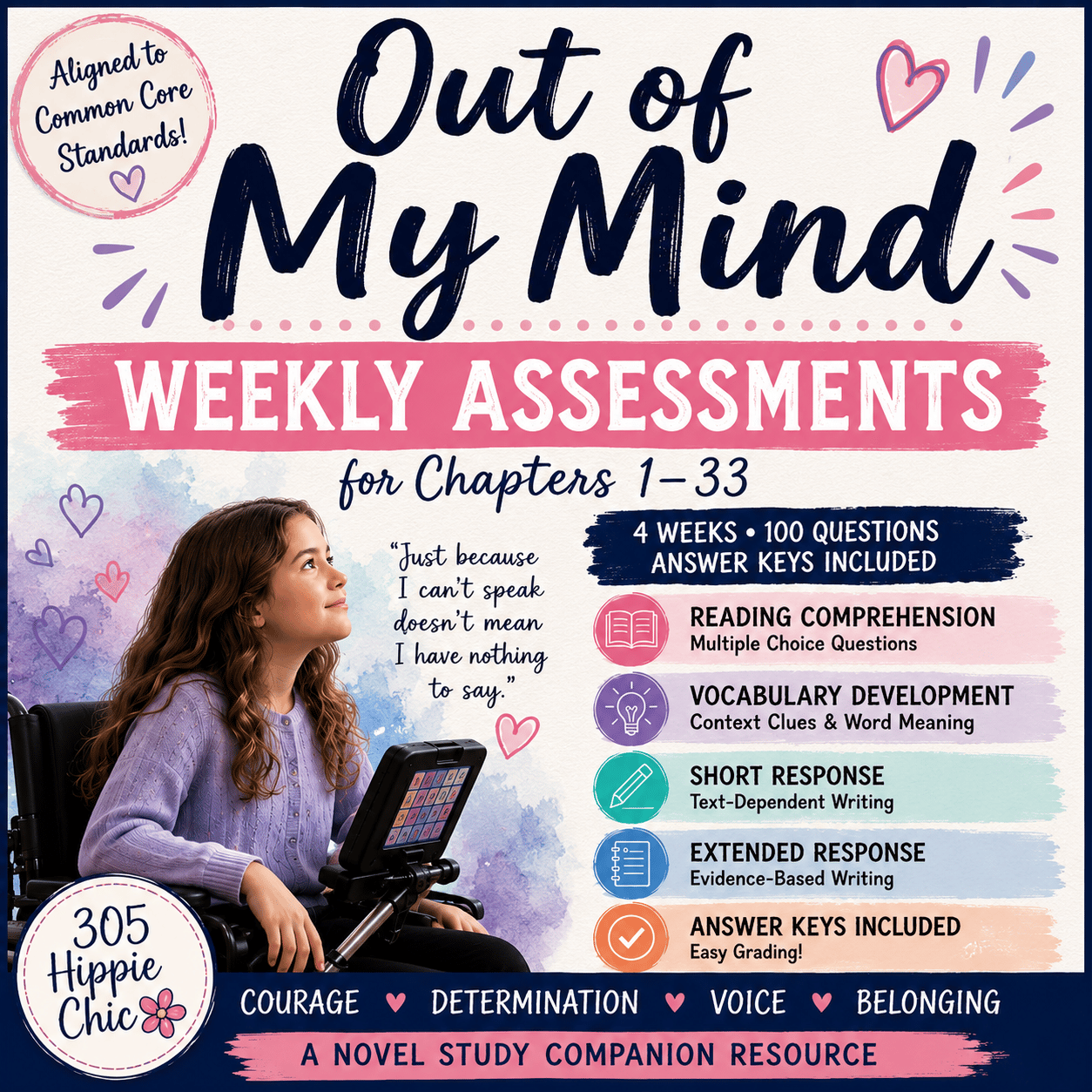
Out of My Mind Assessments | Grades 5–7 Reading Comprehension Tests, Vocabulary, Literary Analysis, Writing Prompts & Answer Keys
Out of My Mind Weekly Assessments by Sharon M. Draper | 100 Questions, 4 Reading Comprehension Tests & Answer Keys | Grades 5–7
Assess comprehension. Strengthen critical thinking. Encourage meaningful literary analysis.
Make assessing Out of My Mind by Sharon M. Draper easier with this comprehensive 28-page, four-week assessment resource designed for Grades 5–7.
Featuring 100 carefully developed assessment questions across four weekly tests, this printable PDF helps teachers evaluate reading comprehension, vocabulary knowledge, character development, literary themes, critical thinking, and evidence-based writing.
Each assessment follows a specific section of the novel, allowing educators to monitor student understanding as readers follow Melody Brooks’ extraordinary journey toward communication, acceptance, independence, and self-worth.
Unlike assessments that focus exclusively on recalling plot details, these tests encourage students to analyze character motivations, make inferences, explore literary themes, and support their interpretations with evidence from the text.
Perfect for upper elementary ELA, middle school literature classes, homeschool instruction, literature circles, reading intervention, and independent reading accountability!
📚 WHAT’S INCLUDED?
This comprehensive 28-page printable assessment resource includes:
✅ 4 Weekly Reading Assessments
Each assessment covers a designated section of Out of My Mind.
✅ 100 Total Assessment Questions
Each weekly assessment contains 25 questions designed to evaluate comprehension, vocabulary, literary analysis, and writing.
✅ Reading Comprehension Multiple-Choice Questions
Evaluate students’ understanding of significant events, character motivations, conflicts, and literary themes.
✅ Vocabulary Development Questions
Assess students’ ability to understand vocabulary, recognize word meanings, and apply language knowledge.
✅ Short-Response Writing Prompts
Encourage students to explain their thinking and support interpretations with textual evidence.
✅ Extended-Response Writing Prompts
Challenge students to analyze literary themes and character development using multiple pieces of evidence.
✅ Complete Answer Keys
Includes multiple-choice answers, vocabulary answers, and suggested responses for written questions.
✅ Common Core Standards Alignment
Supports English Language Arts standards for Grades 5–7.
📖 FOUR-WEEK ASSESSMENT BREAKDOWN
Each weekly assessment follows the novel’s progression and emphasizes a meaningful literary theme.
🌱 WEEK 1: CHAPTERS 1–8
Theme: Looking Beyond Appearances
Students demonstrate their understanding of Melody Brooks’ intelligence, determination, and experiences being underestimated by others.
Assessment Focus:
- Character traits and motivations
- Reading comprehension
- First-person point of view
- Internal conflict
- Character relationships
- Vocabulary development
- Making inferences
- Supporting interpretations with textual evidence
Short Response: Explain how an event from the opening chapters demonstrates that people judge Melody before understanding her abilities.
Extended Response: Analyze how Sharon M. Draper develops the theme of looking beyond appearances through Melody Brooks.
🌼 WEEK 2: CHAPTERS 9–16
Theme: Communication and Understanding
Students analyze Melody’s desire to communicate independently and the importance of being understood and respected.
Assessment Focus:
- Character development
- Communication and empathy
- Literary themes
- Character relationships
- Author’s purpose
- Point of view
- Vocabulary development
- Evidence-based writing
Short Response: Explain how Mrs. V helps Melody develop confidence and believe in her abilities.
Extended Response: Analyze how Sharon M. Draper develops the theme of communication and understanding through Melody’s experiences.
🌿 WEEK 3: CHAPTERS 17–24
Theme: Opportunity and Inclusion
Students examine how Melody’s communication device changes her opportunities and allows others to recognize her intelligence.
Assessment Focus:
- Character growth
- Communication and independence
- Opportunity and inclusion
- Making inferences
- Theme development
- Character motivations
- Vocabulary development
- Textual evidence
Short Response: Explain how Melody’s communication device changes her life and creates new opportunities.
Extended Response: Analyze how Sharon M. Draper develops the theme of opportunity and inclusion through Melody’s experiences.
🌻 WEEK 4: CHAPTERS 25–33
Theme: Resilience, Self-Worth, and Belonging
Students evaluate Melody’s experiences with disappointment, friendship, acceptance, and personal growth.
Assessment Focus:
- Character development
- Plot and conflict
- Literary themes
- Resilience and determination
- Friendship and belonging
- Character motivations
- Making inferences
- Evidence-based literary analysis
Students reflect on how Melody’s experiences shape her understanding of self-worth and the importance of being respected and included.
🎯 SKILLS ASSESSED
These four weekly assessments evaluate essential upper elementary and middle school literacy skills.
Reading Comprehension
- Identifying important story details
- Understanding plot development
- Making logical inferences
- Analyzing cause-and-effect relationships
- Evaluating character actions
- Supporting interpretations with textual evidence
Literary Analysis
- Identifying character traits
- Analyzing character motivations
- Examining character development
- Identifying central themes
- Understanding conflict
- Analyzing point of view
- Interpreting the author’s message
Vocabulary Development
- Determining word meanings
- Applying context clues
- Recognizing academic vocabulary
- Understanding vocabulary within literary contexts
Writing & Critical Thinking
- Constructing short written responses
- Developing extended literary analysis
- Supporting ideas with textual evidence
- Explaining character development
- Analyzing literary themes
- Organizing written explanations
Social-Emotional Connections
- Empathy and understanding
- Inclusion and belonging
- Communication
- Perseverance
- Resilience
- Self-worth
- Respect for individual differences
📘 COMMON CORE STATE STANDARDS ALIGNMENT
These assessments support Common Core English Language Arts standards for Grades 5–7.
Reading Literature
RL.5.1 / RL.6.1 / RL.7.1
Citing textual evidence to support comprehension, inference, and literary analysis.
RL.5.2 / RL.6.2 / RL.7.2
Identifying central themes and analyzing their development throughout the novel.
RL.5.3 / RL.6.3 / RL.7.3
Analyzing characters, relationships, conflicts, and significant events.
RL.5.4 / RL.6.4 / RL.7.4
Determining vocabulary meanings using context clues.
RL.5.6 / RL.6.6 / RL.7.6
Examining point of view and its influence on readers’ understanding.
Writing
W.5.1 / W.6.1 / W.7.1
Supporting ideas and interpretations with reasons and evidence.
W.5.4 / W.6.4 / W.7.4
Producing organized writing appropriate to the task.
W.5.9 / W.6.9 / W.7.9
Using textual evidence to support literary analysis and reflection.
Vocabulary & Language
L.5.4 / L.6.4 / L.7.4
Determining word meanings using context.
L.5.6 / L.6.6 / L.7.6
Developing and applying grade-appropriate academic vocabulary.
👩🏫 WHO IS THIS RESOURCE PERFECT FOR?
Upper Elementary ELA Teachers
Evaluate reading comprehension and literary analysis while reinforcing essential literacy skills.
Middle School ELA Teachers
Use structured weekly assessments to measure understanding and identify areas requiring additional instruction.
Homeschool Families
Provide organized, ready-to-use reading assessments with answer keys that support independent or guided learning.
Reading Intervention Teachers
Use selected questions to evaluate comprehension, vocabulary knowledge, inference, and written responses.
Literature Circles
Assess students’ understanding of characters, themes, and important events following assigned reading sections.
Small-Group Reading Instruction
Monitor student progress and identify opportunities for targeted instruction.
Independent Reading Programs
Encourage reading accountability through structured assessments covering all 33 chapters.
Summer Reading Programs
Evaluate comprehension and literary understanding with organized reading tests.
⭐ WHY EDUCATORS WILL LOVE THESE ASSESSMENTS
✔ 100 Questions Across Four Assessments
Provides consistent opportunities to evaluate comprehension and literary understanding.
✔ Complete Novel Coverage
Assessments cover Chapters 1–33 of Out of My Mind.
✔ Multiple Assessment Formats
Includes multiple-choice questions, vocabulary questions, short responses, and extended responses.
✔ Detailed Answer Keys
Multiple-choice answers and suggested written responses simplify grading and instructional review.
✔ Standards-Aligned Instruction
Supports Common Core ELA standards for Grades 5–7.
✔ Ready-to-Print PDF
Download, print, and distribute assessments as needed.
✔ Flexible Instructional Use
Appropriate for weekly quizzes, comprehension checks, formative assessments, homeschool instruction, and independent reading evaluations.
✔ Meaningful Literary Analysis
Encourages students to examine character development, themes, empathy, inclusion, communication, and resilience.
✔ Saves Valuable Planning Time
Eliminates the need to create four separate assessments from scratch.
📥 PRODUCT DETAILS
Product: Out of My Mind Weekly Assessments
Novel Author: Sharon M. Draper
Created By: 305HippieChic
Recommended Grades: 5–7
Subject: English Language Arts / Reading / Literature
Resource Type: Weekly Reading Assessments / Novel Study Tests
Format: Printable PDF Digital Download
Total Pages: 28
Total Assessments: 4
Total Questions: 100
Questions Per Assessment: 25
Chapters Covered: 1–33
Instructional Duration: 4 Weeks
Includes:
- Multiple-Choice Reading Comprehension
- Vocabulary Questions
- Character Analysis
- Theme Analysis
- Short-Response Writing
- Extended-Response Writing
- Complete Answer Keys
- Common Core Standards Alignment
🌼 PAIR WITH THE OUT OF MY MIND NOVEL STUDY!
Looking for a complete instructional experience?
These weekly assessments are designed to complement the 305HippieChic Out of My Mind Novel Study, which includes:
- Four weeks of structured reading activities
- Vocabulary development
- Reading comprehension questions
- Character analysis
- Theme exploration
- Short-response writing
- Reflection activities
- Teacher guidance
- Answer keys
Use the novel study to guide instruction and the weekly assessments to evaluate student learning!
Both resources can also be used independently.
Explore the complete Out of My Mind Novel Study in the 305HippieChic store.
📌 IMPORTANT PURCHASE INFORMATION
This product is a digital PDF download. No physical item will be shipped.
Students must have access to their own copy of Out of My Mind by Sharon M. Draper. The novel is not included.
This resource is independently created and is not affiliated with or endorsed by the author or publisher.
Purchase includes a single-user educational license for classroom, homeschool, tutoring, or other permitted instructional use.
Redistribution, resale, or unauthorized sharing of this digital resource is prohibited.
🌼 MAKE READING ASSESSMENT MEANINGFUL!
Out of My Mind offers powerful opportunities to explore communication, empathy, inclusion, determination, and self-worth.
These comprehensive weekly assessments help educators evaluate essential literacy skills while encouraging students to think critically about Melody Brooks’ experiences.
Save planning time, strengthen reading comprehension, and assess literary understanding with 100 ready-to-use questions and complete answer keys!
Add the Out of My Mind Weekly Assessments to your teaching resources today!
🌼 305HippieChic
Print. Write. Think. Learn.