
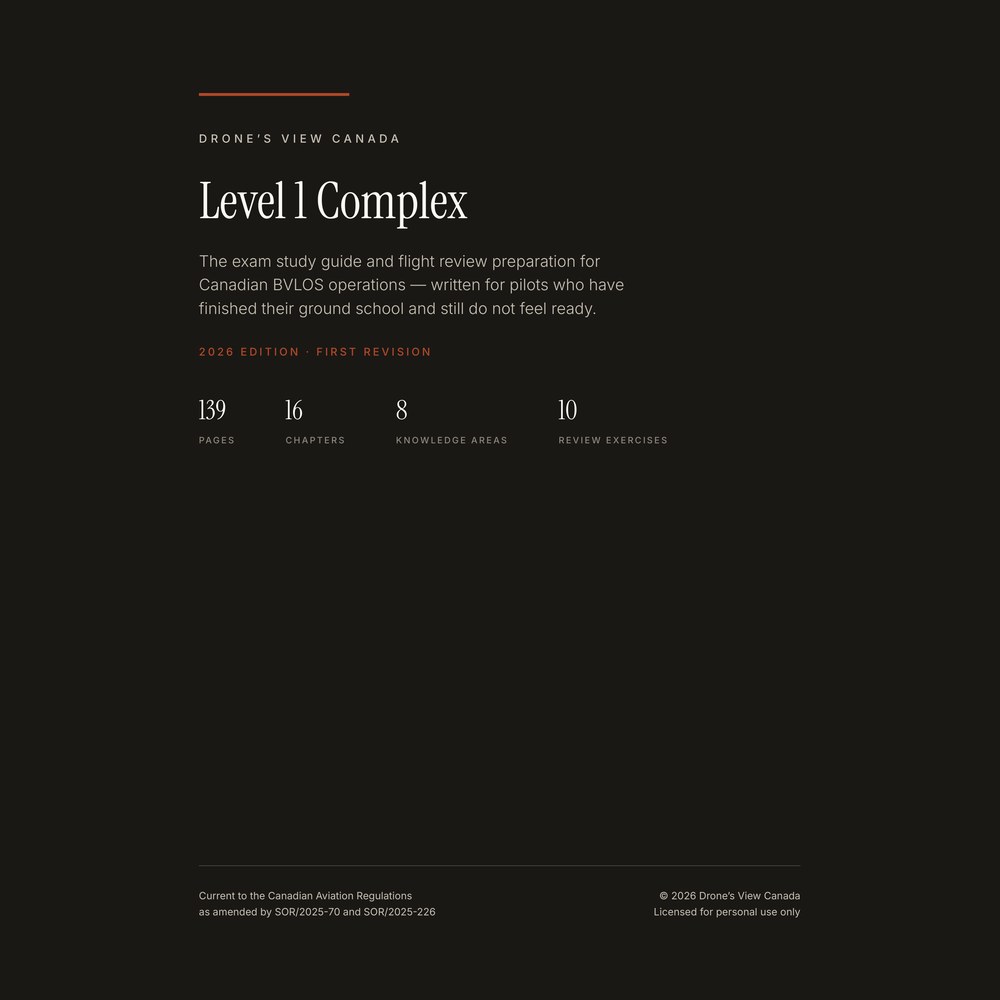
Level 1 Complex Exam Study Guide — BVLOS Certification & Flight Review Prep
You have sat through twenty hours of ground school. You have the certificate of completion in your inbox. And you still could not confidently explain, to someone who asked, what a ground risk buffer is for or why your obstacle-avoidance sensors do not count as detect and avoid.
That gap is what this guide is for.
139 pages, sixteen chapters, written for a working commercial pilot moving into BVLOS — not for a beginner. It assumes you hold an Advanced certificate and have flown for money, and it does not re-explain the airspace classes.
WHAT IS IN IT
Part one — the eight knowledge areas, in the same order Transport Canada publishes them, so you can map this guide against your ground school syllabus and find what your provider skimmed: air law and Division VI section by section; airframes, systems, command and control links, radio propagation and detect and avoid; human factors and crew resource management without a cockpit; meteorology including the Standard 923 weather gates worked as arithmetic; navigation, terrain models and population density; flight operations and the operational risk assessment end to end; theory of flight; and radiotelephony.
Part two — the flight review. Ten exercises under Standard 921.07, walked through from the reviewer's side of the table: what is actually being assessed, what a weak answer sounds like, and what a strong one sounds like. Plus the pre-review verification list that stops a review before it starts.
Part three — reference. The full pathway with current Transport Canada fees, the questions to ask a ground school before you pay it, a glossary, every number and every deadline in one place, and a page on what is changing.
WHY THIS ONE
Written by a Transport Canada–recognized flight reviewer. The flight review chapters describe the assessment from the position of the person conducting it — which is not available in any published document, because Transport Canada tells reviewers what to assess and does not tell candidates what that looks like from the other chair.
Honest about the source material. Where two Transport Canada documents contradict each other — and on Level 1 Complex several do — this guide shows you both and tells you which one governs. Standard 921 still cites a paragraph of the regulations that does not exist. You will not find that in a course workbook.
Verified, not assumed. Every citation checked against the consolidated Canadian Aviation Regulations at the Justice Laws website, current to 17 June 2026. Fees taken from Transport Canada's service fees database rather than its drone pages, because at the time of writing those pages still showed the previous year's amounts.
YOURS TO KEEP
Most Level 1 Complex material is bundled inside a course, and your access to it ends when the course does — thirty days, ninety days, or whenever the login expires. This is a PDF. Download it, print it, keep it on the tablet in the truck. It is still yours in three years when a client asks whether you can fly the job.
And it stays current: every purchaser receives all revisions published within twelve months of purchase, at no charge. The regulations are actively moving.
WHAT THIS IS NOT
This guide prepares you for the Transport Canada Level 1 Complex Operations examination. It is NOT the 20 hours of RPAS ground school instruction required under CARs 901.90(c), which must be delivered by a training provider that has made a declaration under section 921.08 of Standard 921. Nothing in it is, or can be used as, proof of completion of ground school — that comes only from your declared provider, and your flight reviewer must see it before your review begins.
Every practice question and explanation in this line is original, written from the published knowledge areas and the regulations. None of it is drawn from a real examination.
Drone's View Canada is an independent publisher and is not affiliated with, endorsed by, or produced on behalf of Transport Canada.