

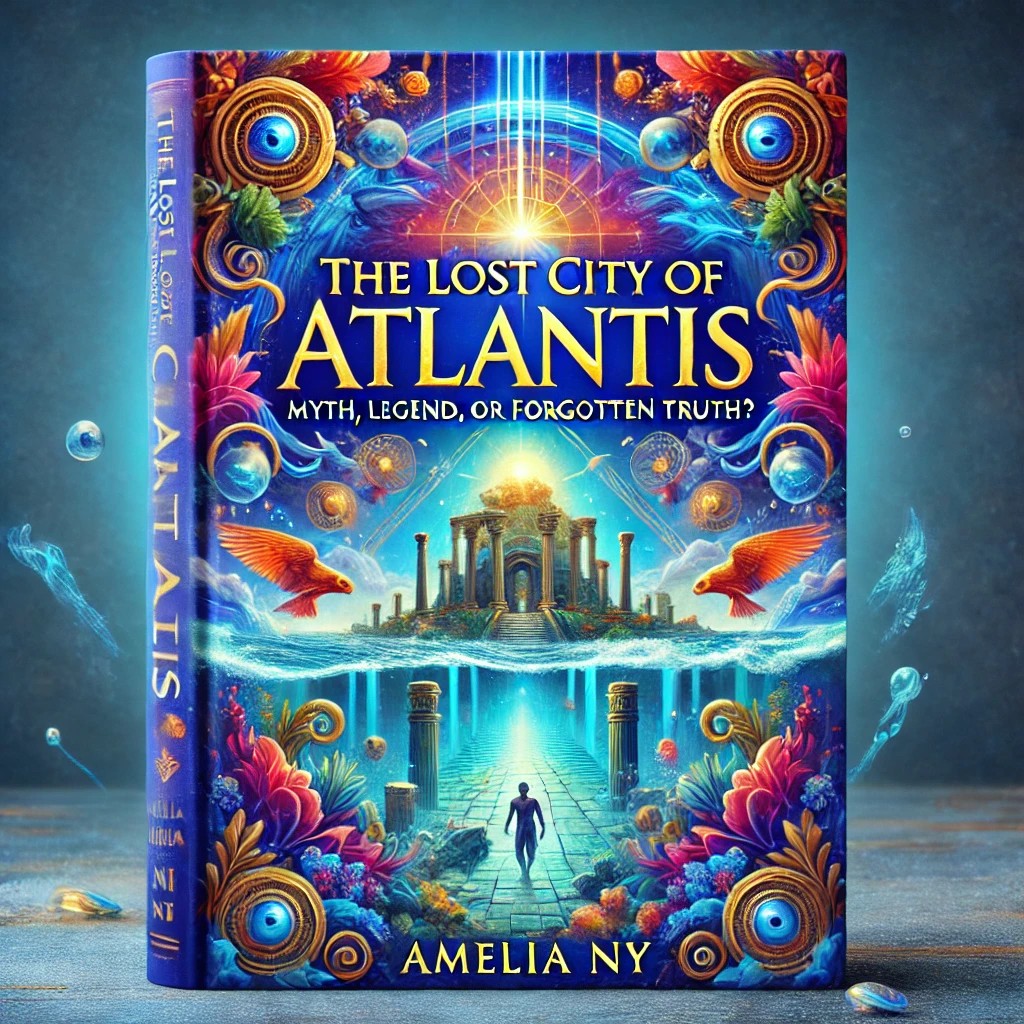
The Lost City of Atlantis Myth, Legend, or Forgotten Truth
The Lost City of Atlantis: Myth, Legend, or Forgotten Truth? takes readers on a sweeping journey through the history, mystery, science, and symbolism of one of humanity’s most enduring legends.
More than just a story about a sunken city, Atlantis becomes a powerful lens for exploring human ambition, the fragility of civilizations, and the timeless allure of the unknown.
The book begins by tracing the origins of the Atlantis story in Plato’s dialogues Timaeus and Critias, examining whether Plato intended Atlantis to be a real historical account or a moral allegory.
It investigates possible influences from ancient Egyptian records, the meaning behind Plato’s reference to "9,000 years ago," and how Atlantis fits into wider Greek mythology.
From there, the narrative dives into real-world possibilities.
It explores the Minoan civilization and the eruption of Thera as a possible inspiration, the sunken cities of Heracleion, Dwarka, and Yonaguni, and how geological changes like rising sea levels might have preserved echoes of Atlantis across different cultures.
Readers are introduced to bold theories that place Atlantis in the Americas, connect it to prehistoric advanced societies, and even link it to ancient extraterrestrial influences.
The book addresses how Atlantis became a global myth through books, movies, video games, television, and the internet, showing how the legend adapted with each generation.
Importantly, The Lost City of Atlantis does not simply chase lost ruins; it also explores Atlantis as a psychological and symbolic mirror:
- A metaphor for humanity’s lost golden age.
- A warning about the dangers of pride and technological overreach.
- A story about personal transformation and collective memory.
In the final chapters, the book considers the modern scientific search for Atlantis using sonar, satellites, and LIDAR, examines the fierce debate between skeptics and believers, and imagines what would happen if Atlantis were truly discovered—scientifically, culturally, and emotionally.
Ultimately, the book concludes that Atlantis' greatest power lies not in whether it is found beneath the ocean, but in its eternal role as a story that invites us to dream, to question, and to seek both inwardly and outwardly.
Atlantis may or may not have existed as a city.
But as a human longing for lost wisdom, balance, and greatness, it is profoundly real—and timeless.