
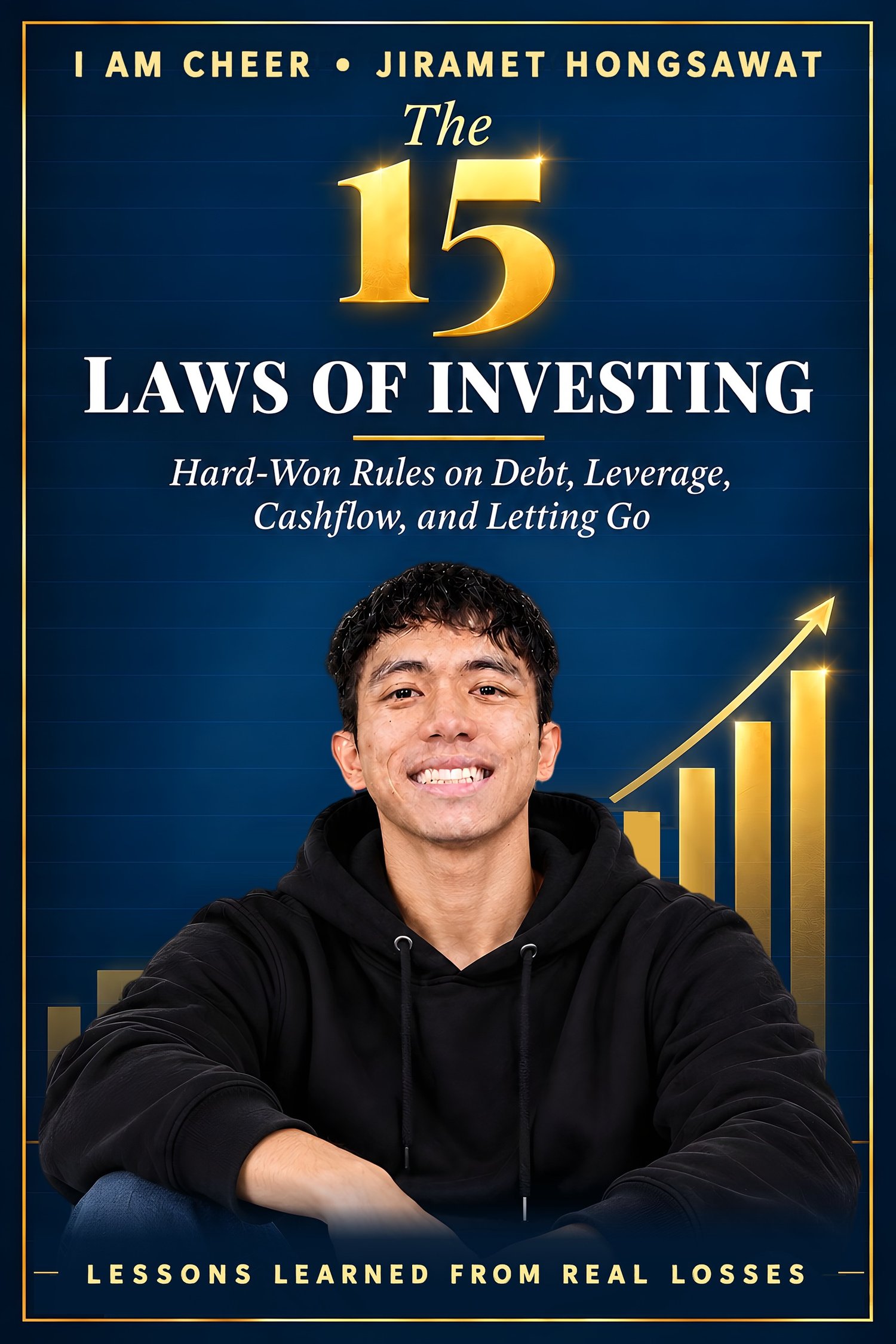
The 15 Laws of Investing: Hard-Won Rules on Debt, Leverage, Cashflow, and Letting Go
At one point, Jiramet "Cheer" Hongsawat's real businesses, about 12–13 branches of coin-operated washing machines (with fuel dispensers at some), were sending him income every month. At the same time, about 15,000 baht a month was flowing straight back out to service debt: 200,000 baht owed to two banks at 25% a year, and 400,000 baht borrowed against gold at about 15%. He hadn't borrowed for a need. He had borrowed to speculate.
The 15 Laws of Investing is the bill for that education, itemized. Over several years, Cheer lost money on options he didn't fully understand, on gold pledged again and again, on crypto "dual investment" yields that didn't deliver, and on a few machines that cost more than they earned. After each loss, he wrote one rule that would have prevented it. There are fifteen of them now.
Inside:
- Escape the debt trap: why 25% debt comes first, and why no clever trade belongs beside it.
- Leverage without ruin: when borrowing to invest can make sense (only at 3–5%, and only for real assets), and why your starting loan-to-value decides how much room you have to survive.
- Guard the principal: invest only in what you understand, and learn before you pay.
- Think, then protect: an imagined "AI Mastermind" panel for testing decisions, and how options can work as insurance.
- Cashflow first: why boring machines that wait for customers beat assets that make you wait for a price.
- Let it go: anchoring, sunk cost and pride, and how Cheer finally let the gold go.
Each law combines Cheer's own numbers with a short history of money, lessons from Benjamin Graham, Warren Buffett, Robert Kiyosaki and Andy Tanner, and practical worksheets. The appendices include a debt payoff worksheet, a leverage checklist, an options primer, Thailand notes on rate ceilings, gold and tax, an AI prompt library and a personal financial statement, followed by a glossary, full notes and sources, and an index.
Written for anyone who has borrowed to chase a return, or is tempted to. The examples come from Thailand, but the laws apply everywhere.
This book is for education and inspiration. It is not financial, investment, tax or legal advice.