
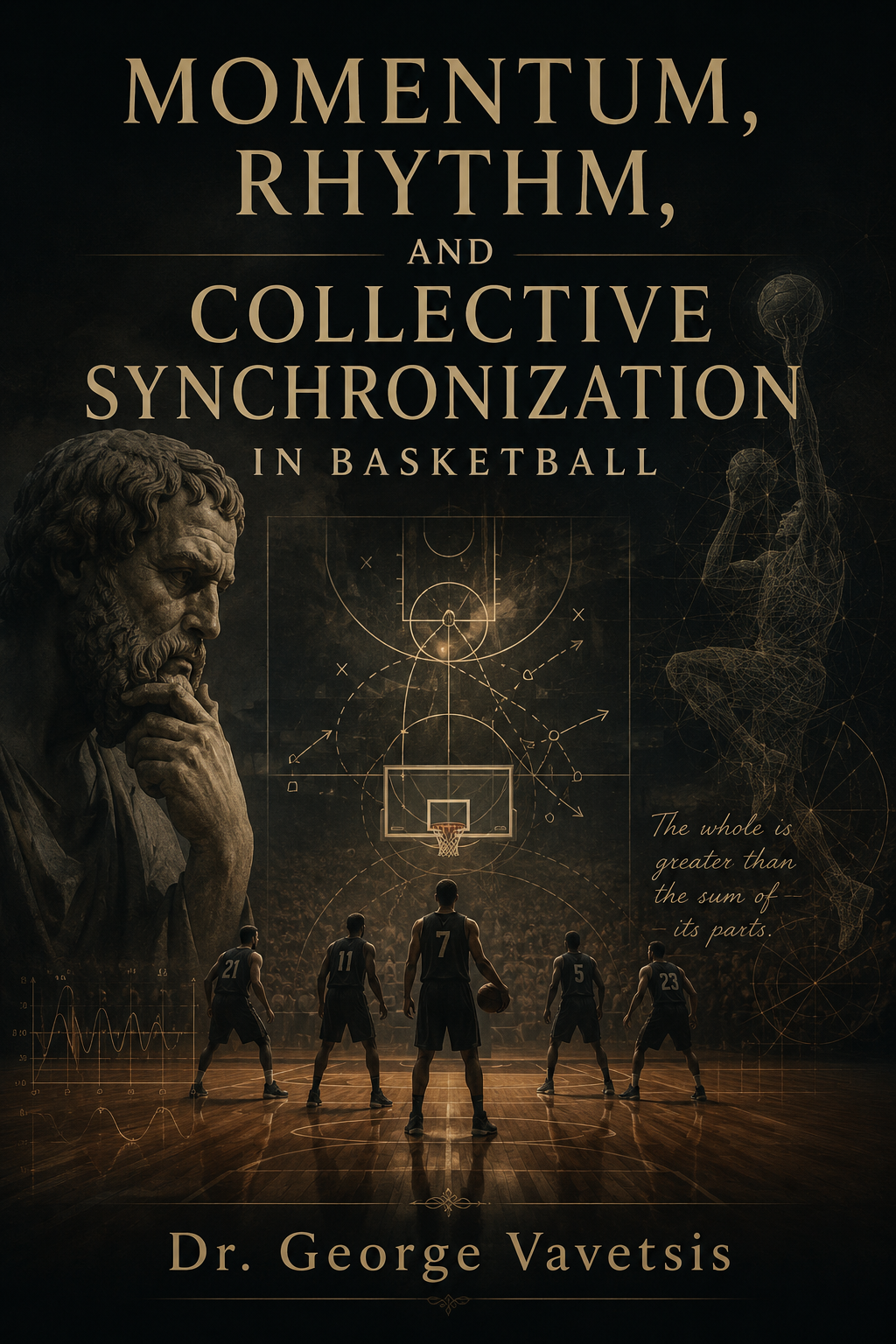
Momentum, Rhythm, and Collective Synchronization in Basketball
Pages: 643
Basketball has always existed beyond the boundaries of statistics, diagrams, and isolated tactical systems. Beneath the visible architecture of possessions, scores, and rotations lies a deeper structure of human interaction—a constantly evolving ecosystem of rhythm, emotion, perception, collective intention, and synchronized movement. This book, Momentum, Rhythm, and Collective Synchronization in Basketball, was written from the belief that basketball is not merely a technical game of execution, but a living system of interconnected consciousnesses operating under pressure, uncertainty, and temporal acceleration.
For decades, basketball analysis has largely focused on quantifiable variables: shooting efficiency, pace, spacing, turnover ratios, lineup metrics, and biomechanical optimization. These dimensions remain essential and indispensable for elite performance environments. Yet coaches, athletes, and spectators alike intuitively recognize that the deepest moments in basketball cannot always be captured numerically. Every experienced coach has felt the emotional shift of a game before the scoreboard reflected it. Every athlete has sensed the invisible momentum of a crowd, the tightening of defensive tension, or the sudden collective flow in which five players begin operating almost as a single organism.
This work attempts to explore those invisible dimensions scientifically, philosophically, and practically.
The central premise of this book is that basketball momentum is not a mystical abstraction, nor merely a psychological illusion. Rather, it is an emergent property of dynamic interactions occurring between athletes, tactical systems, environmental stimuli, emotional contagion, and neurocognitive synchronization. Momentum emerges through relational connectivity. It is constructed possession by possession through communication patterns, tactical coherence, emotional resonance, spatial occupation, and collective belief structures.
Within elite basketball environments, rhythm becomes a physiological and existential force. Tempo is not simply speed; it is perceptual timing. Offensive continuity is not merely tactical sequencing; it is the preservation of collective cognitive flow. Defensive collapse is not only positional failure; it is often the breakdown of synchronized awareness under stress. The game therefore becomes a continuous oscillation between order and disorder, structure and improvisation, control and chaos.
Throughout this book, basketball is approached as a self-organizing living system. Players continuously adapt to environmental information while simultaneously influencing the environment itself. Tactical systems are not static diagrams but evolving ecosystems shaped by perception, fatigue, emotional climate, and interpersonal synchronization. Coaches do not merely call plays—they regulate psychological energy, manipulate emotional atmospheres, and stabilize collective behavior during moments of competitive instability.
One of the fundamental themes explored here is the concept of collective synchronization. Elite basketball performance frequently depends upon the ability of players to coordinate perception and action under severe temporal constraints. During fast breaks, defensive rotations, pick-and-roll sequences, or secondary transition attacks, players operate within compressed windows of cognition where conscious deliberation becomes insufficient. In these moments, shared tactical consciousness emerges. Decision-making accelerates beyond verbal communication. Teams begin functioning through implicit relational understanding rather than explicit instruction.
Such synchronization reflects principles deeply connected to neuroscience, ecological dynamics, systems theory, embodied cognition, and complex adaptive behavior. The basketball court becomes a laboratory of emergent intelligence. Each possession represents a temporary reorganization of spatial meaning, emotional energy, and tactical probability. Every transition from offense to defense involves an ontological shift in team identity—a transformation of intention, awareness, and collective orientation toward space.
Modern basketball coaching cannot remain confined to rigid tactical instruction alone. Elite coaching requires management of perception, emotional regulation, environmental manipulation, attentional control, and adaptive decision-making. Coaches must understand how rhythm influences confidence, how defensive pressure reshapes cognition, how bench behavior alters emotional contagion, and how collective belief cascades can either stabilize or destroy performance structures. Tactical intelligence without emotional synchronization remains incomplete.
Accordingly, this book integrates philosophical inquiry with applied basketball methodology. It examines the fast break not merely as transition offense, but as existential acceleration of collective intentionality. It studies half-court offense as a form of structured becoming where tactical freedom emerges through relational constraints. It interprets pick-and-roll basketball as a relational ontology between creator and screener, emphasizing co-dependent perception and shared tactical consciousness.
The concepts explored here are intended for coaches, performance scientists, sport psychologists, analysts, and athletes seeking a deeper understanding of elite competitive environments. Every philosophical framework is linked to observable basketball behavior. Every theoretical construct ultimately serves applied performance. The objective is not abstraction for its own sake, but a richer and more complete framework for understanding how high-level basketball truly functions under real competitive stress.
Basketball is fundamentally human. Beneath the biomechanics and tactical structures exist fear, courage, anxiety, confidence, anticipation, joy, aggression, frustration, trust, and collective resilience. Momentum swings are experienced emotionally before they are statistically confirmed. Teams frequently win or lose not because of superior systems alone, but because one collective identity adapts more effectively to pressure, uncertainty, and emotional instability.
Every possession contains uncertainty. Every defensive rotation requires trust. Every offensive action involves coordinated intention under incomplete information. Teams continuously oscillate between coherence and fragmentation. Success emerges not from perfect control, but from adaptive synchronization amidst chaos.
The deeper one studies basketball, the clearer it becomes that the sport mirrors the structure of complex human systems themselves.
Ultimately, this book was written to challenge reductionist interpretations of basketball performance. The game cannot be fully understood through statistics alone, nor purely through philosophy detached from practical execution. Basketball exists simultaneously as biomechanics, psychology, neuroscience, emotion, rhythm, tactical architecture, environmental adaptation, and collective human becoming.