






Fair Value Gaps Explained — Read imbalance (PDF Guide)
You were told unfilled gaps act like magnets, so you marked one and waited. Price filled it and carried on in the same direction, and you were on the wrong side of it. The magnet part was true. The part you assumed came with it was not.
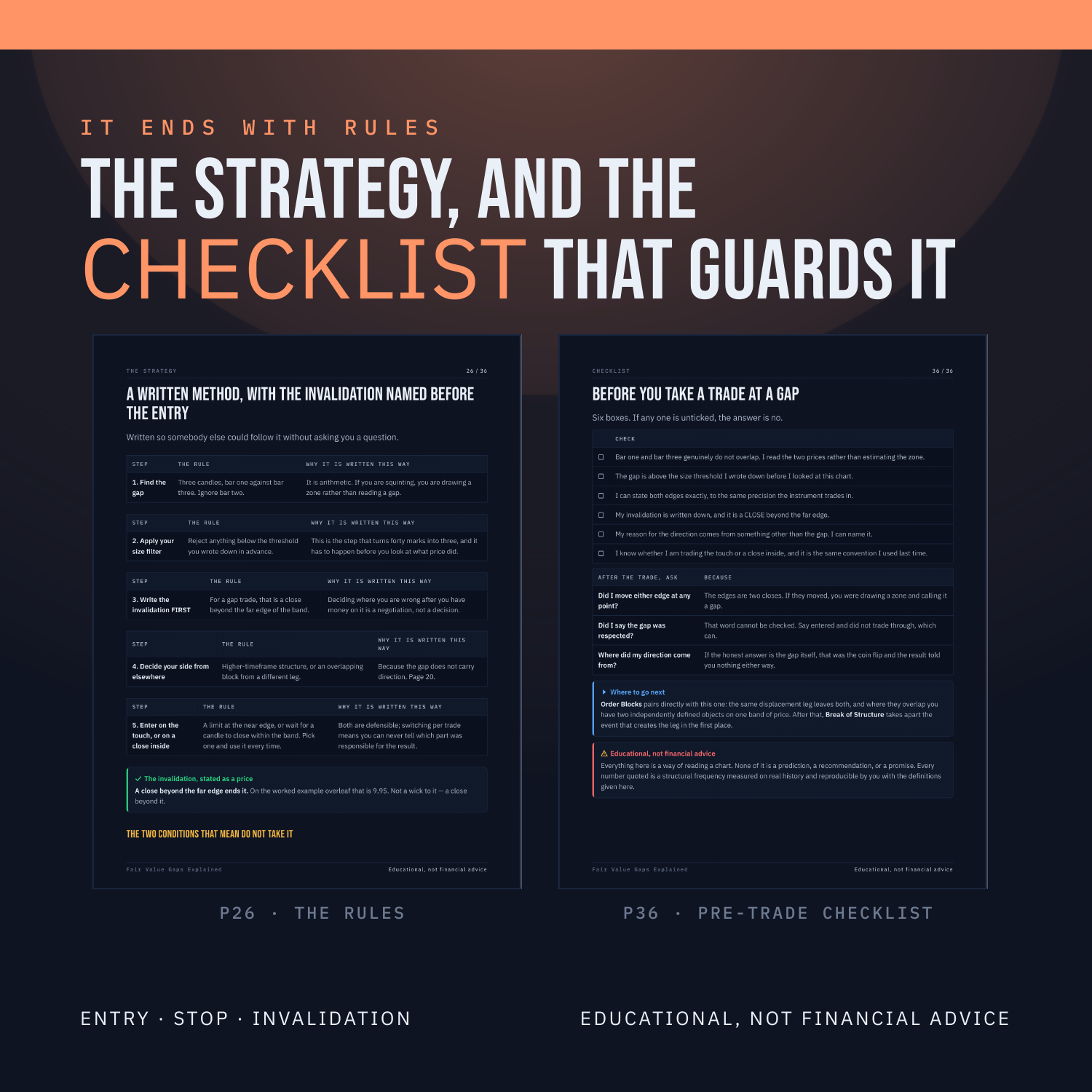
A fair value gap is a three-candle imbalance with an exact definition, and it is the most reliable LOCATION signal in this series: measured across 6,553 gaps on 35,944 bars of real history, 92.06% get filled, a median of 4 bars later. Direction on the touch is 51.64% - noise. This guide teaches you to find them by rule, size-filter the ones worth marking, and tell the difference between price touching a gap and price filling it. This is a 36-page PDF that teaches Fair Value Gaps from the first thing you see on the screen through to a written strategy with an entry, a stop and an explicit rule for when the trade is wrong.
Nothing is taught underneath a chart. Every label sits on the candle, the line or the level it is describing, on real market data. There are three quizzes on real charts, each followed by the same chart re-shown annotated with the reasoning, plus faded practice pages where the first steps are filled in and you finish the rest.
WHAT'S INSIDE
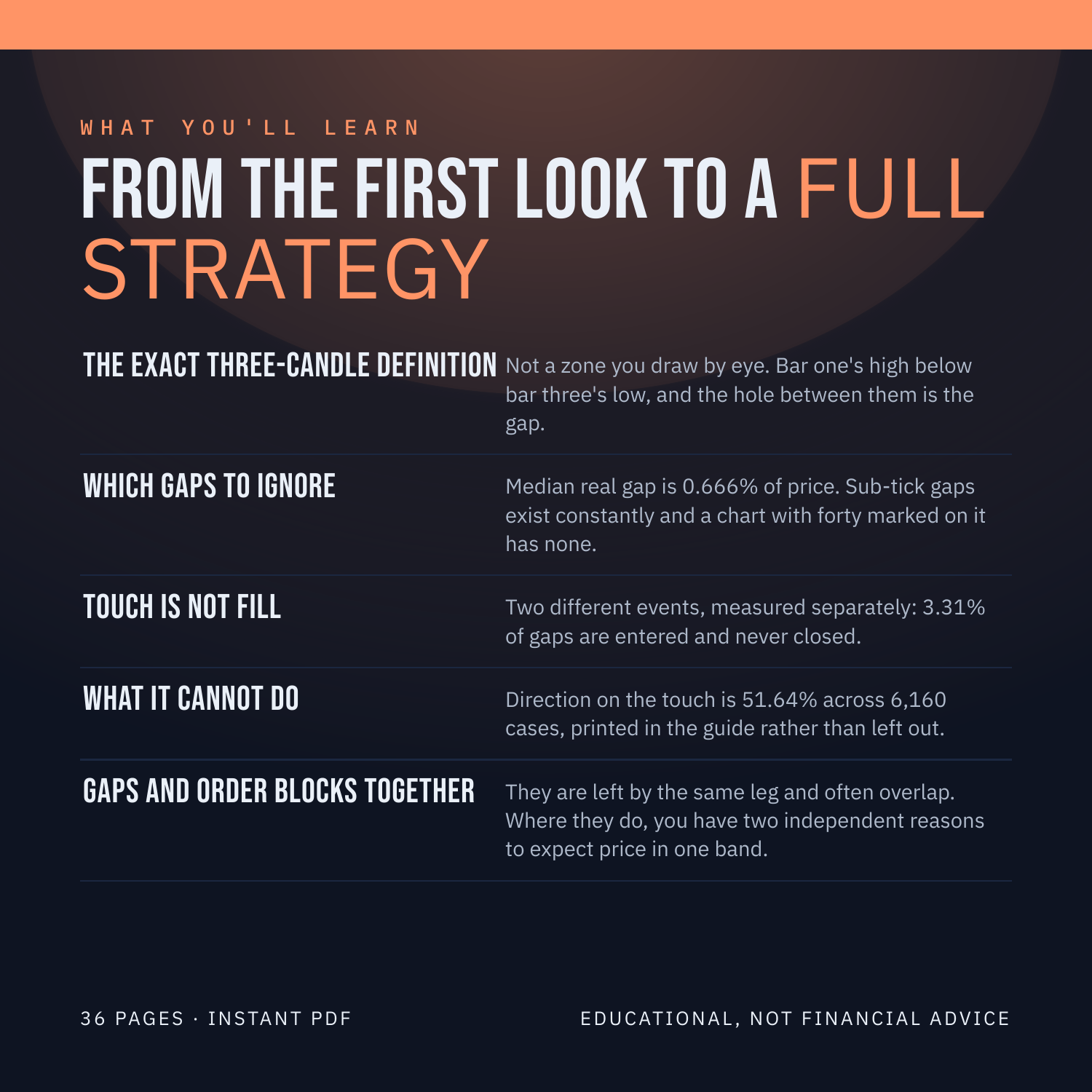
- The exact three-candle definition — Not a zone you draw by eye. Bar one's high below bar three's low, and the hole between them is the gap.
- Which gaps to ignore — Median real gap is 0.666% of price. Sub-tick gaps exist constantly and a chart with forty marked on it has none.
- Touch is not fill — Two different events, measured separately: 3.31% of gaps are entered and never closed.
- What it cannot do — Direction on the touch is 51.64% across 6,160 cases, printed in the guide rather than left out.
- Gaps and order blocks together — They are left by the same leg and often overlap. Where they do, you have two independent reasons to expect price in one band.
WHAT YOU'LL BE ABLE TO DO
- Find a fair value gap by rule instead of by eye.
- Reject the small ones, and say what the cutoff is.
- Tell a touch from a fill, and know why the distinction matters.
- Say what a gap can and cannot tell you, with the numbers.
- Use a gap and an order block together without double-counting them.
AN HONEST NOTE
Fair Value Gaps is a clue, not a crystal ball. It describes what price has already done. This guide contains no win-rates, no backtest results and no promises about what you will make, because nobody can verify those and you should not trust anyone who prints them. What it hands you instead is a set of rules you can test yourself on TradingView in an afternoon. Educational, not financial advice.
Instant download. 36 pages, PDF.