
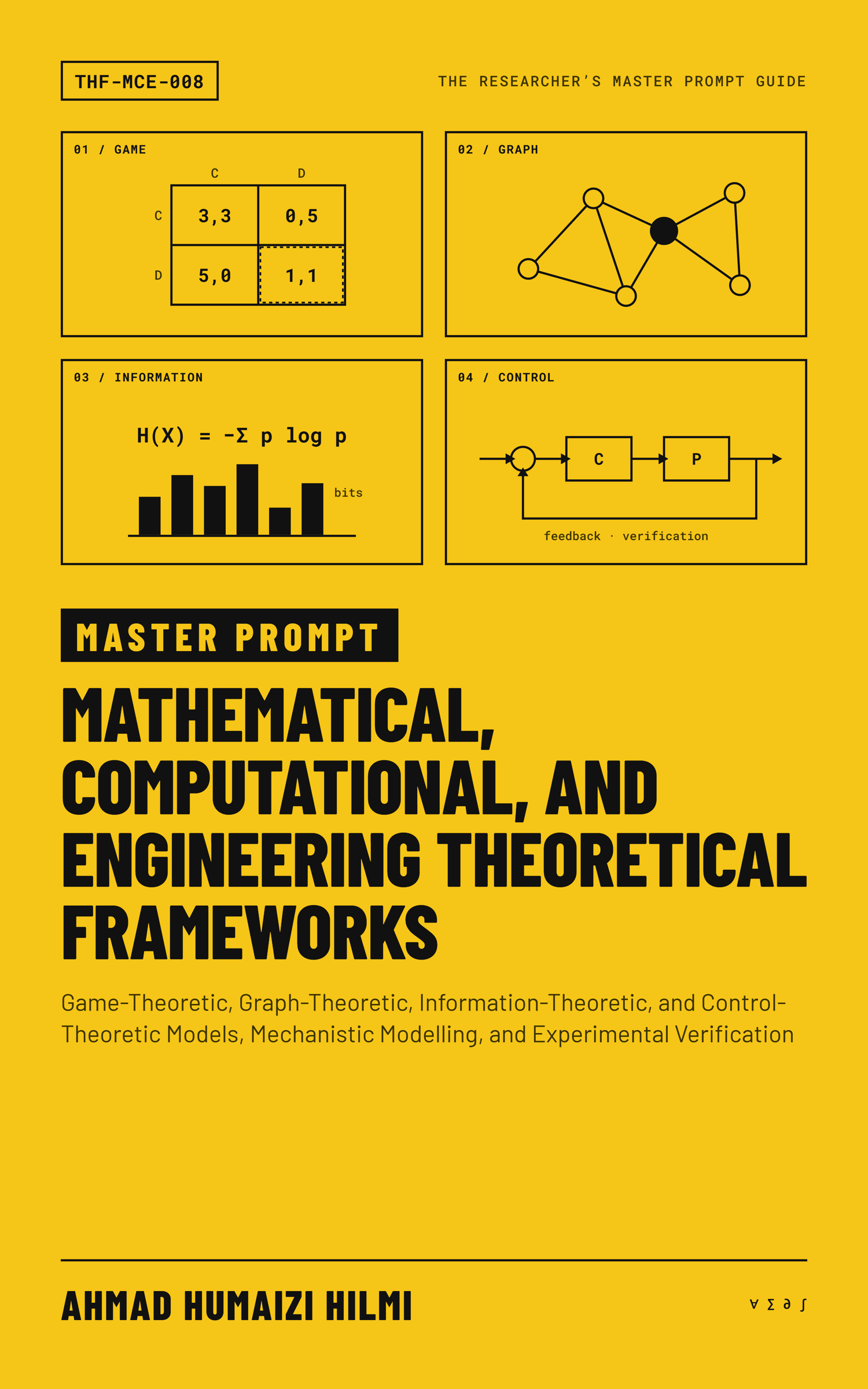
THF-MCE-008 — Mathematical, Computational, and Engineering Theoretical Frameworks, Game-Theoretic, Graph-Theoretic, Information-Theoretic, and Control-Theoretic Models, Mechanistic Modelling, and Experimental Verification
Description
This Master Prompt theme investigates the development of formal, computational, and mechanistic theoretical frameworks in mathematics, the physical and chemical sciences, the life sciences, and engineering. Their aim is to explain and predict the behaviour of systems through explicitly stated assumptions, rigorously derived relationships, and transparently verified results. The theme covers game theory and equilibrium analysis, graph and network theory, chemical graph theory and topological indices, and information theory. It also covers control theory and dynamical systems, measure theory and nonadditive aggregation, stochastic and reliability modelling, optimization and mathematical programming, continuum and constitutive mechanics, thermal, electrochemical, and materials theory, multi-scale coupling, and sensor and network design. It addresses system definition, modelling assumptions, notation, governing principles and equations, boundary and initial conditions, analytical derivation, theorems and proofs, existence, uniqueness, and stability, and closed-form and bounding results. It further addresses algorithm design, numerical implementation, parameter identification, verification through analytical–numerical agreement and simulation, benchmarking against baseline methods, sensitivity and scalability analysis, uncertainty quantification, and experimental, field, or full-scale validation. Particular attention is given to distinguishing mathematical consistency from empirical validity, and internal agreement between theorems and computations derived from the same representation from independent validation. It likewise distinguishes simulation results from measured performance, equilibrium solutions from real-world behaviour, computational efficiency from correctness, and model generality from the domain of applicability defined by its assumptions. Researchers will be guided in stating assumptions and notation, presenting derivations and proofs, conducting dimensional and sensitivity analysis, designing verification and validation programmes, and critically checking equations and derivations produced with artificial intelligence assistance.