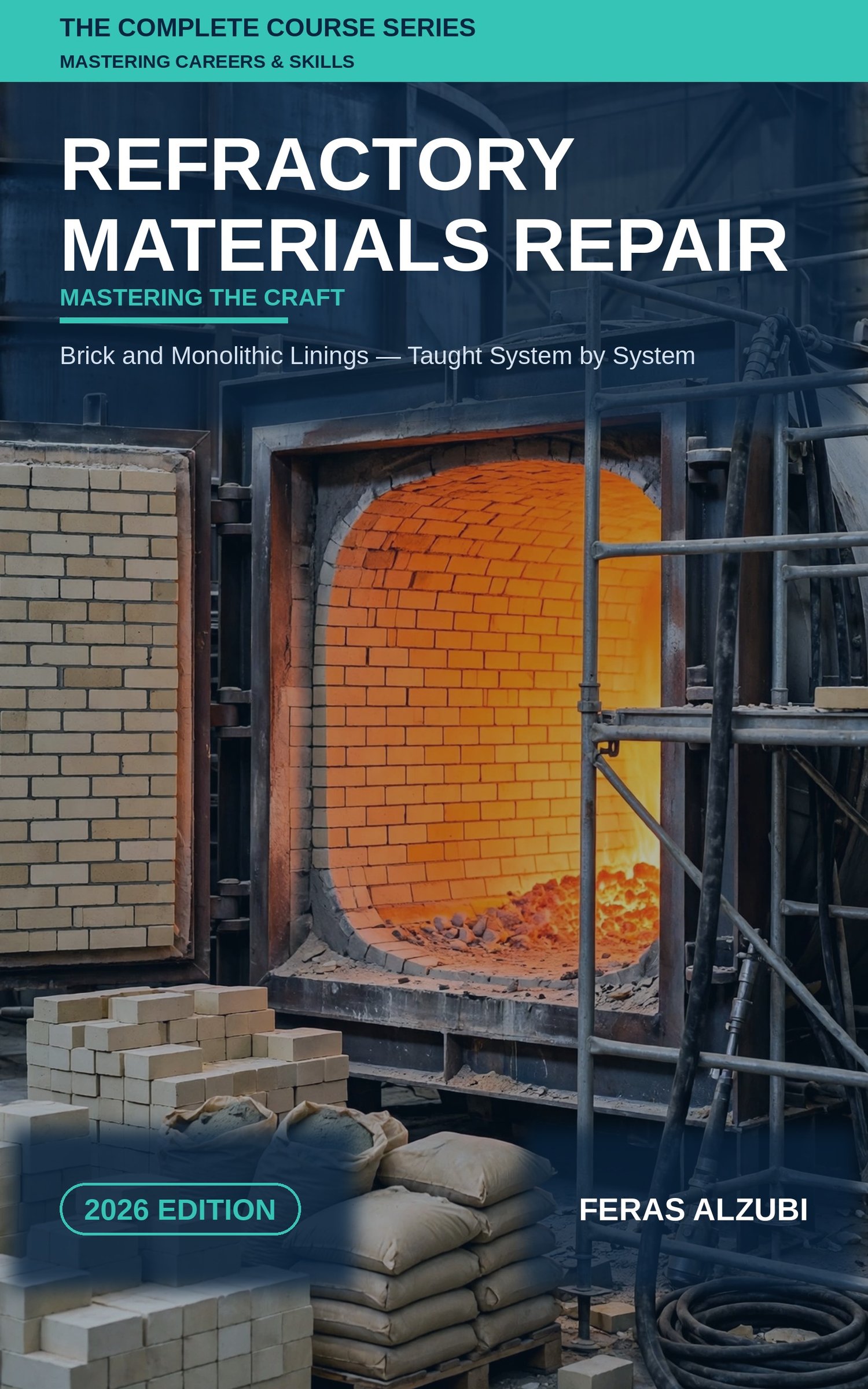
Refractory Materials Repair: Mastering the Craft
Refractory Materials Repair: Mastering the Craft
What this book teaches. The full refractory trade — the building and repair of the linings that let furnaces, kilns, cupolas, boilers, converters, ladles, soaking pits, and ovens hold fire and molten process — taught A to Z in one volume, from first principles to proved, documented work. The foundations come first: the refractory world and the industries it serves; the safety discipline that governs dusty demolition and hot, confined work — silica, heat, and confined spaces in front of every task; the lining understood as one engineered system of hot face, backup, anchors, and shell; and the standards and authority — API 936 and its companion standards, the ASTM test methods, and above all the manufacturer's documentation — that decide what correct means. Then the materials, family by family: the brick families and their chemistries — fireclay, high-alumina, silica, and basic brick; castables, plastics, and ramming mixes; mortars, coatings, and ceramic fiber; the anchors and lining hardware that hold a lining to its shell; and the selection method that matches material chemistry to the slag, atmosphere, and temperature of the service. The installation crafts follow: demolition and surface preparation, brickwork, casting and gunning, and the repair work — patching, hot repairs, and ladle practice — that keeps vessels in campaign. Then the quality and campaign part: curing and dryout, the API 936 inspection and testing system, failure diagnosis from the evidence of a worn lining, and the management of shutdowns, turnarounds, and lining life. The book closes with the working professional's world: the refractory business and its shutdown seasons, documentation, records, and traceability, and the career itself — API 936 and the working life. Every system is taught so you can explain it, test it, and trust your conclusion — and the manufacturer's data and the job specification for the specific vessel and material always govern its values and procedures.
Who it is for. Working refractory repairers, and the bricklayers, mechanics, and laborers who work beside them, who want the whole trade — materials, installation, quality, and campaign life — in one place and in the order the work itself flows; apprentices and new hands entering the trade through refractory contractors and plant maintenance departments, who want names, systems, and reasoning for what their hands are learning and the ground prepared for the API 936 credential and for manufacturer and owner qualification; inspectors, supervisors, and plant engineers responsible for lining quality, who need to understand what the work demands and how honest refractory work is proved — by records, samples, and procedures followed exactly; and the mechanically minded reader weighing this specialty, given an honest picture of shutdown seasons, travel, heat, and dust, and the satisfaction of a lining that holds its campaign. No general book replaces the documentation for the vessel in front of you — the book teaches the systems, the principles, and the method.
What's inside (every count verified against the actual book):
- Complete course — 20 chapters in five parts, foundations to the career
- 340 practice questions — every answer explained, right and wrong
- 40-question diagnostic — scored by domain, with a routing worksheet
- 240 chapter questions — a 12-question check closes every chapter
- 60-question final review — sampling the whole trade, with routed re-study
- 40 labeled figures — lining-system diagrams and material maps, two in every chapter
- 25 tables — material data, sequences and reference data for the field
- 150-term glossary · 8 cheat sheets · 3 study plans — the full read (12 weeks), the working repairer upgrading (6 weeks), and crew readiness for a turnaround (8 weeks)
- Safety taught as structure — silica and dust control, heat and confined-space discipline, and dryout discipline throughout
Every one of the 340 questions is original, written for this book, and every explained answer tells you why the right answer is right and why each wrong answer is wrong. The book's facts rest on verified sources, listed in a Sources & Verification Note at the back of the book: the SOC 49-9045 occupation definition (O*NET 49-9045.00, Refractory Materials Repairers, Except Brickmasons), the API 936 refractory inspection system and its companion standards, the ASTM refractory test methods, the OSHA silica discipline, and the rule that manufacturer documentation governs. Safety is structural throughout — no procedure in the book outranks the safety discipline, and no item teaches working uncontrolled silica dust, entering a confined space without its permit discipline, or breaking a dryout schedule as correct.
Read the first chapter free — the sample on this page is Chapter 1 of this book, exactly as it appears in the full edition.
From the Mastering Careers & Skills library — complete A-to-Z professional teaching books for careers, trades, and certifications.
This book is an independent teaching work. The American Petroleum Institute (API) is named as the industry standards and certification body it is; this book is not published by, endorsed by, or affiliated with it. It teaches the trade — no credential comes from this book: API 936 Refractory Personnel certification is earned from the American Petroleum Institute by examination, and owner specifications, site qualifications, and employer requirements are set by those bodies; this book does not itself confer a license or a certification.
Refunds: Please read the free sample chapter before you buy. This is a digital ebook, delivered instantly by download. If the file is defective, or you cannot open or download it and we cannot fix the problem, you will receive a full refund — email us within 14 days of purchase. Because the book is delivered instantly as a downloadable file, all other sales are final.
How to read this book (EPUB format): After checkout, download the EPUB file, then open it in any free ebook reader app. On iPhone or iPad: Apple Books — it is already on your device. On Android phones and tablets: Google Play Books (free: https://play.google.com/store/apps/details?id=com.google.android.apps.books) — upload the file in the app — or ReadEra (free). On a Windows or Mac computer: Thorium Reader (free: https://thorium.edrlab.org) or Adobe Digital Editions (free). On Kindle: use Amazon's free Send to Kindle (https://www.amazon.com/sendtokindle) to add the file to your Kindle library.