
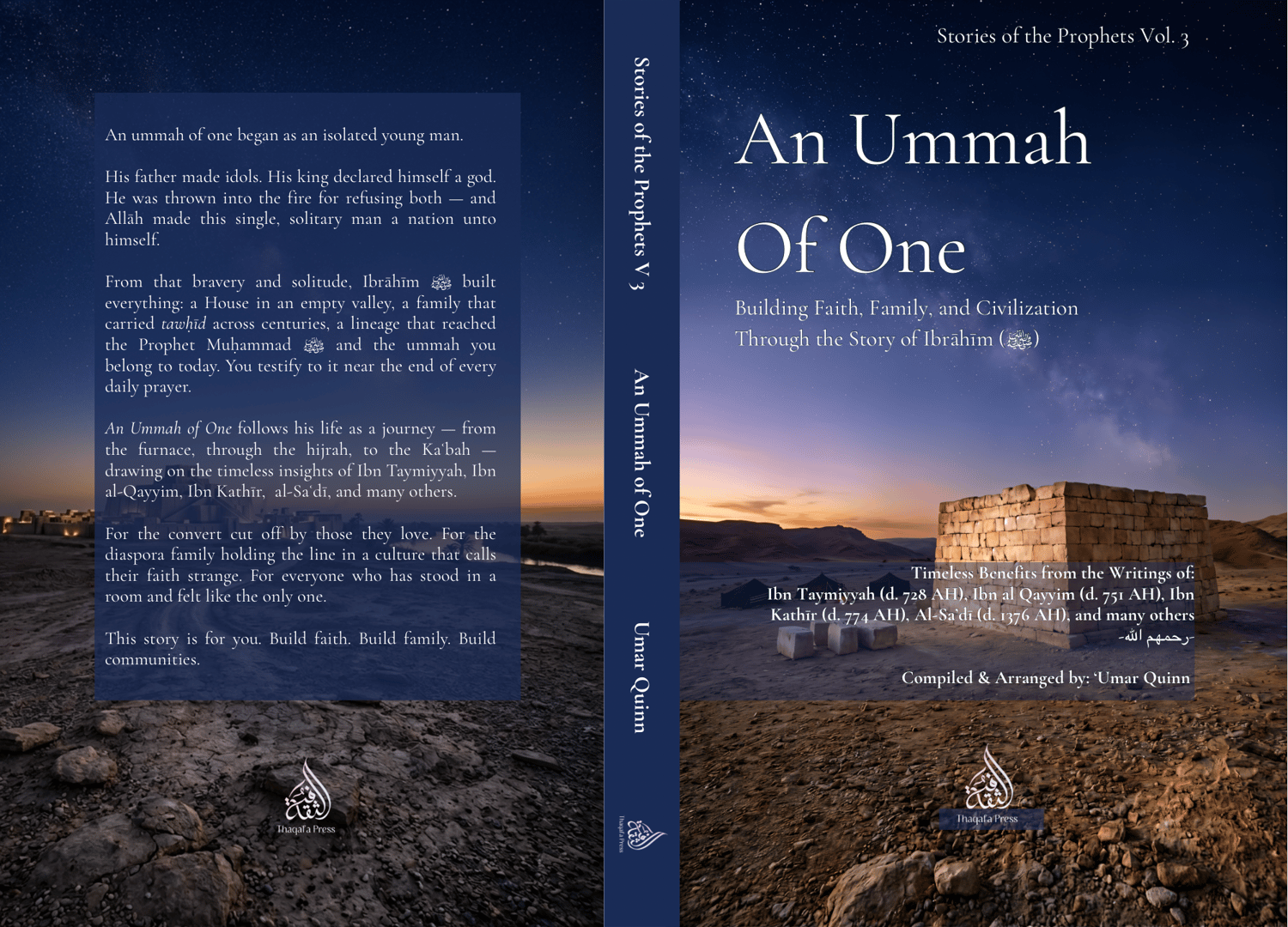
[Digital Edition] An Ummah of One: Building Faith, Family, and Civilization through the Story of Ibrahim (عليه السلام)
An Ummah of One Building Faith, Family, and Civilization through the Story of Prophet Ibrāhīm (ʿalayhi as-salām)
Every night they looked up and saw what they believed to be gods. The stars were not signs pointing beyond themselves. They were the thing itself: intelligences that governed harvests, births, illnesses, and the fates of kings.
That was the world Ibrāhīm was born into, and he opposed it alone. Allāh called him an ummah — a nation, a community, a complete model, contained in one man.
This book is about what one person can carry.
It begins before he enters his own story. A prologue reads the ruins of the civilizations that came before him: ʿĀd, whose cruelty was the cruelty of brute force; Thamūd, whose cruelty was more refined and in some ways more instructive; and the people of Lūṭ. None of them were primitive. ʿĀd was the most physically powerful civilization of its era. Thamūd's engineering remains impressive today. Something else was missing.
From there the book follows Ibrāhīm through the whole arc: the argument with his father, the furnace, the shattered idols, the confrontation with the tyrant, the departure from Babylon, the valley with no water, the raised knife, the standing with Lūṭ, and the raising of the House.
Inside:
Chapters 1 to 6 trace the confrontation. Entering the Ṣabian world and its astral theology, then turning the mirror to the present and tracing that same architecture into our own age. Calling a hostile father with mercy. Surviving personal fires. Smashing both faces of shirk before a king. Severing old ties and leaving for the better.
Chapters 7 to 11 trace the building. Walking away from a wife and infant in a lifeless valley, and what came of it. Dreaming the unthinkable, and a son who answered. Pleading for a doomed people. Raising the foundation of the House and asking that it be accepted. Pioneering the hospitality his descendants inherited.
Chapters 12 and 13 turn from what he did to who he was. Nine qualities named in the Qurʾān, examined in turn: ummah, qānit, ḥanīf, shākir, awwāh, ḥalīm, munīb, ṣiddīq, and finally khalīl, the intimate friend of Allāh. Then his prayers for generations he would never see.
Throughout, the words of Ibn Taymiyyah (d. 728 AH), Ibn al-Qayyim (d. 751 AH), Ibn Kathīr (d. 774 AH), Imām al-Saʿdī (d. 1376 AH), and many others, with the Arabic set alongside the English and every citation documented. A glossary and full bibliography are included.
What you receive:
- EPUB for phones, tablets, and e-readers
- PDF at 6 × 9, matching the printed edition page for page, so study groups can work from either
- Study guide
The Arabic is fully vocalized and set in dedicated Arabic and ʿUthmānic typefaces, embedded in the file. It displays correctly on any device, including devices with no Arabic support installed.
From the Sacred Stories Series.