
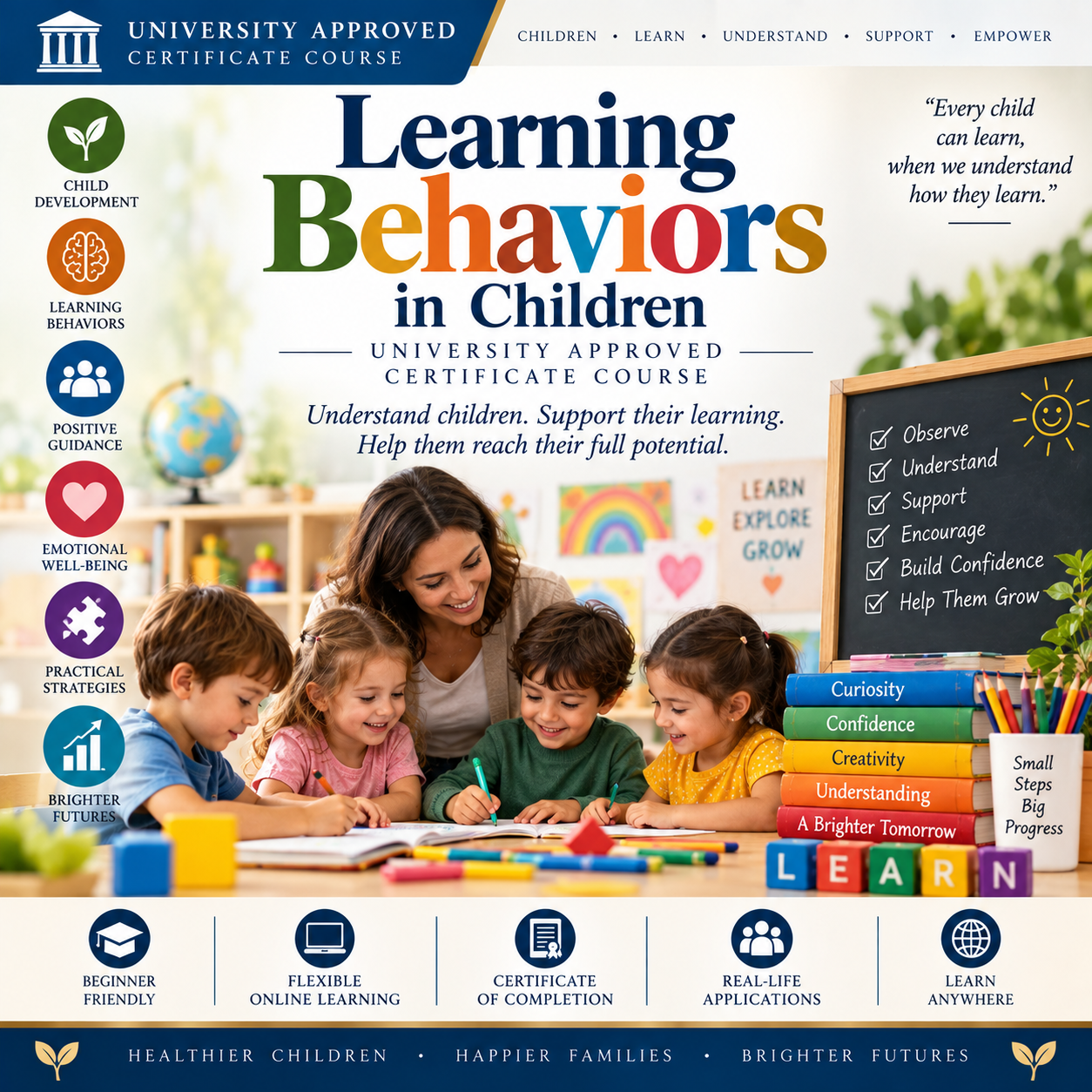
Learning Behaviors in Children University Approved Certific
Learning Behaviors in Children – University Approved Certificate Course
Understand How Children Learn, Behave, Adapt, and Develop
Every child learns differently.
Children vary in the way they pay attention, communicate, respond to instructions, manage emotions, interact with others, solve problems, develop confidence, and engage with learning.
The Learning Behaviors in Children – University Approved Certificate Course provides a structured and accessible introduction to the behaviors, developmental processes, emotional factors, environmental influences, and learning patterns that can affect children in educational and everyday settings.
This course is designed for teachers, teaching assistants, parents, childcare workers, education students, coaches, support workers, social care professionals, and anyone interested in understanding children more effectively.
No previous specialist qualification is required to begin.
The course focuses on understanding children, supporting positive learning experiences, encouraging healthy development, and creating environments where children can participate, build confidence, and reach their potential.
What Are Learning Behaviors?
Learning behaviors are the patterns of behavior, attitudes, habits, emotional responses, and social skills that influence how a child participates in learning.
These may include:
- Attention
- Curiosity
- Motivation
- Persistence
- Confidence
- Cooperation
- Communication
- Emotional regulation
- Independence
- Problem-solving
- Following instructions
- Participation
- Social interaction
- Response to feedback
- Coping with difficulty
Learning behavior is not simply about whether a child is “good” or “bad.”
Children’s behavior is often influenced by a combination of developmental, emotional, social, environmental, cognitive, and educational factors.
Understanding these factors can help adults respond more effectively.
What You Will Learn
Throughout this course, you will explore topics such as:
- Child development
- Learning behaviors
- Cognitive development
- Emotional development
- Social development
- Motivation
- Attention
- Memory
- Communication
- Confidence
- Curiosity
- Independence
- Classroom behavior
- Positive guidance
- Reinforcement
- Learning environments
- Individual differences
- Group behavior
- Relationships
- Emotional regulation
- Supporting positive learning
- Professional boundaries
The course provides a broad foundation suitable for beginners.
Understanding Child Development
Children change rapidly as they grow.
Development may involve:
- Physical growth
- Language
- Thinking
- Memory
- Emotional awareness
- Social skills
- Independence
- Identity
- Relationships
A child’s behavior often needs to be understood within the context of their developmental stage.
Expectations that are appropriate for one age group may not be appropriate for another.
This course helps learners develop a more realistic understanding of childhood development.
Cognitive Development
Cognitive development involves the way children:
- Think
- Learn
- Remember
- Understand
- Solve problems
- Make decisions
- Use language
- Interpret experiences
The course introduces learners to basic ideas relating to cognitive growth and how children’s thinking changes over time.
Understanding cognitive development can help adults choose learning activities and expectations that are suitable for children’s developmental abilities.
How Children Learn
Children learn in many different ways.
Learning may occur through:
- Observation
- Repetition
- Practice
- Play
- Exploration
- Conversation
- Feedback
- Experience
- Demonstration
- Social interaction
Children are active learners.
They often learn best when they can explore ideas, ask questions, make mistakes, receive guidance, and connect new information with previous experiences.
Learning Through Play
Play is a major part of childhood learning.
Through play, children may develop:
- Communication
- Imagination
- Creativity
- Problem-solving
- Social skills
- Emotional understanding
- Physical coordination
- Cooperation
Different forms of play can support different areas of development.
The course introduces learners to the educational importance of play and active exploration.
Attention and Concentration
Attention plays an important role in learning.
Children may differ considerably in how long they can concentrate and what types of activities capture their interest.
Attention can be influenced by:
- Age
- Environment
- Motivation
- Fatigue
- Stress
- Difficulty level
- Distractions
- Personal interest
The course explores practical ways of creating learning environments that support concentration without expecting unrealistic levels of attention.
Motivation
Motivation influences whether children want to participate, continue, and engage with learning.
Motivation may be affected by:
- Interest
- Confidence
- Praise
- Success
- Feedback
- Challenge
- Relationships
- Rewards
- Personal goals
- Learning environment
A child who repeatedly experiences failure may become reluctant to participate.
Supporting achievable progress can therefore be important for maintaining motivation.
Curiosity and Exploration
Curiosity is one of the strongest natural drivers of childhood learning.
Children often learn by asking:
- Why?
- How?
- What happens if?
- Can I try?
- What is this?
Learning environments that encourage appropriate curiosity can help children become more independent and confident learners.
The course explores how adults can support exploration while maintaining clear and safe boundaries.
Memory and Learning
Memory is essential for learning.
Children need to:
- Receive information
- Pay attention to it
- Process it
- Store it
- Retrieve it later
The course provides an introductory understanding of memory and discusses how repetition, meaningful examples, practice, and active participation can help reinforce learning.
Emotional Development
Emotions strongly influence learning behavior.
A child may find it difficult to concentrate when they are:
- Anxious
- Frustrated
- Angry
- Overwhelmed
- Tired
- Afraid
- Upset
Children gradually develop the ability to recognise, express, and regulate emotions.
Adults can support this process by providing calm, consistent, and respectful guidance.
Emotional Regulation
Emotional regulation refers to the ability to manage emotional responses.
Young children are still learning these skills.
They may need help to:
- Identify emotions
- Express feelings appropriately
- Calm down
- Wait
- Manage frustration
- Solve disagreements
- Recover from disappointment
The course introduces supportive approaches to emotional regulation without expecting children to manage emotions in the same way as adults.
Social Development
Children learn within relationships.
Social development may include:
- Making friends
- Sharing
- Taking turns
- Cooperating
- Communicating
- Understanding others
- Resolving conflict
- Participating in groups
Positive social experiences can influence confidence and engagement with learning.
Communication Skills
Clear communication between adults and children can significantly influence behavior.
Learners will explore principles such as:
- Using age-appropriate language
- Giving clear instructions
- Listening
- Maintaining respectful tone
- Checking understanding
- Encouraging questions
- Avoiding unnecessary complexity
Good communication can reduce confusion and improve participation.
Positive Guidance
Positive guidance focuses on helping children understand expectations and develop better choices.
Approaches may include:
- Clear rules
- Consistency
- Encouragement
- Appropriate consequences
- Modelling
- Redirection
- Problem-solving
- Reinforcement of positive behavior
The objective is not simply to control behavior.
It is to help children gradually develop self-regulation and responsibility.
Positive Reinforcement
Positive reinforcement involves recognising and encouraging desirable behavior.
Examples may include:
- Verbal praise
- Encouragement
- Recognition
- Responsibility
- Positive feedback
- Appropriate rewards
Effective reinforcement is most useful when it is specific.
Instead of simply saying “good job,” adults may say:
“You stayed focused until you finished the activity.”
This helps children understand exactly what behavior is being encouraged.
Classroom Behavior
Children may display different behaviors in learning environments.
These can include:
- Participation
- Withdrawal
- Interrupting
- Cooperation
- Distraction
- Curiosity
- Avoidance
- Independence
- Dependence on adults
The course encourages learners to look beyond the behavior itself and consider what might be influencing it.
Understanding Challenging Behavior
Challenging behavior can have many possible causes.
These may include:
- Frustration
- Difficulty understanding
- Communication problems
- Emotional stress
- Attention-seeking
- Fatigue
- Environmental factors
- Developmental needs
- Peer difficulties
Rather than automatically labelling a child, adults can ask:
What happened before the behavior?
What might the child be trying to communicate?
What support may be needed?
Understanding context is essential.
Individual Differences
Every child is different.
Children vary in:
- Developmental pace
- Personality
- Temperament
- Learning preferences
- Confidence
- Interests
- Communication
- Motivation
- Family background
- Cultural experience
Effective support recognises individual differences rather than expecting every child to learn in exactly the same way.
Building Confidence
Confidence can strongly influence learning behavior.
Children who believe they can succeed are often more willing to try.
Adults can support confidence by:
- Setting realistic challenges
- Recognising effort
- Allowing mistakes
- Encouraging independence
- Avoiding unnecessary comparison
- Providing constructive feedback
Confidence often develops through repeated experiences of progress.
Developing Independence
Children gradually need opportunities to take responsibility for their own learning.
Independence may involve:
- Choosing activities
- Organising materials
- Completing tasks
- Asking for help appropriately
- Solving problems
- Reflecting on progress
Too much adult intervention can sometimes prevent children from developing these skills.
Support should gradually encourage appropriate independence.
Learning from Mistakes
Mistakes are a normal part of learning.
Children benefit from environments where mistakes are treated as opportunities rather than failures.
Adults can encourage children to ask:
- What happened?
- What can I try differently?
- What did I learn?
- What should I do next?
This can support resilience and problem-solving.
Building Resilience
Resilience involves adapting to difficulties and continuing after setbacks.
Children can develop resilience when they experience manageable challenges and receive appropriate support.
The course explores ways to encourage:
- Persistence
- Confidence
- Problem-solving
- Emotional regulation
- Flexible thinking
- Positive coping
The aim is not to remove every difficulty, but to help children learn how to respond to challenges.
Creating a Positive Learning Environment
The environment can significantly influence learning behavior.
Positive learning environments are often:
- Safe
- Predictable
- Organised
- Encouraging
- Inclusive
- Respectful
- Stimulating
Clear routines and expectations can help children understand what is expected and reduce unnecessary uncertainty.
Structure and Routine
Many children benefit from consistent routines.
Predictable routines can help children:
- Understand expectations
- Prepare for transitions
- Develop independence
- Feel secure
- Manage time
However, routines should also allow appropriate flexibility.
Transitions
Changes between activities can sometimes be difficult for children.
Transitions may include:
- Starting school
- Changing classrooms
- Moving between activities
- Ending play
- Preparing for meals
- Going home
Adults can support smoother transitions by giving clear instructions, warnings, and consistent routines.
Learning Through Relationships
Positive relationships can have a powerful influence on learning.
Children are often more willing to participate when they feel:
- Safe
- Respected
- Valued
- Heard
- Supported
A supportive relationship does not mean removing boundaries.
Children often benefit from both warmth and clear expectations.
The Role of Teachers and Caregivers
Adults can influence children’s learning behavior through:
- Expectations
- Communication
- Feedback
- Modelling
- Environment
- Relationships
- Consistency
Adults also model behavior.
Children observe how adults respond to mistakes, frustration, conflict, and other people.
Working with Families
Families have important knowledge about their children.
Constructive communication between educational professionals and families can support a more complete understanding of the child.
Effective communication may involve:
- Respect
- Confidentiality
- Clear information
- Listening
- Shared problem-solving
- Avoiding judgement
The objective is to support the child.
Supporting Different Learning Needs
Children may need different levels or types of support.
Useful strategies can include:
- Clear instructions
- Visual support
- Repetition
- Breaking tasks into steps
- Additional time
- Practical activities
- Individual encouragement
The course provides a general educational overview and does not train learners to diagnose learning disorders or developmental conditions.
Observation
Observation can help adults understand patterns in children’s learning behavior.
Useful questions may include:
- When does the behavior occur?
- What happens before it?
- What happens afterwards?
- Does it occur in every environment?
- What activities increase engagement?
- What situations cause difficulty?
Objective observation is more useful than assumptions.
Supporting Positive Peer Relationships
Peer relationships are an important part of childhood.
Adults can support skills such as:
- Sharing
- Cooperation
- Turn-taking
- Listening
- Conflict resolution
- Respect
- Empathy
Group activities can provide valuable opportunities for practising these skills.
Encouraging Creativity
Creativity can support learning and problem-solving.
Children may express creativity through:
- Art
- Music
- Writing
- Building
- Role play
- Storytelling
- Problem-solving
- Imaginative play
The course encourages adults to value exploration and original ideas rather than focusing only on correct answers.
Real-Life Applications
The knowledge gained from this course can be useful in:
- Schools
- Nurseries
- Childcare settings
- Family environments
- Educational support
- Youth programs
- Community programs
- Tutoring
- Coaching
- Learning support
It can help learners better understand the everyday behaviors they observe in children.
Who Is This Course For?
This course may be suitable for:
- Teachers
- Teaching assistants
- Parents
- Childcare workers
- Nursery staff
- Education students
- Psychology students
- Counselling students
- Coaches
- Tutors
- Social care professionals
- Youth workers
- Community workers
- Learning support staff
- Anyone interested in child development
No previous specialist qualification is required.
Beginner Friendly
The course introduces concepts progressively and uses accessible explanations.
You do not need previous academic knowledge of child psychology or developmental psychology.
The objective is to provide a strong introductory foundation.
Flexible Online Learning
Study at your own pace and according to your own schedule.
The online format makes the course particularly suitable for learners balancing education with:
- Employment
- Family responsibilities
- Professional development
- University study
- Other training
You can revisit course material whenever needed.
What You Can Gain From This Course
By completing the course, you can develop a broader understanding of:
- Child development
- Learning behaviors
- Motivation
- Attention
- Memory
- Emotional development
- Social development
- Communication
- Positive guidance
- Reinforcement
- Learning environments
- Individual differences
- Confidence
- Independence
- Resilience
- Classroom behavior
- Relationships
- Observation
This knowledge can support both personal and professional development.
A Foundation for Further Study
The course may provide useful preparation for further learning in:
- Child psychology
- Developmental psychology
- Education
- Early childhood education
- Educational psychology
- Teaching
- Learning support
- Counselling
- Special education
- Child development
- Social care
Certificate of Completion
Learners who successfully complete the applicable course requirements may receive a Certificate of Completion for:
Learning Behaviors in Children – University Approved Certificate Course
The certificate may be useful for:
- CVs and résumés
- LinkedIn profiles
- Continuing professional development
- Personal learning portfolios
- Educational portfolios
- Professional development records
- Demonstrating additional learning
Course Format: Online
Level: Beginner / Introductory
Study Method: Self-Paced
Subject: Child Development and Learning Behavior
Certificate: Available upon successful completion of applicable course requirements
Why Choose This Course?
Understand Children Better
Explore the factors that influence learning, motivation, emotions, and behavior.
Practical Knowledge
Connect theory with everyday situations involving children.
Beginner Friendly
No previous specialist training is required.
Positive Approach
Focus on understanding, guidance, support, and development rather than labels.
Flexible Online Learning
Study according to your own schedule.
Broad Application
Useful for education, childcare, parenting, tutoring, coaching, and support roles.
Certificate of Completion
Receive documentation of your learning after successful completion of applicable requirements.
Understand. Support. Encourage. Empower.
Children do not all develop at the same speed.
They do not all learn in the same way.
They do not all respond to the same strategies.
The more we understand about development and learning behavior, the better prepared we can be to provide appropriate support.
The Learning Behaviors in Children – University Approved Certificate Course provides an accessible introduction to these important concepts.
Observe more carefully.
Understand behavior more deeply.
Support learning more effectively.
Encourage confidence and curiosity.
Help children develop their potential.
Healthier Children. Happier Families. Brighter Futures.
Start your learning journey today.
Important Professional Notice
This course is intended for educational and personal/professional development purposes.
Completion of this course does not qualify the learner to diagnose developmental disorders, learning disabilities, mental health conditions, or other medical or psychological conditions.
It does not replace assessment, diagnosis, or treatment provided by appropriately qualified psychologists, physicians, educational specialists, speech and language professionals, or other regulated practitioners.
Anyone working professionally with children should comply with safeguarding, child protection, professional registration, and qualification requirements applicable in their country or jurisdiction.