
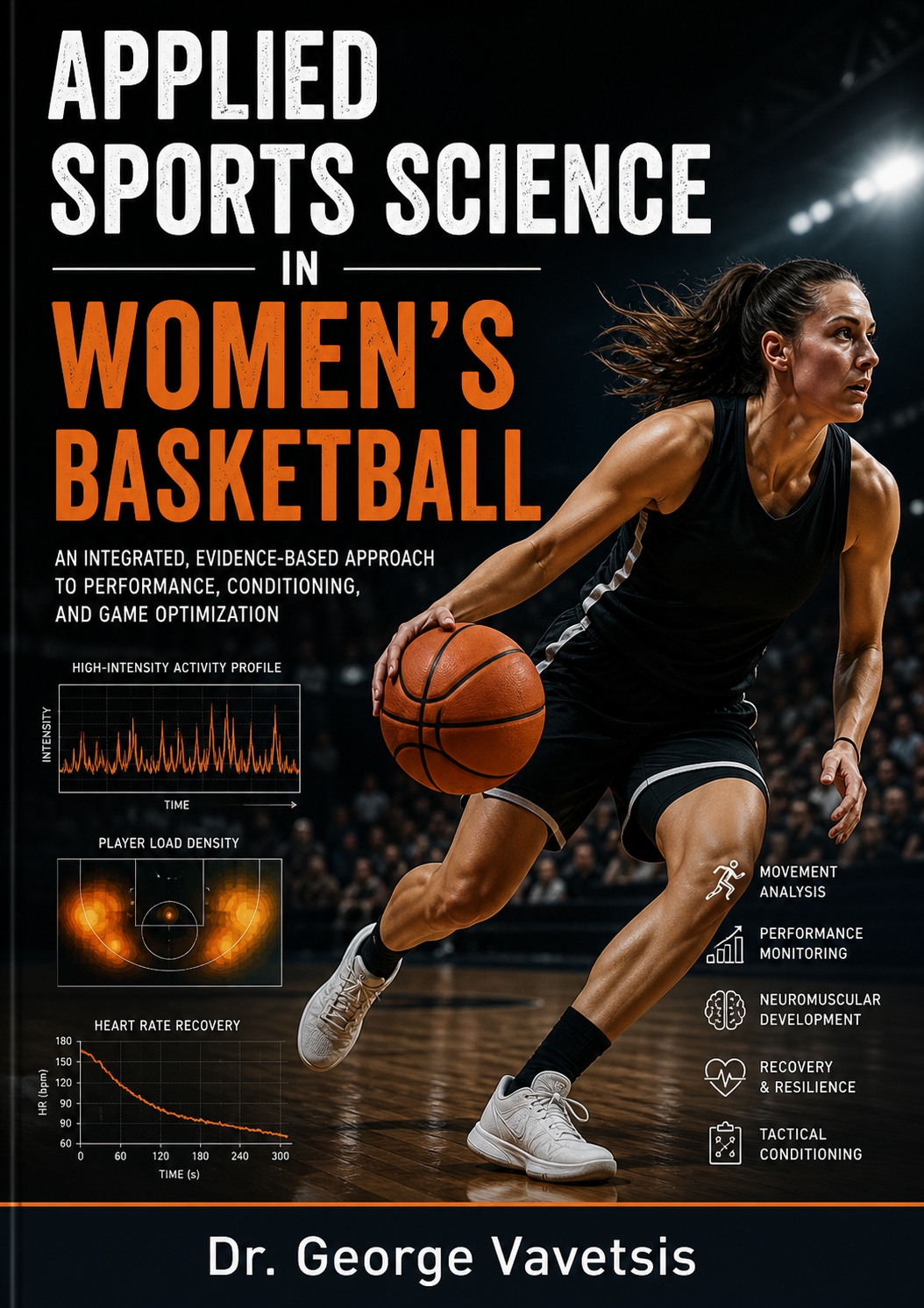
Applied Sports Science in Women’s Basketball
Pages: 1806
Women’s basketball has entered a transformative era defined by unprecedented athleticism, tactical sophistication, physiological intensity, and scientific advancement. Across the modern game—from the WNBA to EuroLeague Women, NCAA Division I, Olympic competition, and elite developmental systems—the female athlete is now exposed to movement densities, acceleration demands, neuromuscular fatigue profiles, and metabolic stressors that rival many traditionally studied male invasion sports. Yet despite the exponential growth of the women’s game, the scientific literature, applied performance models, and conditioning frameworks specific to female basketball athletes have remained comparatively underdeveloped, fragmented, or generalized from male-derived data.
The purpose of this text is not simply to discuss basketball conditioning, but to construct a complete high-performance framework specifically designed for the physiological, biomechanical, tactical, and neurocognitive realities of elite female basketball players. The women’s game possesses unique tempo structures, spacing behaviors, locomotor signatures, fatigue responses, hormonal considerations, recovery characteristics, and tactical sequencing patterns that require individualized scientific interpretation rather than adaptation from male models. Therefore, every chapter within this work approaches women’s basketball as its own distinct performance ecosystem.
The modern female basketball athlete performs within a highly intermittent environment characterized by repeated acceleration–deceleration chains, explosive multidirectional transitions, dense ball-in-play workloads, incomplete recovery windows, repeated sprint exposure, high eccentric braking demands, perceptual–cognitive stress, and complex tactical decision-making under fatigue. These elements interact continuously with neuromuscular readiness, endocrine status, autonomic regulation, tendon loading, and psychological resilience. Consequently, strength and conditioning in women’s basketball can no longer be reduced to generalized running protocols, isolated resistance training, or simplistic “basketball fitness” concepts. Instead, performance preparation must integrate biomechanics, physiology, motor control, sports analytics, load management, tactical periodization, fatigue science, and individualized recovery monitoring into a unified system.
This book was designed specifically for elite-level strength and conditioning coaches, sports scientists, performance directors, physiotherapists, athletic trainers, basketball coaches, and applied researchers seeking a deeper understanding of the female game. The emphasis throughout the text is highly practical while remaining scientifically rigorous. Every concept aims to bridge the gap between research and court application.
A central theme throughout this work is the concept of basketball-specific density. Women’s basketball is not merely defined by total distance covered or isolated sprint actions, but by the clustering of explosive events within compressed temporal windows. Repeated accelerations, short recovery intervals, high-frequency changes of direction, reactive braking sequences, jump–land–contact interactions, and tactical movement variability collectively shape the physiological architecture of competition. Understanding these density dynamics is fundamental for constructing conditioning systems that truly transfer to live-play performance.
Equally important is the recognition that women’s basketball possesses unique tactical movement signatures. Guards navigate constrained pick-and-roll spaces requiring rapid micro-accelerations and perceptual processing under pressure. Wings operate within repeated full-court transition demands involving high-speed sprint exposure and eccentric braking tolerance. Post players sustain repeated contact-density collisions requiring isometric trunk stability, force absorption, and neuromuscular restoration. These positional distinctions necessitate individualized physical preparation models rather than generalized team-wide conditioning approaches.
Another major objective of this text is the integration of internal and external load monitoring into practical decision-making. Heart-rate recovery kinetics, heart-rate variability restoration, countermovement-jump monitoring, reactive-strength-index tracking, PlayerLoad density metrics, acceleration band profiling, sprint decrement analysis, and neuromuscular fatigue detection are presented not as isolated laboratory tools, but as actionable systems for guiding training dosage, recovery interventions, substitution strategies, and competition-readiness profiling.
Importantly, the physiological realities of female athletes are considered throughout the book. Training adaptation cannot be separated from hormonal fluctuations, connective tissue characteristics, recovery behavior, energy availability, menstrual-cycle considerations, and sex-specific injury epidemiology. Women’s basketball performance science requires an integrated appreciation of both high-performance physiology and athlete health preservation. Sustainable performance enhancement depends not only on improving output capacities, but also on maintaining long-term resilience, availability, and recovery efficiency.
The tactical evolution of the women’s game further reinforces the need for advanced applied sports science. Pace-and-space systems, transition-heavy offenses, expanded floor geometries, high-possession structures, defensive switching schemes, and late-clock acceleration demands create increasingly complex movement environments. Modern players are required to repeatedly execute high-velocity technical skills while under metabolic, cognitive, and mechanical stress. As a result, conditioning must evolve beyond traditional linear running models toward multidirectional, cognitively integrated, tactically contextualized preparation systems.
This book also reflects a broader philosophical belief: that elite preparation in women’s basketball deserves the same depth of scientific sophistication historically reserved for other high-profile sports. Female athletes should not receive simplified adaptations of male systems, but performance methodologies derived directly from the demands of their own game. Precision, specificity, and contextual relevance must define future practice.
To the coaches working long hours in practice facilities, the sports scientists interpreting complex monitoring data, the physiotherapists restoring athletes to performance, the performance directors managing congested schedules, and the athletes relentlessly pursuing excellence—this book was written for you.
It is my hope that these pages contribute to the advancement of women’s basketball performance science and inspire a more precise, evidence-informed, and athlete-centered approach to the preparation of elite female basketball players.