
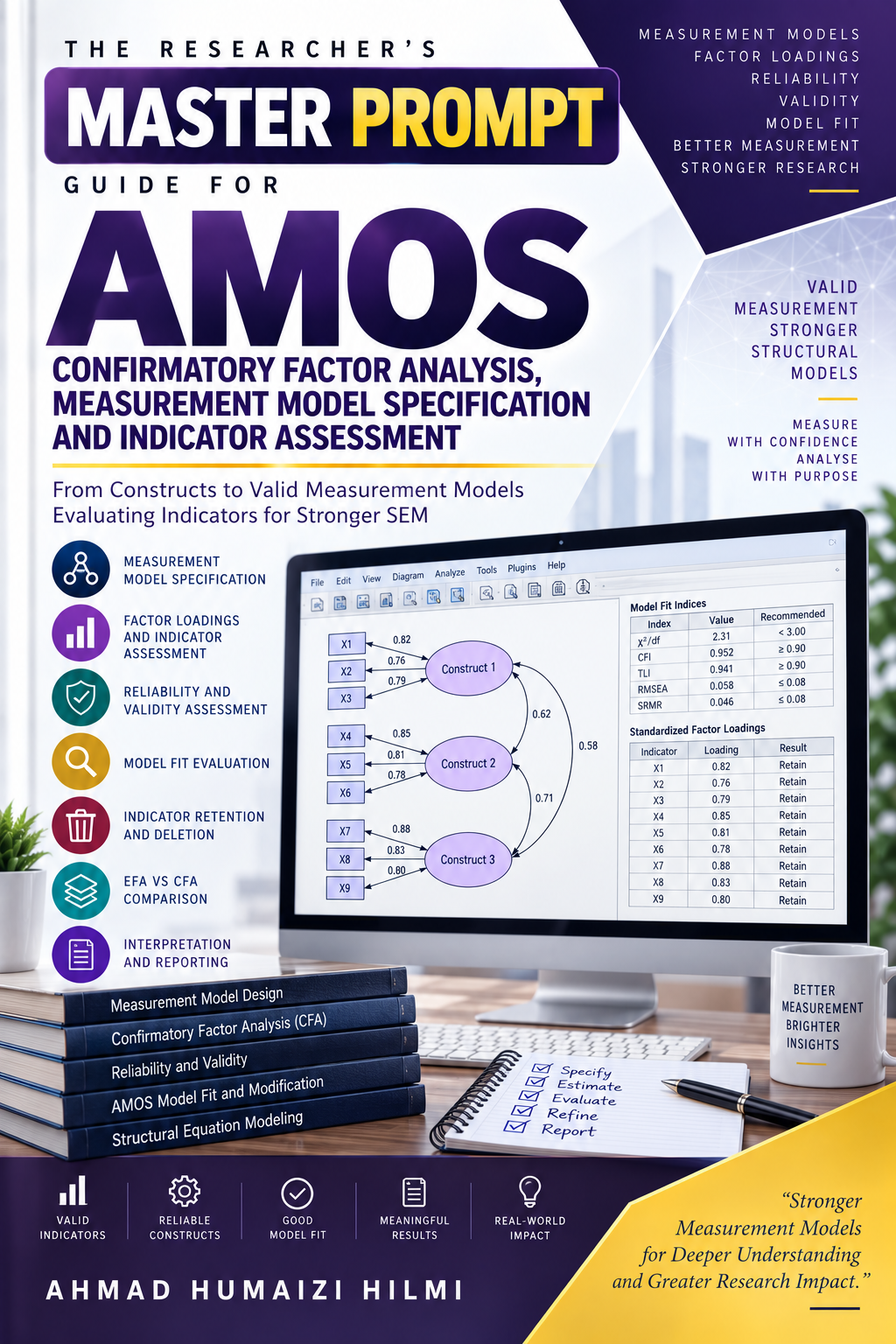
AMOS-CFA-004 — Confirmatory Factor Analysis, Measurement Model Specification and Indicator Assessment
Description
This Master Prompt focuses on constructing, estimating and evaluating the measurement model through Confirmatory Factor Analysis (CFA) in IBM SPSS AMOS. It guides researchers in translating theoretically defined latent constructs into an explicit measurement structure, linking each construct to its observed indicators, estimating standardized and unstandardized factor loadings, examining error terms and residuals, assessing construct dimensionality, identifying problematic indicators and determining whether the hypothesized measurement structure is empirically defensible before any structural relationships are interpreted.
A major emphasis is placed on distinguishing CFA from EFA. The uploaded literature shows the exploratory–confirmatory sequence clearly: EFA is used to uncover or refine factor arrangements, whereas CFA in AMOS is then used to confirm whether those observed indicators represent their intended latent constructs. Other studies use a two-stage SEM approach in which the measurement model is assessed first and only after its reliability and validity are supported is the structural model used to test hypotheses.
The prompts should therefore prevent researchers from treating CFA as a mechanical model-fitting exercise. Indicator deletion, error covariance specification and model respecification should be based on theory, measurement logic and empirical diagnostics together rather than on fit improvement alone. The uploaded studies also demonstrate the use of standardized factor loadings, composite reliability, AVE and multiple goodness-of-fit indices in evaluating the CFA model.