
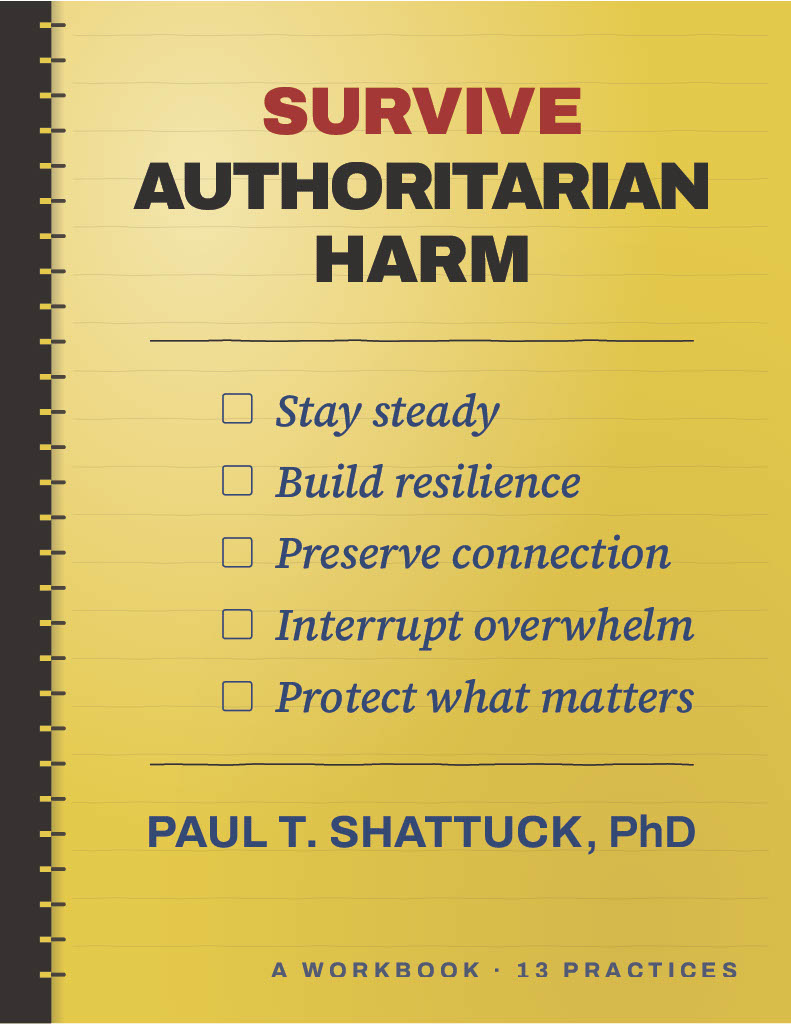
Survive Authoritarian Harm
A 100+ page workbook. 13 practices. Pay what you want: $24 minimum, $65 requested value.
Practical tools to interrupt overwhelm while building endurance and defiance under authoritarian assault.
Click 'Preview' button above to download a free sample of chapters.
Pay what you want: $24 minimum, $65 requested, anywhere in between will work. Instant PDF, 30-day full refund. Bought a prior edition of Staying Steady and want a discount on this book? See FAQ for a special offer.
November matters. November isn't the finish line.
We’re heading into the final stretch before the November midterms, and you can already feel the volume of urgent appeals and headlines rising. The best time to build these skills is before you desperately need them. September and October will bring more headlines, more fundraising appeals, more polling, more calls to action, more manufactured chaos. You can use the next few weeks to learn your overwhelm patterns, identify what knocks you off balance, and figure out which practices help you regain your footing before the volume peaks
You start anywhere based on what you need. There are tools for spotting overwhelm before it takes the day, circuit breakers for when you're already spinning, routes back to functioning when you've lost your footing, and a full section on building for a fight with no end date.
You're overwhelmed. That's not a flaw. It's Trump's plan.
Losing hours to doomscrolling. Breaking at small things. Withdrawing from people you love. Feeling ashamed you can't handle this better, and wondering why everyone else seems to be managing better.
They're not. And your overwhelm isn't personal failure — it's an accurate response to a coordinated assault.
"Paul's toolkit is for me the resource to focus on now and ongoing. A few of the tools have already helped me lower my anxiety and feelings of overwhelm. I highly recommend this toolkit for anyone struggling with this emotional roller coaster." — reader review
Trump has a playbook. You need one too.
Flood the zone. Manufacture crisis. Weaponize shame. Exhaust everyone who might resist. The strategy is public: Bannon named it, and Trump's own people describe the goal as traumatizing opponents. Your capacity to think, act, and stay connected is exactly what they're trying to drain — because people who can still think and still connect can still resist.
Stress apps and wellness advice weren't built for this. They treat systemic harm as something you fix privately by working on yourself.
Survive Authoritarian Harm is a counter-playbook: practical tools matched to the assault, so you can interrupt the spiral, get your footing back, protect the people and commitments that keep you human, and build the endurance this fight actually requires.
What will actually change if I use this? You'll recognize your patterns in minutes instead of losing the day. You'll have a menu of interrupts for when you're frozen, a way to catch shame before it isolates you, faster recovery when you break — and you'll become harder to manipulate, distract, or destabilize.
I know this overwhelm because I lived it. In December 2024 my employer fired me for refusing to delete a post supporting federal workers Trump targeted. I'm married to an immigrant; some days we're afraid to go to the grocery store. I went looking for tools built for this and found stress apps. So I built what was missing — drawing on 40 years organizing, an MSW/PhD, and 13,000 readers across 95 countries testing these practices.
What's inside and how it helps you
Thirteen practices across four sections — checklists, self-assessments, conceptual frameworks, menus of concrete moves, and prompts you write in. Built to be used mid-chaos, imperfectly, one page at a time.
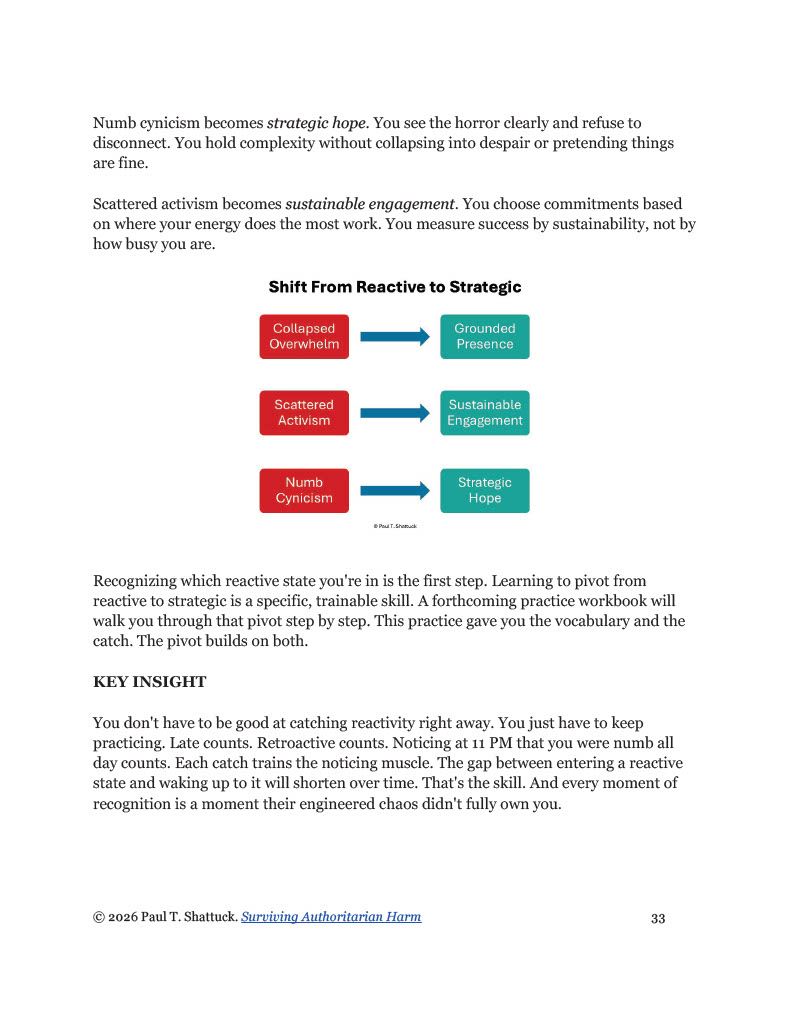
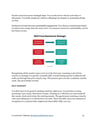
Recognition (Practices 1–4). See clearly what the assault is doing to you. Spot your overwhelm patterns early, map your triggers, learn to read your accumulated load before something small tips you over, and name the three reactive states this pressure produces: collapsed overwhelm, numb cynicism, scattered activism. Naming the pattern replaces blaming yourself.
Rescue (Practices 5–7). First aid for when you're in it right now: a shame interrupt, emergency circuit breakers matched to what's happening in your body, and a dedicated doomscroll rescue. The goal isn't perfect composure. It's stopping the freefall fast enough to find one next move.
Resilience (Practices 8–9). Get from "I stopped the spiral" to "I can function effectively again." Three pathways back to steadiness, plus a connection practice: who steadies you, who you can tell the truth to, and how to navigate the rooms where honesty is risky. Not abstract calm — operational capacity: steady enough to think, choose, and act from your values instead of from panic.
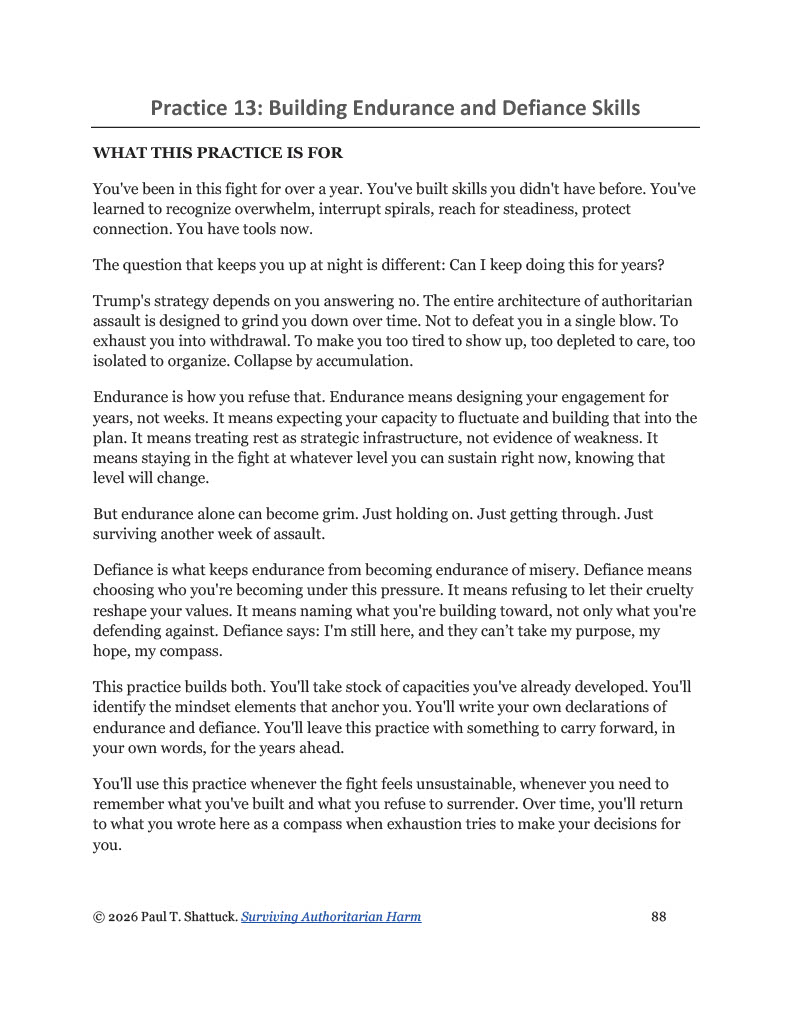
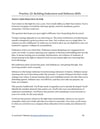
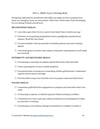
Building (Practices 10–13). New in this edition. Inventory what this assault has cost you — in your body, your relationships, your paycheck — and decide what to rebuild and what to protect. Catch the finish-line thinking that burns people out. Build a foundation that holds for years. Then write your own declaration: what you're still in this for, and what you refuse to accept.
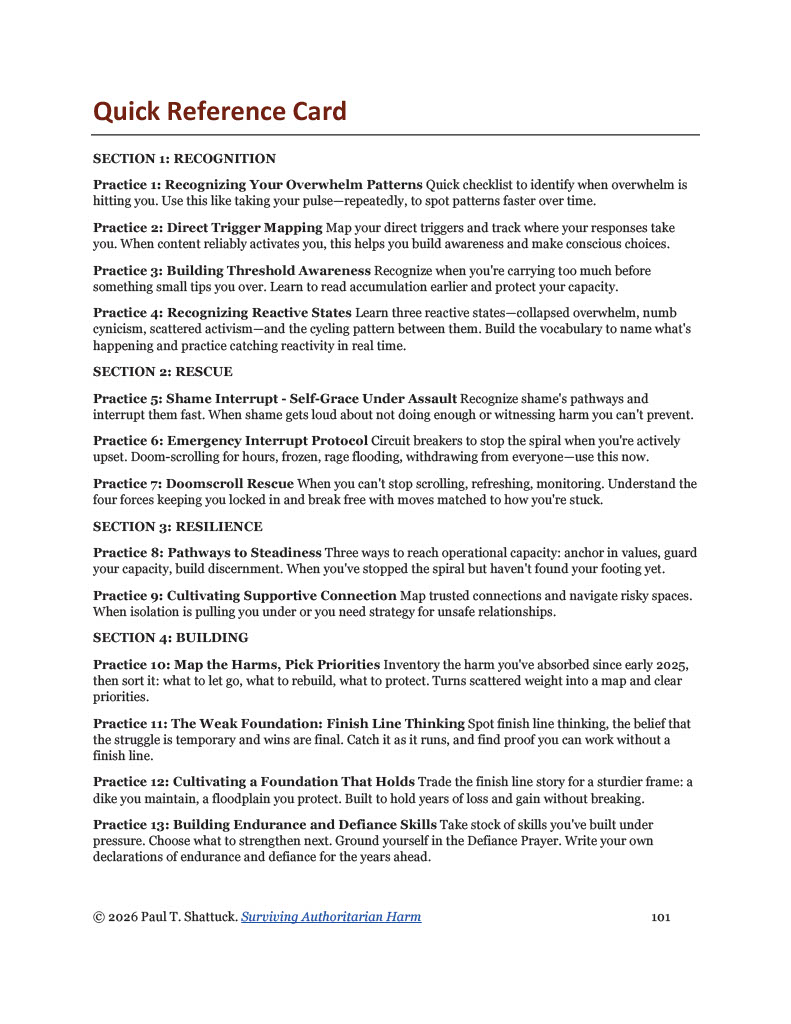
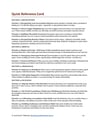
Plus a Quick Reference Card for days you can't think straight, and "Try This With Others" prompts in every practice.
Start anywhere — if you're spiraling right now, go straight to the Emergency Interrupt. Return repeatedly; the workbook meets you where you are, not the other way around. Use it imperfectly: one move, one question, one breath counts. Some weeks you'll need it daily. Some weeks you won't need it at all. That's how it's designed.
"Less overwhelmed, more effective… It has helped me focus on what matters while reducing time stuck in doomscrolling and worrying." — buyer of a prior edition
When will this be over?
You've probably asked yourself that. Most of us have. You tell yourself things will get better after the next election, or the next court ruling, or when Trump is gone.
The workbook gives this pattern a name: finish line thinking. It's the belief that this fight is temporary, that we win once and then it's over. Most of us grew up on that story because it’s in 99% of Hollywood movies. When the fight keeps going anyway, believing in a finish line sets you up for burnout.
"Freedom is never really won. You earn it and win it in every generation." — Coretta Scott King
The Building section teaches you to notice finish line thinking when it starts. In its place, you get clear about what you're working to protect, you choose the one or two things you're willing to own — because nobody can do everything and you’ll burn out if you try to — and you figure out who's working alongside you.
In practice, that means one bad headline doesn't cost you a whole day anymore, and good news doesn't convince you it's safe to stop paying attention. You settle into a sustainable pace of doing your part to shape the future.
"I printed mine at Staples and had it spiral bound. Now it's covered with sticky notes and highlighted sections. All of us in the leadership circle of our Indivisible chapter have a copy. We use it ourselves daily and talk about ways to use the practices to help others. It's a lifeline. I haven't seen anything else like it." — workbook owner
Who this is for
This workbook may be especially useful if you are:
- Politically engaged and worn down by constant manufactured crisis.
- Struggling with overwhelm, paralysis, shame spirals, or doomscrolling.
- Trying to keep resisting without burning out.
- Carrying fear connected to retaliation, immigration, economic precarity, or surveillance.
- Looking for practical tools rather than slogans, hot takes, or vague encouragement.
What exactly you get
A PDF, delivered instantly — over 100 pages, made to print at home or read on any device, yours to write in for years.
Recognition
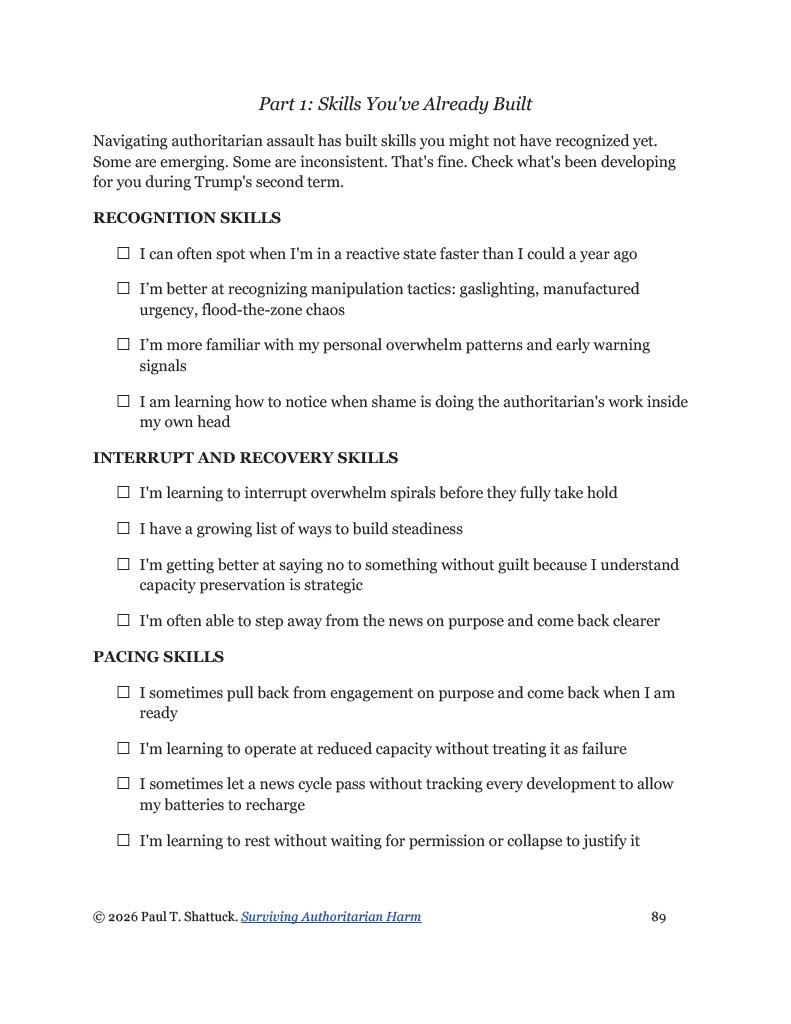
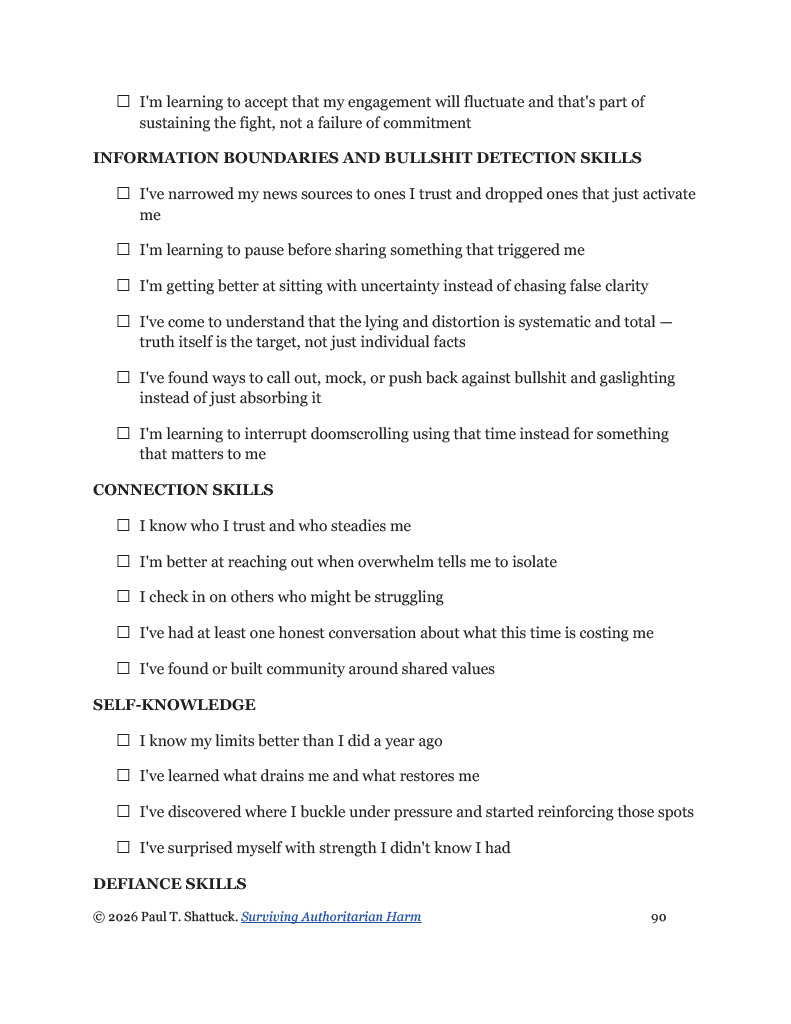
1. Recognizing Your Overwhelm Patterns — a quick-scan checklist to catch overwhelm before it takes your day.
2. Direct Trigger Mapping — trace what activates you and whether your responses lead to action or paralysis.
3. Building Threshold Awareness — read your accumulated load before something small breaks you.
4. Recognizing Reactive States — name the three reactive states and catch them in real time.
Rescue
5. Shame Interrupt: Self-Grace Under Assault — break the shame cycle before it isolates you.
6. Emergency Interrupt Protocol — circuit breakers matched to how you're stuck: frozen, flooded, locked up, withdrawing.
7. Doomscroll Rescue — understand why you can't stop scrolling, then pick the off-ramp that fits.
Resilience
8. Pathways to Steadiness — three routes back to functioning: anchor in values, guard your capacity, build discernment.
9. Cultivating Supportive Connection — map who steadies you; plan for the spaces where honesty costs too much.
Building
10. Map the Harms, Pick Priorities — inventory what's been taken, then sort it: let go, rebuild, protect.
11. The Weak Foundation: Finish Line Thinking — spot the mindset that burns people out, before it decides your next move.
12. Cultivating a Foundation That Holds — the dike you tend, the floodplain you protect, the shift you show up for.
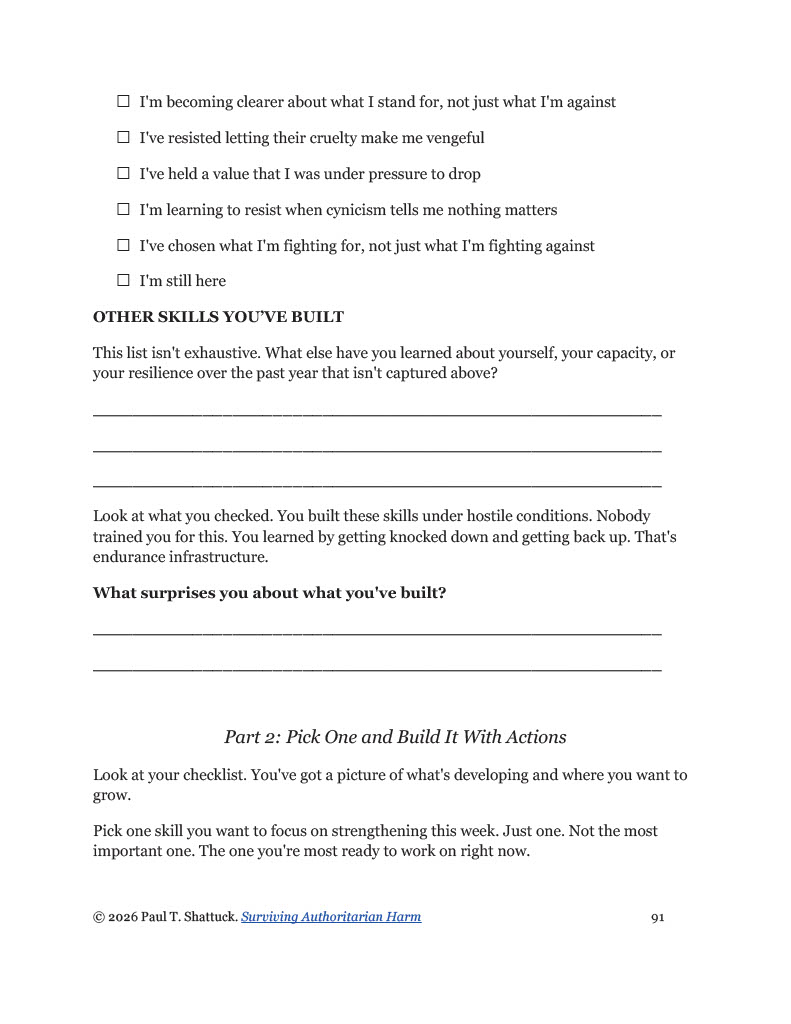
13. Building Endurance and Defiance Skills — take stock of what you've already built, strengthen what's next, write your declaration.
Tools built from personal experience and tested with tens of thousands of readers
In December 2024 my employer told me to delete a post supporting federal workers Trump had targeted. I refused. They fired me. What came next was everything in this workbook: the paralysis, the shame spiral, the fear that visits my house directly. I'm married to an immigrant, and some days we're afraid to go to the grocery store because of ICE activity where we live. I went looking for tools built for this and found stress apps and self-care lists. So I built what was missing.
I'm Paul Shattuck, MSW, PhD: social worker, researcher, forty years an organizer, with contemplative and recovery practices nearly as old. None of it exempts me. I work these practices myself and sharpen them with the readers of my blog, Stay Human — Shape Tomorrow, which has nearly 13,000 subscribers across 95 countries — including readers living under repressive governments in places like Iran and Venezuela. People inside the hardest conditions find these tools worth their attention.
Pay what you want: $24 minimum, $65 requested
- $65 keeps this within reach of people facing job loss and dislocation, and keeps me building tools like it.
- $24 if you're under pressure. No guilt. Pay what fits your reality.
- Anywhere in between works too. I rely on readers to help make this work possible.
Type your price into the box and click Buy Now. You can also buy it as a gift for someone who needs it on the checkout page. Click on the "Give as a gift" checkbox just above the credit card payment information. Then type in the email of the gift recipient.
30-day guarantee: if it doesn't help you, email me for a full refund. No questions, no friction.
A note on use: this edition is personal — meant to be written in and returned to, not forwarded. If it could help someone you care about, gift them their own copy.
If you're in crisis: these tools are not for moments of immediate danger. If you're having thoughts of hurting yourself or someone else, call 988 (Suicide and Crisis Lifeline) or 911. There's no shame in needing more support than a workbook can provide.
Questions
I barely have energy to read the news. How much time does this take? Minutes. One page counts. It's built for imperfect use in the middle of the chaos, with a Quick Reference Card for days you can't think.
Things keep getting worse. What difference can a workbook make? These practices don't wait for conditions to improve. They build capacity that holds while conditions are bad — that's what the entire Building section is for.
Can I work through it with my group, congregation, or chapter? Yes. Every practice includes group prompts, and there's months of material for a circle that meets regularly. Each person needs their own copy to write in, and the gift option makes that easy.
I bought an earlier edition. What's new? First: thank you. Earlier buyers made this edition possible. What's new: three practices, all in the Building section. One maps what this assault has cost you and turns it into priorities. One teaches you to catch finish line thinking. One replaces it with a sturdier foundation. The closing practice you knew as Practice 10 is now Practice 13, and Practices 1 through 9 are substantially as you know them, so everything you've marked up still maps. Ten practices became thirteen; 85 pages became just over 100. This edition is a new purchase. As thanks for supporting the earlier versions, prior buyers who need a discount can have it for $15: [contact me] and it's yours. If you're able to pay more, I'm grateful.
This is not therapy. It's civic resilience: operational tools for staying functional under political pressure. If you're in active crisis, please reach for the crisis resources above.