
Strong & Steady: Strength — A 28-Day Home Strength Program
Most of what people call "getting old" in their legs is really years of doing a little less each month. The chair gets harder. Then the stairs. Then the grocery bag.
Muscle responds to being asked at 80 much the way it does at 40 — more slowly, but it responds. This program asks, three days a week, for four weeks.
What makes this different
Every exercise comes in four levels, from a fully seated version to a loaded standing one. You start each movement wherever you are today and climb when you've earned it.
That matters more than it sounds. Most programs pick a difficulty and hope you fit it. This one lets you be at level 3 on standing up from a chair and level 1 on pushing — which is normal, because different muscles decondition at different rates.
A thirty-second test at the front of the guide tells you where to begin.
The eight movements
Each one is named for the job it does outside the program:
- Rise — getting off the toilet, out of a low chair, up from the couch
- Push-off — walking, pushing off the last stair, catching yourself when you stumble
- Stabilize — staying steady on one leg, stepping sideways, keeping your hips level
- Hinge — picking up the newspaper, loading the dishwasher, making the bed
- Step — stairs, curbs, getting in and out of the shower
- Push — pushing a heavy door, getting up off the floor, pushing up out of bed
- Pull — opening the fridge, pulling on your pants, holding yourself upright
- Carry — groceries, the laundry basket, a suitcase through an airport
Not a muscle group among them. That's the point.
What you get
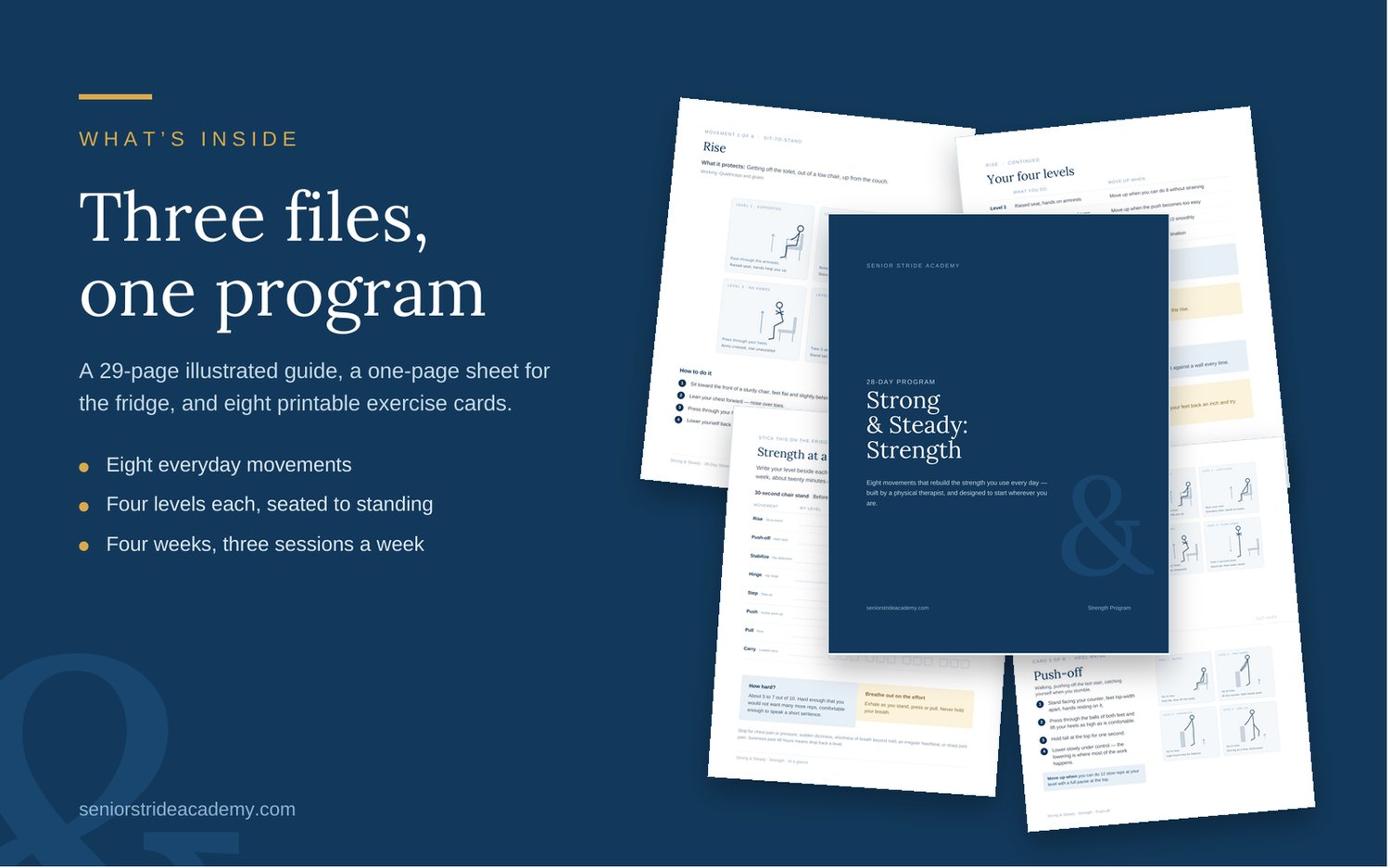
Three files, downloaded instantly:
- The 28-day program guide — 29 pages. Every exercise illustrated at all four levels, with setup, common mistakes, and the specific signal that tells you when to move up or drop back.
- The at-a-glance sheet — one page for the fridge. Your level beside each movement, a box to tick after every session, and space for your before-and-after test scores.
- Eight exercise cards — print and cut, one movement per card. Prop it on the counter instead of holding the guide open.
How the four weeks work
Three strength sessions a week, about twenty minutes each, with lighter movement days in between. Strength days aren't daily on purpose — muscle rebuilds during the recovery between sessions, and three good days beat six rushed ones.
Week 1 you learn the movements. Week 2 adds a set. Week 3 is where most people move up a level. Week 4 holds steady and retests, so you finish with a number to compare against the one you started with.
What you'll need
A sturdy chair, a kitchen counter, and a bottom stair. One long resistance band — light or medium, and the only thing you may need to buy. Something to hold for the carries: light dumbbells, or a grocery bag with a few cans in it.
Written by a physical therapist
Fifteen years in home health, which mostly means fifteen years of watching what actually goes wrong in real houses — and which exercises people will still be doing in week three.
Please read before you buy
This is general education, not personalised medical advice, and it doesn't replace assessment from your own physician or physical therapist. Check with your doctor first if you've had a fall in the last six months you haven't discussed with a provider, have a heart condition, uncontrolled high blood pressure, or recent surgery, have a new or unstable joint problem or a recent joint replacement, or feel unsteady simply standing.